
The Slow Burn of Revolution: Why Technology Always Changes Us Gradually
From Dial-Up to AI: How Technological Evolution Takes Time and Why Human Adaptation Always Prevails

There was a time, not so long ago, when the hiss and crackle of a dial-up connection was the sound of the future. For older millennials, young Baby Boomers, and all of Gen X, the World Wide Web arrived like a magician’s trick—promising the impossible, thrilling us with every click. The magic of that moment was palpable: buying a book on a fledgling site called Amazon, downloading music (often illegally) from Napster, and waiting to hear “You’ve got mail!” from AOL. It felt as if the world was being rewritten at the speed of light, as if overnight, anything was possible.
But the real revolution didn’t happen overnight.
AI today feels like the early web—wild, full of promise, and slightly terrifying. The headlines are filled with predictions of a future dominated by algorithms and machine learning, where jobs are at risk, and human skills are being redefined. But if history has taught us anything, it’s that technological change is rarely as swift or as radical as it first seems.
The Web That Changed Everything… Slowly
Consider the early internet boom. It was clear even in the 90s that music would eventually become something you downloaded rather than bought in stores. Napster led the charge, reshaping how we listened to music, even as it courted controversy and lawsuits. The service imploded, but the idea didn’t die. We now live in a world where streaming is the norm, but the transformation took years, not months. Similarly, email quickly became ubiquitous, immortalized by the Meg Ryan and Tom Hanks romantic comedy “You’ve Got Mail,” yet the post office didn’t shut down. Snail mail stubbornly clung on, and still today, our mailboxes fill with more than just bills and junk.
The early tech adopters could see what was coming, but for most people—and most businesses—change was incremental, often resisted, and not always embraced. The IT guy in your office wasn’t a visionary guiding you to a digital future; he was a guy in jeans who showed up to fix your printer. It took time, education, and adaptation for tech to permeate everyday life. The world didn’t wake up one morning to find that everything was different.
The Human Instinct to Resist
Humans, by nature, cling to what’s familiar. We go to the same restaurant because we know the food will be good. We listen to the songs we loved in high school because they make us feel something deep and nostalgic. We shop where we feel comfortable, in places where we understand the prices and the quality. This innate resistance to change isn’t just about habit—it’s a survival mechanism, a way of keeping us safe from the unknown.
In the business world, this resistance is even more pronounced. Leaders are cautious, unwilling to upend entire departments on the back of unproven technology. AI may be reshaping the arts, sparking debates among actors and writers, but in most corporate settings, it’s still seen as a tool rather than a takeover. Sure, AI can sort through data faster than any human, automate repetitive tasks, and enhance efficiency. But it’s not about to replace the empathetic touch of customer service or the creative spark of human ingenuity.
Think about your last trip through an airport. Perhaps you bought a magazine and a bottle of water at a kiosk without talking to a single person. That’s AI at work, removing a simple transaction from the realm of human interaction. But vending machines have been doing the same thing for decades. It’s automation, but not a revolution.
Evolution, Not Revolution
The truth is, technology tends to evolve in fits and starts. The early promise of the internet was undeniable, but the reality was a slow crawl towards the world we live in now. We didn’t suddenly stop going to brick-and-mortar stores when Amazon first appeared. We didn’t abandon record stores the moment Napster launched. And despite the surge of email, we never stopped sending letters entirely.
AI, too, is on this path of gradual integration. It’s not a tidal wave that will drown us but a slow, rising tide that reshapes the shoreline bit by bit. Strikes in Hollywood in 2023 reminded us of this: progress can be halted, redirected, or even rolled back when society demands it. Whether you’re an executive deciding on your company’s AI strategy or an employee worried about your job’s future, remember that change, even when inevitable, moves at a pace that allows us to adapt.
The Future We Build Together
Rather than fear AI, learn to work with it. Master the tools that make your job easier, enhance your skills, and explore new ways to do what you already do well. The data tells us that workers who embrace AI often find themselves more productive, yet the same data reveals their fear of job loss. But the question is, will AI take your job, or just change it? Accountants didn’t disappear when calculators became mainstream—they adapted. Travel agents may be rare today, but the travel industry still thrives, run by humans who harness technology to enhance the customer experience.
Change is the only constant, but it’s rarely sudden. There is time to pivot, time to learn, and time to embrace the future without abandoning the past. AI is not a threat looming on the horizon; it’s just the next tool in a long line of innovations that make us more human, not less.
So, let’s navigate this moment the way we always have: with curiosity, caution, and the relentless ability to evolve. Because if there’s one thing the internet age taught us, it’s that tomorrow arrives slowly, and we’re always ready when it does.
About the Creator
Keep reading
More stories from Anshuman Mishra and writers in Futurism and other communities.
The Art of Self-Deception: Finding Balance Between Optimism and Reality
We all tell ourselves little lies. Sometimes, these lies are simple: “I’m good at my job,” or “I’m happy.” Other times, they’re more profound, shaping how we see ourselves and the world around us. While our self-identities may be half-truths, the delicate balance between fiction and fact is crucial to our mental well-being. The challenge lies in finding the right balance between positive illusions and reality anchors, ensuring we stay grounded without losing the optimism that keeps us moving forward.
By Anshuman Mishraabout a year ago in Psyche
About Binding Prometheus
I want to start actively advocating on behalf of my own work, and the most valuable part of my canon is, without a doubt, Binding Prometheus, the play I have been working on since 2019 and only finished in 2023 as part of my MA. The play itself is an amalgamation of a million different inspirations. On one end, it evokes the Ancient Greek myth-play, deriving its own title from the earliest extant work of Western drama we have, Aeschylus’s Prometheus Bound. On the other end, it borrows significantly from the sci-fi bulwarks from over the years, namely Mary Shelley’s Frankenstein and Karel Capek’s Rossum’s Universal Robots. The play could be an episode of Black Mirror, I fear. I don’t know. I’ve only ever seen one episode of Black Mirror.
By Steven Christopher McKnight21 days ago in Futurism
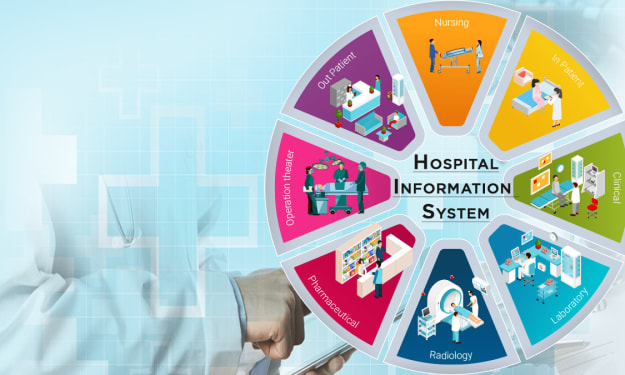
Hospital Information System Market: Electronic Health Records Integration, Workflow Automation & Care Quality
According to IMARC Group's latest research publication, global hospital information system market size reached USD 27.2 Billion in 2024. Looking forward, IMARC Group expects the market to reach USD 58.9 Billion by 2033, exhibiting a growth rate (CAGR) of 9% during 2025-2033.
By sujeet. imarcgroup2 days ago in Futurism
Smart phones, Humans and Aliens.
WARNING. I will be tapping into one of your favorite creative tensions: The absurdity of humans worshipping their glowing rectangles as if they were tiny oracles. There’s something deliciously poetic about that contradiction, and it lends itself beautifully to an instructive proviso.
By Novel Allen6 days ago in Poets



Comments
There are no comments for this story
Be the first to respond and start the conversation.