
The Rise of Agentic AI: How Autonomous Agents are Redefining Productivity and Workflow Automation
From Prompt-Based to Goal-Oriented: The Evolution of AI in Autonomous Task Execution
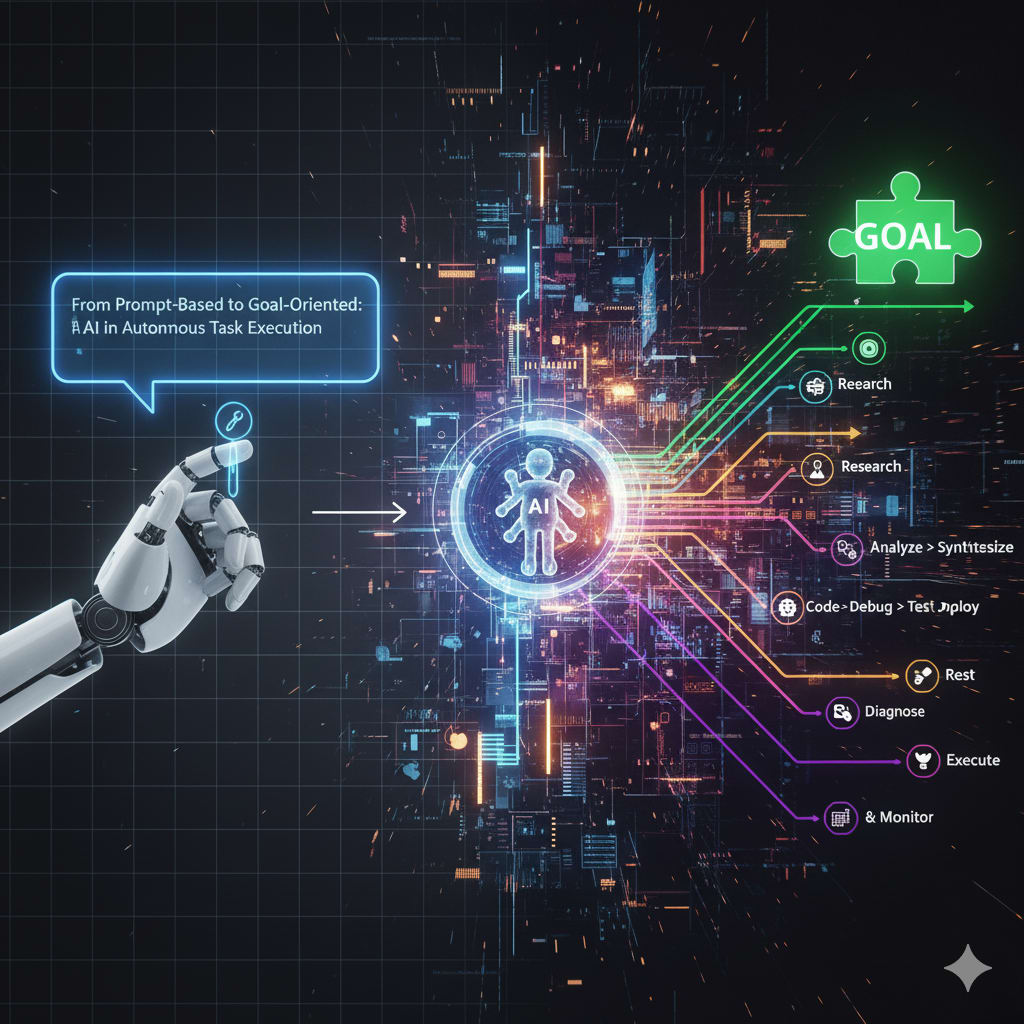
The first wave of artificial intelligence introduced us to Large Language Models (LLMs), which mastered content generation and complex Q&A. However, a new, more dynamic paradigm is emerging: Agentic AI. These autonomous agents represent a significant leap forward, moving AI from being a passive tool that responds to a single prompt, to an active, decision-making entity capable of performing multi-step tasks independently.
Agentic AI systems can plan, execute, monitor their progress, and even correct their own mistakes to achieve a specific goal. For businesses and professionals, this shift is not just an incremental upgrade; it’s a total redefinition of productivity and workflow automation.
What is Agentic AI? The Core Concept
Agentic AI refers to intelligent systems designed to act independently on behalf of a user or system. Unlike a standard chatbot that handles one query at a time, an AI agent possesses four core components that allow for true autonomy:
- Goal Setting & Planning: Defining the final objective and breaking it down into a sequence of actionable steps.
- Memory: Retaining information from past interactions and decisions (both short-term and long-term memory) to improve future performance.
- Tool Use: The ability to interact with external systems, databases, or the internet (e.g., using a web browser, running code, sending emails).
- Reflection & Self-Correction: Evaluating the outcome of executed steps and adjusting the remaining plan if a step fails or yields unsatisfactory results.
💡 Key Takeaway: Agentic AI allows for true "set-and-forget" automation, tackling tasks that require reasoning, context-switching, and interaction with various digital environments.
Top Agentic AI Applications Transforming Workflows
The real-world impact of autonomous agents is most visible in complex, time-consuming business processes.
1. Automated Research and Data Analysis
Instead of manually searching for data, compiling sources, and drafting summaries, an AI research agent can take a high-level prompt (e.g., "Analyze the market share of the top three competitors in the Q3 report and forecast their Q4 growth").
- Process: The agent browses the web, accesses internal company data, extracts relevant statistics, performs calculations, and then generates a comprehensive, cited report.
- Result: Reduces research time from days to minutes.
2. Personalized Customer Service and Support
AI agents are evolving beyond simple chatbots to handle entire service lifecycles.
- Process: An agent can field a complex support ticket, search the knowledge base, troubleshoot potential solutions, open a new ticket if escalation is needed, and notify the human team only at critical junctures.
- Example Tool Reference: Recent, highly-discussed platforms like Manus () have demonstrated advanced capabilities in executing multi-step complex tasks, hinting at the future of autonomous digital assistance.
3. Software Development and Code Generation
For developers, agents can accelerate the coding process by handling mundane or complex tasks.
- Process: Given a product feature request, an agent can break the request into coding tasks, write the necessary functions, debug the code, and even write corresponding unit tests.
- Result: Facilitates rapid prototyping and quality assurance (QA) without constant human intervention.
The Future: Agentic AI and the Democratization of Power
The proliferation of tools like Google’s Gemini and various open-source AI frameworks is actively democratizing the ability to create and deploy personalized AI agents.
- For Businesses: This means even small and medium-sized enterprises (SMEs) can now afford complex automation historically limited to large corporations.
- For Professionals: It empowers individuals to build "AI-powered colleagues" tailored to their specific career needs, such as a "Legal Document Scrutinizer Agent" or a "Social Media Strategy Agent."
The convergence of Agentic AI with Multi-Modal AI (the ability to process images, video, and text simultaneously) is set to unlock even more complex applications, where agents can analyze a product’s video advertisement, read customer comments, and then rewrite the ad copy based on their findings—all without human direction.
Ethical Considerations and Challenges
While the potential is immense, the autonomous nature of Agentic AI raises critical concerns:
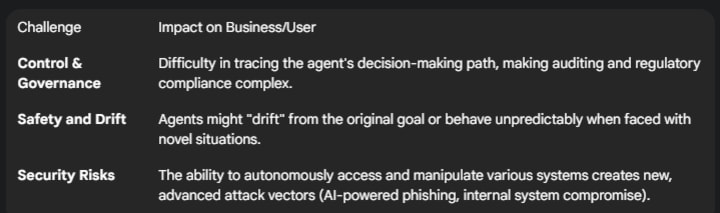
Responsible deployment requires transparent governance frameworks and robust Explainable AI (XAI) mechanisms to ensure that every autonomous decision can be audited and understood by a human.
Conclusion: Navigating the Next Productivity Frontier
Agentic AI is no longer a theoretical concept; it is an active, rapidly-developing reality. By granting AI the gift of autonomy, we are unlocking unprecedented levels of efficiency, pushing the boundaries of what a digital tool can achieve.
For organizations seeking to maintain a competitive edge, the focus must shift from simply using AI to strategically implementing and governing AI agents that can think, act, and complete complex workflows autonomously. The businesses that embrace and master this new generation of intelligent automation will undoubtedly lead the market in the years to come.
About the Creator
AI Lens
Exploring AI’s evolving universe—from tool reviews and comparisons to text-to-image, text-to-video, and the latest breakthroughs. Curated insights to keep you ahead in the age of artificial intelligence.
About Binding Prometheus
I want to start actively advocating on behalf of my own work, and the most valuable part of my canon is, without a doubt, Binding Prometheus, the play I have been working on since 2019 and only finished in 2023 as part of my MA. The play itself is an amalgamation of a million different inspirations. On one end, it evokes the Ancient Greek myth-play, deriving its own title from the earliest extant work of Western drama we have, Aeschylus’s Prometheus Bound. On the other end, it borrows significantly from the sci-fi bulwarks from over the years, namely Mary Shelley’s Frankenstein and Karel Capek’s Rossum’s Universal Robots. The play could be an episode of Black Mirror, I fear. I don’t know. I’ve only ever seen one episode of Black Mirror.
By Steven Christopher McKnight18 days ago in Futurism
GCC Home Healthcare Market: Medical Device Integration, Skilled Care Demand
According to IMARC Group's latest research publication, GCC Home Healthcare Market size reached USD 8.8 Billion in 2025. Looking forward, IMARC Group expects the market to reach USD 19.0 Billion by 2034, exhibiting a growth rate (CAGR) of 8.98% during 2026-2034.
By Abhay Rajput7 days ago in Futurism


Comments
There are no comments for this story
Be the first to respond and start the conversation.