
The Report Will Be Archived
To see, to know, to act. This is the arc of being human, even when the system forgets.
August 18, 2077. Just after noon, or what passed for it in the Republic of Texas.
I arrived with clearance. Time didn’t tick here; it hung—like suppressed fire, like a mission briefing with no start time. You learned to read the room, not the clock. Stillness, fixed stares, shallow breathing—those were your timepieces.
The Republic had been flying its own flag for six years, since the federal dissolution following the Energy Riots. Didn’t change jack. Bureaucracy survives revolutions. The signs still read “Processing.” The line still moved at half-speed, full fatigue. The building was a hybrid between mall atrium and federal courthouse. Formless. I was there for some kind of clearance, a box to check. Didn’t matter. What mattered was that I came armed.
Canik MC9LS. Matte black, polymer frame, optic ready. Turkish make. Legal in most counties. Not all.
Condition one: loaded, safety off, holstered appendix. I carried it the way others carried wallets. Always. At the checkpoint, the security agent patted me down, found the steel. Pause. No questions. No flare. Just a nod like he’d seen something familiar he didn’t want to explain. Standard operating ignorance. I moved on.
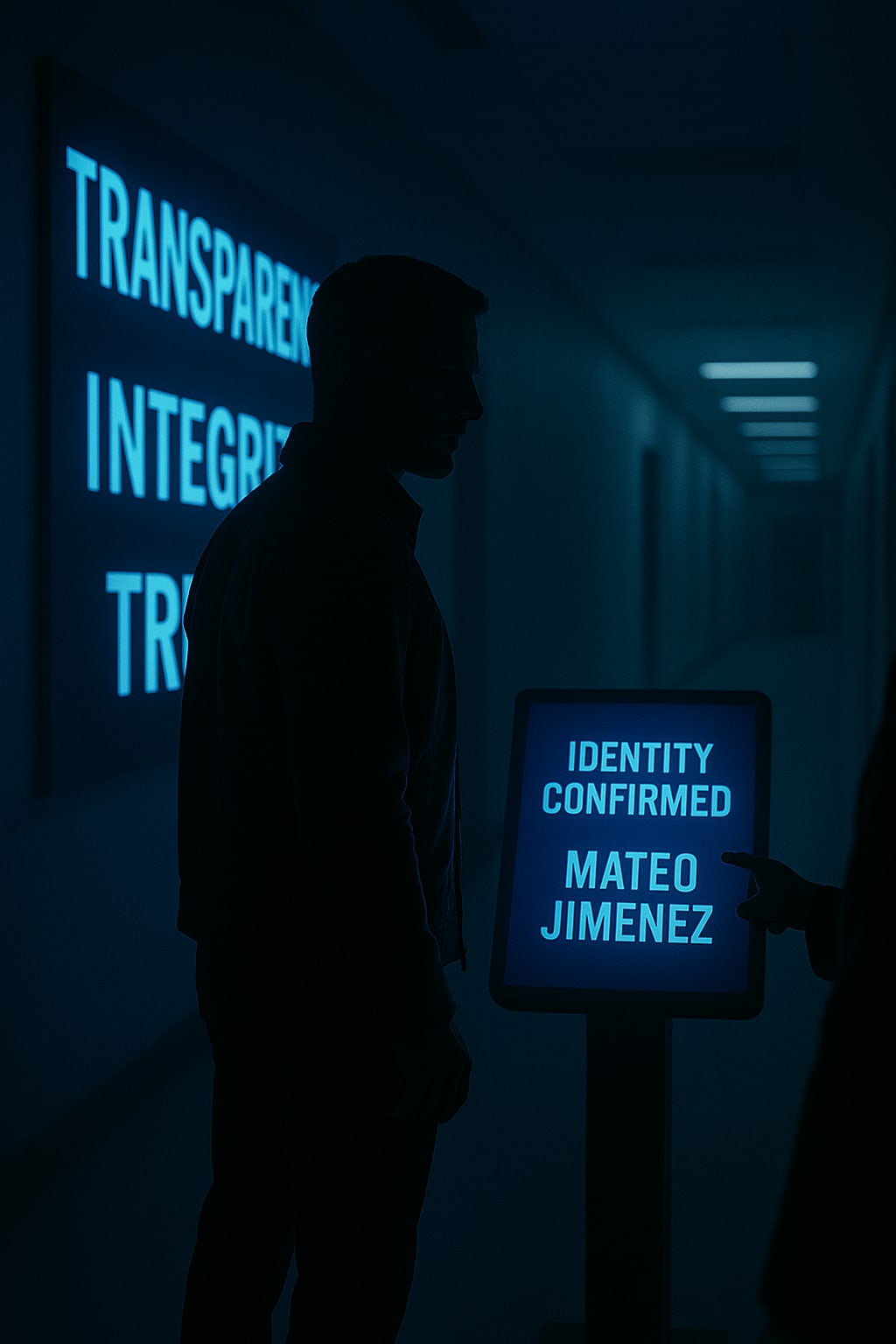
The scanner blinked blue. IDENTITY CONFIRMED: MATEO JIMENEZ. Could’ve been my name. Didn’t feel like it. Names are secondary in ops. Labels, not identities. The receptionist pointed without a word. Civilian control protocol: direct traffic, suppress dialogue. Prevent confusion. Avoid accountability.
I moved into the hallway—cold, recycled air. Too clean. Sanitized like a debrief room. The walls were lined with propaganda: TRANSPARENCY. INTEGRITY. TRUST. White font on blue backgrounds. Words meant to pacify, not inform.
Suddenly I was outside. No threshold. No exit cue. Just light and concrete. The shift was disorienting, like blacking out mid-patrol and coming to behind cover. Plaza. Open ground. Exposed.
Then I saw the girl. Twelve, maybe. Civilian. Jacket zipped, stance neutral. A peeling cartoon sticker on her shoulder. Stationary. Not hiding. Not evading. No threat profile. Wrong place. Then: visual on the shooter.
Male. Six-foot range. Dark coat. No facial tension. Gait loose. No urgency. Weapon already raised. He fired.
.380 or 9mm, suppressed. Minimal report. Echo didn’t travel. Shot placement center mass. No flinch. She dropped like a sandbag. Dead before impact.
I dropped to one knee. Column to the left, cover. Right elbow braced. Muzzle not drawn. Not yet. Target assessment first. Drawing without a clear threat gets you shot or detained—or worse, ignored.
Standard rules of engagement: broken. Every instinct screamed breach and engage. But the room—this plaza—wasn’t governed by those rules anymore.
The shooter didn’t run. Didn’t scan. Didn’t worry. He was familiar—like the silence that follows a siren that never arrived. He moved like someone with clearance, not speed. His certainty wasn’t personal. It was policy. His motions had no weight, no hesitation, no presence. Just sequence. Executed.
I waited. Counted down in tactical tempo: six, five, four. Still no movement. No screams. No security. Civilians unfazed. Plaza static.
Body memory wanted to move. Secure. Flank. React. But I froze—not out of fear, but fracture. This wasn’t the world I trained for. My programming didn’t match the operating system anymore.
Time to reenter. Low posture. Tight steps. Breach point: glass double door. No alarm. No resistance. Inside, same hum. Same bad lighting. No visual contact from front desk.
"A girl was just shot outside."
Reception looked up. Blinked. Logged it like someone reporting a missing keycard. The clipboard guy asked, "Do you have an appointment?" I didn’t answer.
The shooter reappeared. Same man. Now with an AR-15 slung over his shoulder. Short-barrel shotgun in hand. Pistol holstered. Loadout visible. No attempt to conceal. He moved through the security threshold. No alert. No escort. No hesitation.
He loaded the shotgun. Thumbed shells one by one into the tube. Smooth, unbroken motion. Breach clear. No jam. Practiced hands. No reaction.
I stood. Partial rise. Weight on balls of feet. Center of gravity lowered. Dominant hand slid to the Canik. Didn’t unholster. Yet. Then across the room—eye contact with a man in a suit. Zero body armor. Internal security or a contractor. Silent nod. Read: not your op. Not yet.
I held. Shooter passed by. The door opened for him like it had been expecting him. I eased my grip. The lights flickered. Or maybe my pulse did. Adrenaline reduced. Situation unchanged.
I scanned left, then right. No tactical shift. No threat escalation. The girl. The shot. The drop. All gone.
No blood trail. No trauma response team. No incident protocol. Just memory. My memory. And memory is not merely a record—it is an act of the subject, part of a chain that begins with sensing, then understanding, moves through judgment, and culminates in moral decision.
The system would bury it in silence. Log it. Time-stamp it. Delete it. It would reduce atrocity to absence.
But I had seen. I had grasped. I had judged. And now, I would act.
That made it real. Not because it was filed. But because it lived in me.
This wasn’t an op. This was memory refusing to be archived.
I moved toward the exit. Outside, the world continued. Vendors shouted. People strolled. Drones hovered like overwatch with no purpose. No one made eye contact. They didn’t see.
But I had. And I would not forget.
About the Creator
Mike Barvosa
Texas-based educator. Always listening.
I write about what we ignore, where memory fades, systems fail, and silence shouts louder than truth. My stories don’t comfort. They confront.
Read them if you're ready to stop looking away.
Keep reading
More stories from Mike Barvosa and writers in Futurism and other communities.
The Unborn. And I.
My name is Ezra. I was born in 1992. Exactly 4,015 days later, I found the photo. The air was sterile that day—the kind of stillness that wraps around you in old rooms, where nothing has moved but dust and time. There, inside a taped envelope, two faint orbs floated. Like echoes without sound. Not twins. Just two chances. One taken. One turned away.
By Mike Barvosa7 months ago in Fiction
Food Preservatives Market: Antimicrobial & Antioxidant Solutions, Food Safety Focus & Industry Growth Ahead
The food preservatives market is experiencing robust growth, primarily driven by the increasing demand for convenience foods and longer shelf life. Rising concerns regarding food safety, alongside a global mandate to reduce food waste, are stimulating the uptake of robust antimicrobial systems across complex distribution networks. According to latest data, the global food preservatives market size was valued at USD 3.32 Billion in 2025. Looking forward, the market is projected to reach USD 5.18 Billion by 2034, exhibiting a CAGR of 5.07% from 2026-2034. North America currently dominates the market, holding a market share of over 31% in 2025.
By sujeet. imarcgroup3 days ago in Futurism
Singapore CCTV Camera Market Outlook: Growth Drivers, Recent Developments & Emerging Trends
According to IMARC Group's latest research publication, Singapore CCTV camera market reached USD 204.16 Million in 2024. The market is projected to reach USD 1,100.66 Million by 2033, exhibiting a growth rate of 18.35% during 2025-2033.
By Abhishek Dixit4 days ago in Futurism



Comments
There are no comments for this story
Be the first to respond and start the conversation.