
The Power and Perils of Solar Flares
Understanding and Mitigating the Impact of Space Weather

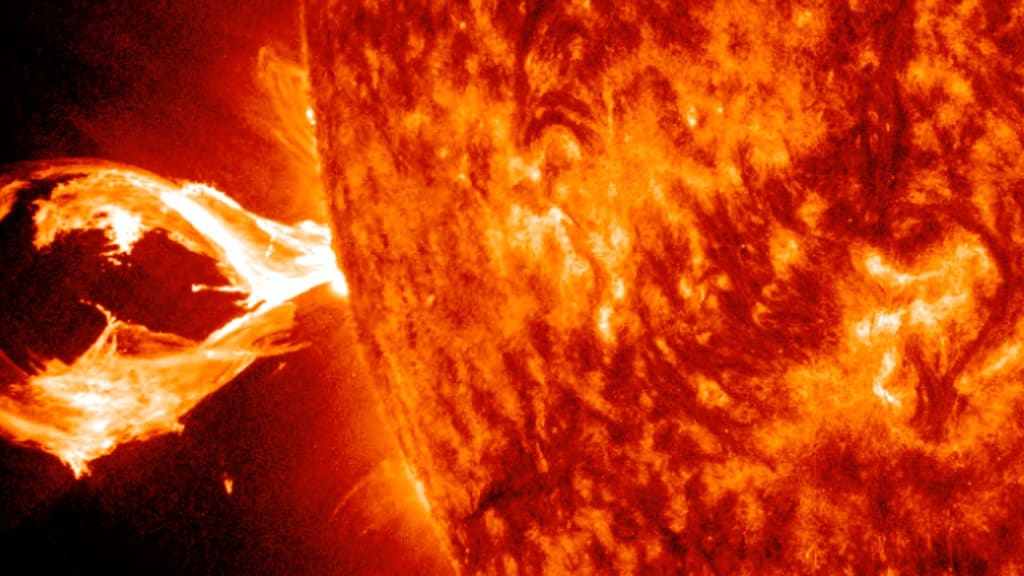
A solar flare, or a solar eruption, is a sudden burst of electromagnetic radiation and charged particles from the sun's surface. These events occur when magnetic energy that has built up in the solar atmosphere is suddenly released, causing a massive burst of energy that can send charged particles hurtling toward Earth and other planets.
Solar flares are classified based on their X-ray brightness, with the most powerful flares reaching the highest classification of X9 or even X20. The energy released in a solar flare is equivalent to millions of nuclear explosions and can have a significant impact on Earth's atmosphere, satellites, and communication systems.
The effects of a solar flare on Earth can range from minor disruptions to severe damage. The charged particles released during a flare can interact with Earth's magnetic field, causing auroras or disrupting communication systems and power grids. In extreme cases, a solar storm can cause widespread blackouts, satellite failures, and even damage to orbiting spacecraft.
Scientists and researchers study solar flares and other space weather phenomena in order to better understand their effects on Earth and other planets. By monitoring solar activity, they can predict the likelihood of a solar flare and take steps to mitigate the potential damage.
In addition to their practical applications, solar flares are also a subject of fascination and wonder for many people. The beautiful auroras that can result from a solar flare are a natural wonder that has captivated people for centuries, and the study of solar activity has led to a greater understanding of our place in the universe.
Solar flares are powerful and unpredictable events that have the potential to cause significant damage to Earth's systems. However, with advances in technology and research, we can better understand these phenomena and take steps to mitigate their effects. The study of solar activity also allows us to gain a deeper understanding of the universe and our place within it.
Solar flares are not just a concern for scientists and researchers, but also for those in the field of space exploration. Astronauts and space stations are particularly vulnerable to the effects of a solar storm, as they are outside of Earth's protective atmosphere and magnetic field.
In addition to the immediate effects of a solar flare, there are also long-term impacts on the environment and climate. The charged particles released during a flare can ionize the upper atmosphere, causing changes in the ionosphere that can affect the propagation of radio waves and other forms of communication.
Solar flares and their effects on Earth's systems have been the subject of much research and study, and efforts are ongoing to develop new technologies and strategies to mitigate their effects. In addition, scientists are also studying the sun itself in order to better understand the mechanisms that lead to solar flares and other space weather phenomena.
One such effort is the Solar Dynamics Observatory (SDO), a mission launched by NASA in 2010 to study the sun and its effects on Earth. The SDO is equipped with advanced instruments that allow scientists to observe the sun in unprecedented detail, helping to improve our understanding of solar activity and its impacts on our planet.
Solar flares are a natural phenomenon that have the potential to cause significant disruptions to our communication and power systems, as well as impact space exploration. However, through ongoing research and technological advancements, we can better predict and mitigate the effects of these powerful events.
One promising area of research is the development of early warning systems for solar storms. By monitoring solar activity and predicting the likelihood of a flare, scientists can provide advance warning to those who may be impacted by its effects, including satellite operators, power grid managers, and even airlines.
Another area of focus is the development of technologies that can withstand the effects of a solar storm. This includes the design of more robust spacecraft and communication systems that can continue to function during periods of high solar activity.
Finally, there is ongoing research into the fundamental mechanisms that drive solar flares and other space weather phenomena. By improving our understanding of the sun and its behavior, scientists hope to develop more accurate models for predicting solar activity and its effects on Earth.
In summary, solar flares are a powerful and complex phenomenon that can have significant impacts on our technology, climate, and space exploration efforts. Through ongoing research and technological advancements, we can better predict and mitigate the effects of these events, and gain a deeper understanding of the sun and its behavior.
About the Creator
DRD
a asted life
Why Peanut Butter Is Becoming a Staple in UK Breakfast and Snack Culture?
Peanut butter has steadily gained popularity in the United Kingdom as consumers explore convenient, nutritious, and versatile food options. Once considered a niche product, it is now widely available across supermarkets, health food stores, and online retail platforms. The spread is commonly enjoyed on toast, in smoothies, and as an ingredient in various recipes.
By deepanshu Thakura day ago in Futurism
AI-Based Recommendation System Market to Reach USD 34.4 Billion by 2033; Driven by Personalized Digital Experiences
The Global AI-Based Recommendation System Market is projected to increase from USD 2.8 Billion in 2023 to approximately USD 34.4 Billion by 2033, reflecting a strong CAGR of 28.5% during the forecast period from 2024 to 2033. AI-powered recommendation systems use machine learning algorithms, behavioral analytics, and predictive modeling to deliver personalized suggestions to users. These systems analyze large datasets including browsing history, purchase patterns, search queries, and user preferences to identify relevant content, products, or services. As digital platforms continue to expand globally, recommendation technologies have become essential tools for improving engagement, conversion rates, and customer satisfaction.
By Roberto Crumabout 20 hours ago in Futurism




Comments
There are no comments for this story
Be the first to respond and start the conversation.