
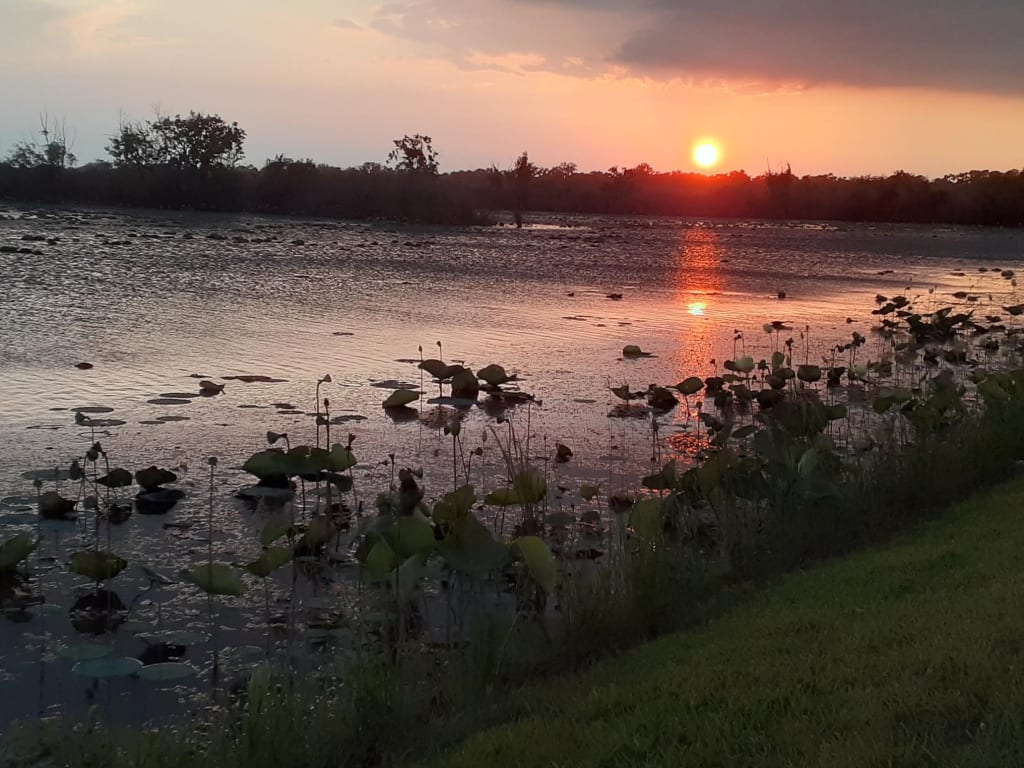
She walked up the grassy incline from her backyard to the top of the levee, as she did every evening, with her dog Sheamus. The pond spread out before her reflecting the golds and reds of the sunset in little ripples from the wind, lily pads and their protruding flowers bouncing. It was the only thing. The Pond. The only thing they had left that was beautiful enough to inspire awe and hope. The rest was shit. The thick green grass, the wild water grasses at the rim, sounds of ducks and geese flying overhead, rustling dense forest beyond – looking at it stopped you from thinking of anything, except the beauty of the scene in front of you.
Sheamus barked. When they were new here, he never barked at the wild life. But now that the neighborhood had become so quiet, he challenged every noise with a bark. The subdivision was placed in the middle of the countryside miles in between two small towns, at the edge of the man-made levee that was built to protect the subdivision from flooding, as it was situated near a large river and a bit further down, a deep creek. On the map it was named as a lake, but everyone called it a pond. When she first moved here two years ago with her husband and first saw it, she called it a pond.
They lived on the last street in the subdivision which petered out into a cul-de-sac, with several empty lots. Previously, they had lived in the small town where her husband grew up, in the large 1950s ranch house where he was raised. His family went back many generations here. The name was well known. Even mentioned in the local museum. Finally, in their 60s they decided to purchase their own house, a new one, and get their own identity, they joked. This subdivision was situated on old plantation land, where the houses were built in between the old towering oak trees with dangling Spanish moss. Neighbors prided themselves on their lots based on the number and size of trees they had. She loved that. She loved that when she moved here it was not a new subdivision but one that had started in the 1970s and never really caught on, houses added a bit at a time. The grass was always thick, spongy and gave the place a park-like appearance, although now it was wild and overgrown.
Her walk down the levee usually took her a half mile, Sheamus keeping close, nose to the ground. She headed down the levee embankment through an empty lot with wet swampy grass; the water always collected in these lots. She looked carefully before moving toward the street, though she really had no reason to fear at this point, several neighbors were retired military and they had kept things going, along with the homeowner’s association, everything was now organized, safe and protected. The route was one that Sheamus was accustomed to, so she took it to appease him, but she did not like walking past the abandoned houses, some of the great trees toppled over, abandoned cars in places where you would not normally see them in a suburb. There was nothing sadder than the abandoned mildewing 1980s houses, high arch above the entry way a dark gaping hole, destroyed by fire. Other houses with bay windows blown out, refrigerators dragged out the back doors when raiding parties had come through ravaging homes for food.
When they first moved here, she did not know if she would take to a manufactured suburban community. Their old house was part of a neighborhood that had grown organically from the town, no HOA rules, no zoning. A bit of funk here and there, small businesses, a real main street. But she had looked forward to the change, buying new furniture, putting too many decorative pillows for the bed. Better Homes and Gardens. Controlled palette of beiges and whites and pale blue. Fluff and stuff. People here kept to themselves, kept up with late model cars, grass blowers working hard to get fresh mowed lawn debris not only off their drive way but over to the other side of the street. She imagined grass blower wars between the well-meaning dads, trying to keep everything neat and perfect for their families. It was her first hint she might not belong here.
She was not far from her house, and still found herself hopefully looking for someone to appear from one of the houses. No one would, on this street they had all died off in the past year, her husband being one of the first to go. In the beginning there was word from the town, or when they went in town, that the small hospital was filled. TV sets were turned on to hear about the latest virus. Face masks reappeared. But it was not like the other epidemic. People became lethargic. They stopped moving around as much. After a week or so they were in bed in what seemed like sleep, but soon was understood to be a coma. So many people were caring for loved ones at home, that they could not get to the hospital, could not get help from the neighbors. Then the breakdown started, deliveries stopped, gas stations ran out of gas. The collapse of the utilities followed, with more than half the population falling ill.
She unlocked her door and called Sheamus to come. Sheamus did not come. He always had problems with the command “come”. She had taken him to doggie daycare where he learned most of his commands, and she learned to give commands, but “come” was the one he resisted. She smiled when she thought of that that family, living in the second floor of their house with their three children, running a cage- free doggie daycare below. Always a ruckus with the many dogs that they fostered. Her door rattled unexpectedly as she pushed it open and she hesitated. Sheamus finally made his way through the door, wagging his tail and into the house. No intruder here, she thought. He would have barked.
She stepped into the kitchen taking stock of her food supplies. After the first wave of deaths, disorganization, and anarchy, the ex-military men in the neighborhood took over with the HOA – accounting for who was left, pushing out violent people and who knows what they did with them. Hunting parties for game were arranged, and each person got their allotment of meat. She took her weekly allotment and carefully put it in a small ice chest, though the luxury of ice was long gone. The edible grasses and berries she had collected, the few tomatoes she helped grow, were carefully stored in her knapsack with her knife. She laughed as she did this at the thought of their grown son, a “prepper” who lived in Colorado. He commented, when they first moved here, that they too were preppers now, having picked a remote place to live near several bodies of water. She wondered if she would see him again, how long of a walk it would be to get to him. They thought he was crazy when he told them he had a ton of freeze-dried prepper food; he would be ready for the end of the world. And here we are, she thought.
She grabbed her bow and arrow, and put it up in its case. She was fortunate to have grown up here in Texas, where young girls were taught to hunt. Her husband and introduced her to the bow and arrow and that skill entitled her to be assigned hunting duties in the neighborhood. That was part of the organization of everything, assignment of duties. She was worried that the remaining young girls would be put into bondage to particular men and it looked like it was leaning that way. She could not bear to think of it. She turned to the bucket where she kept Sheamus’ food, the offal allotted to dogs. Dogs were given a good allotment of food.
It was the dogs. People finally noticed, after everything had broken down and there were no more attempts by the military to save them, that people with dogs were not dying. And it wasn’t just owing a dog. It was sleeping and bonding with the dog. When this was understood people searched out for dogs. She hid in her attic for a week with Sheamus. The family next to her, two parents and three children, tried all sleeping together in one bed with their teenager’s dog, tried to get the dog to breath on them. It was thought the breath of the dog was key. They cried and begged the dog; she could hear them every night. She could the teenager, Aiden, when took the dog out to walk around the backyard, apologizing to the dog and weeping. Finally, one at a time, Aiden’s family members died. She helped him bury them as he had helped her bury her husband. He was 13 years old. He told her he wasn’t going to stay; he was going to head out. She pleaded with him, the others would not let him go and the perimeter of the subdivision was well guarded, it would be hard to get through. Someone would be just looking for an excuse to shoot him and take his dog. A few days later he was gone. Every day on her walk on the levee she looked across the pond for him. She believed he made it as she had not seen anyone with his dog.
Walking into her bedroom with her gear, she tossed the one-to-many decorative pillows to the floor. What a waste. Let Sheamus have them as toys. The last time he had a good time was at doggie day care over a year ago. She shoved one in his face to encourage him to play with it. The last person who made it back from past the outlying town where the doggie day care was located, reported to the HOA military men that the family had made it – they had fostered dogs and the parents and each child had a dog they had bonded with. The family had sent with this man Sheamus’ dog tags, which had fallen off there, to give to her. She had decided when she moved to her new suburb to get him special fancy dog tags, a golden heart shaped locket with etched filigree on the face, like a Victorian locket. Inside was his name, the words Call my Mom! and her phone number. How useless she thought, when they first handed it back to her, the scrolly filigree, a piece of jewelry for a male dog. About as silly as the Home and Gardens decorative pillows she bought, and life she tried to buy into here. At home, before she put the locket back on Sheamus’ collar she paused and opened it. Inside, etched on the blank inner side of the locket was a new, hand-carved word: COME. She knew then they were waiting for her.
How long would it take she thought that night, as she slipped her kayak into the pond, to head out past the next town. With Sheamus in the cockpit, she left the place where death overtook them in neatly arranged houses.
About the Creator
Keep reading
More stories from writers in Futurism and other communities.
About Binding Prometheus
I want to start actively advocating on behalf of my own work, and the most valuable part of my canon is, without a doubt, Binding Prometheus, the play I have been working on since 2019 and only finished in 2023 as part of my MA. The play itself is an amalgamation of a million different inspirations. On one end, it evokes the Ancient Greek myth-play, deriving its own title from the earliest extant work of Western drama we have, Aeschylus’s Prometheus Bound. On the other end, it borrows significantly from the sci-fi bulwarks from over the years, namely Mary Shelley’s Frankenstein and Karel Capek’s Rossum’s Universal Robots. The play could be an episode of Black Mirror, I fear. I don’t know. I’ve only ever seen one episode of Black Mirror.
By Steven Christopher McKnightabout a month ago in Futurism
Embedded Processor Market: Innovation, AI Integration, and Growth Trends
According to IMARC Group's latest research publication,The global embedded processor market size was valued at USD 21.15 Billion in 2024. Looking forward, IMARC Group estimates the market to reach USD 36.63 Billion by 2033, exhibiting a CAGR of 5.98% from 2025-2033.
By James Whitman3 days ago in Futurism
Killing him slowly
There’s an intruder in my house again. He stumbles through the door, wet carrier bags in hand. He’s bought me offerings. I show my appreciation, letting him caress my beautiful body. He wants to touch me. I rub myself against his legs. He sighs, dropping the bags. He can’t resist touching me. Running his hand slowly down my spine, I arch my back towards his caress, let out a low purr. It’s what we both need.
By N J Delmas4 days ago in Horror
A Love Forboding
The chipped stone slope caused unbearable footing. I slid, skirting on my heels. I cast my shield, relinquishing my guard to stay upright. Left with my double-edge and a prayer to the maker, I skated toward my objective. The earthly stubble gave way to solid ground. I found myself restored, a trail of dust in my wake.
By James U. Rizzia day ago in Fiction




Comments
There are no comments for this story
Be the first to respond and start the conversation.