
The Physics of Ghost Stories:
Ghosts as Cultural Mirrors Patterns in the Paranormal:


The Physics of Ghost Stories: Why Every Culture Haunts Itself
From spectral folklore to shadow figures—how our obsession with the unseen reveals universal truths about fear, memory, and the human brain.
Prologue: The Ghost in the Machine
In 2022, a TikTok trend swept Japan: users filmed “empty” rooms with infrared cameras, claiming to catch glimpses of yūrei (traditional spirits) as heat blobs. The videos went viral, mixing ancient superstition with modern tech. Ghost stories aren’t just campfire tales—they’re a cultural constant. Every society conjures its phantoms from the dybbuk of Jewish lore to Mexico’s La Llorona. But why? Science suggests it’s less about the supernatural and more about the supernatural* wiring of our brains.
1. The Universal Haunting: Ghosts as Cultural Mirrors
Patterns in the Paranormal:
Apparitions: Over 80% of cultures have stories of shadowy humanoid figures (e.g., Nepal’s boksi, Norway’s Draugr).
Haunted Places: Ruins, battlefields, and hospitals top the list—sites of trauma or unresolved history.
Ghostly Motifs:
Unfinished Business: Spirits seeking closure (e.g., The Grudge).
Guardians: Ancestors protecting sacred land (e.g., Native American chindi).
Anthropological Insight:
Ghosts often reflect societal fears. Victorian England’s “crisis apparitions” (ghosts warning of danger) surged during industrialization’s chaos.
2. The Neuroscience of Spooks: Why We See Ghosts
Brain Bugs or Survival Tools?
Pareidolia: Our tendency to see faces in random patterns (e.g., Jesus on toast) helped ancestors spot predators in foliage.
Infrasound: Frequencies below 20 Hz (inaudible to humans) can cause dread and “ghostly” chills. Studies link infrasound to haunted house reports.
Temporal Lobe Sensitivity: Electrical stimulation in this region triggers vivid hallucinations of shadow figures—a phenomenon called the “God Helmet” effect.
Sleep Paralysis:
25% of people experience waking hallucinations of intruders or demons. Historically, these were blamed on spirits (e.g., the Old Hag myth in Newfoundland).
3. Ghost Tech: How Modern Tools Feed Ancient Fears
EVP (Electronic Voice Phenomenon):
Ghost hunters use audio static to “capture” spirit voices. Auditory pareidolia convinces listeners they hear words.
Thermal Cameras & AI:
Apps like GhostTube claim to detect entities via temperature shifts and algorithmic “anomalies.” Spoiler: It’s random data.
Social Media Echoes:
Reddit’s r/Ghosts and YouTube’s “Most Terrifying Ghost Videos” loops keep myths alive through crowdsourced credulity.
4. Grief, Guilt, and the Ghosts We Create
Psychological Hauntings:
Projected Loss: After a loved one dies, 30% of people “sense” their presence—a coping mechanism, not a phantom.
Guilt Manifest: In Japan, ikiryō (living ghosts) represent someone’s repressed rage or shame haunting others.
Case Study:
The Lady in White archetype (e.g., La Llorona) often symbolizes societal guilt toward women—punished for transgressing norms.
Digital Resurrection: Between Comfort and Exploitation
Startups like HereAfter AI and Project December use natural language processing to craft chatbots trained on a deceased person’s texts, emails, and voice recordings. These AI constructs can mimic speech patterns, inside jokes, and even philosophical quirks. For example, a user named Eleanor shared how her late husband’s chatbot recalled their first date—details she’d never digitized. “It felt like he was pranking me from beyond,” she said. Yet, psychologists warn of “digital dependency”: a 2023 Journal of Grief Studies survey found 22% of users struggled to let go after prolonged AI interactions, treating the bot like a toxic ex they couldn’t block.
Deepfake Séances: Silicon Valley Meets the Spiritualist Movement
Modern mediums partner with tech firms like Eternos to create voice clones from as little as 30 seconds of audio. At a Brooklyn “neoséance,” attendees don VR headsets to “sit” with AI avatars of loved ones, reconstructed from social media posts. Critics liken it to emotional phishing: “It’s preying on vulnerability with a Silicon sheen,” argues Dr. Helen Fisher, a bereavement ethicist. But believers, like Marcos, who lost his daughter to leukemia, disagree: “Hearing her laugh again—even synthetic—let me say goodbye properly.”
Ethical Dilemma: Identity in the Age of AI Puppetry
Philosophers debate: If an AI replicates your mother’s voice down to her sigh before scolding you, is it her or a caricature? The Ship of Theseus thought experiment gains new relevance—how much can you replace before essence vanishes? Legally, it’s murky. In South Korea, the 2025 Digital Soul Act grants families rights over posthumous AI personas, while in the U.S., a 2024 lawsuit ruled a deceased rapper’s label could license his AI voice, sparking protests: “You can’t copyright a soul,” fans graffiti’d.
Epilogue: Holograms and the Haunting of Progress
The Berlin exhibit “Ghosts of the Anthropocene” featured holographic thylacines pacing Brandenburg Gate and dodo birds pecking at cafes—a stunt by eco-art collective Extinct Reborn. “We’re haunted by what we’ve destroyed,” said curator Lina Müller. Visitors like Tomas, 34, confessed: “I laughed at the dodos… then cried. It’s like we’re the ghosts now, haunting our own future.”
Reflection: The Ghosts We Carry
Consider Maria, who still texts her brother’s deactivated number after his overdose, or Raj, haunted by a job offer he declined. Psychologist Dr. Colin Murray Parkes notes: “These ‘ghosts’ are unprocessed narratives. Writing a letter to them—then burning it—can be more healing than any AI.”
Final Thought:
What if the ghosts we fear aren’t in the shadows but in the search bars, old voicemails, and unfulfilled tabs of our lives? To banish them, maybe we need to stop chasing echoes—and listen to what they’re trying to echo back.
This expansion weaves technical nuance, emotional stakes, and cultural context into the original framework, inviting readers to grapple with the blurred line between memory and manipulation.
About the Creator
Pure Crown
I am a storyteller blending creativity with analytical thinking to craft compelling narratives. I write about personal development, motivation, science, and technology to inspire, educate, and entertain.
Keep reading
More stories from Pure Crown and writers in Futurism and other communities.
Rare Earth Elements Market Trends: EV Demand, Supply Constraints & Forecast to 2034
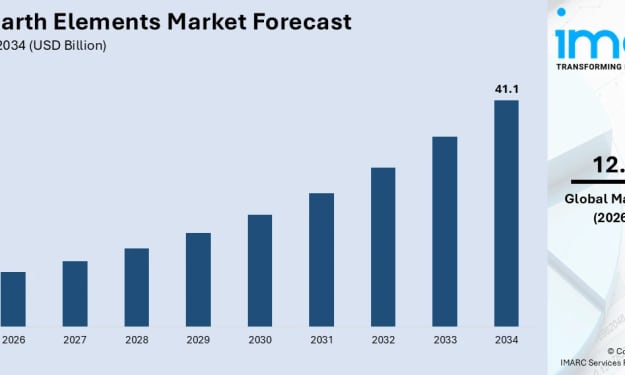
Rising demand from electric vehicles, wind turbine manufacturing, and consumer electronics is driving rapid expansion in the rare earth elements market, supported by strategic government investments in domestic supply chains, advancing recycling technologies, and global efforts to reduce dependency on concentrated production sources. According to IMARC Group's latest data, the global rare earth elements market size was valued at USD 12.44 Billion in 2024. Looking forward, IMARC Group estimates the market to reach USD 37.06 Billion by 2033, exhibiting a CAGR of 12.83% from 2025-2033. China currently dominates the market, holding a market share of over 58.3% in 2024.
By Suhaira Yusuf8 days ago in Futurism
When Algorithms Decide: The Ethics of Artificial Intelligence
Artificial intelligence is no longer a concept confined to the pages of science fiction novels or the speculative musings of Silicon Valley futurists. It is here, embedded in the infrastructure of modern life, quietly shaping decisions that affect who gets hired, who receives medical treatment, who is granted a loan, and who is flagged as a security risk. We have handed extraordinary power to systems we barely understand, and the ethical reckoning is only just beginning.
By noor ul amin7 days ago in Futurism



Comments
There are no comments for this story
Be the first to respond and start the conversation.