
The Last Superpower: How America Fell from the Top
Once a symbol of dreams and dominance, the USA crumbled—not with a war, but with silence, division, and debt.
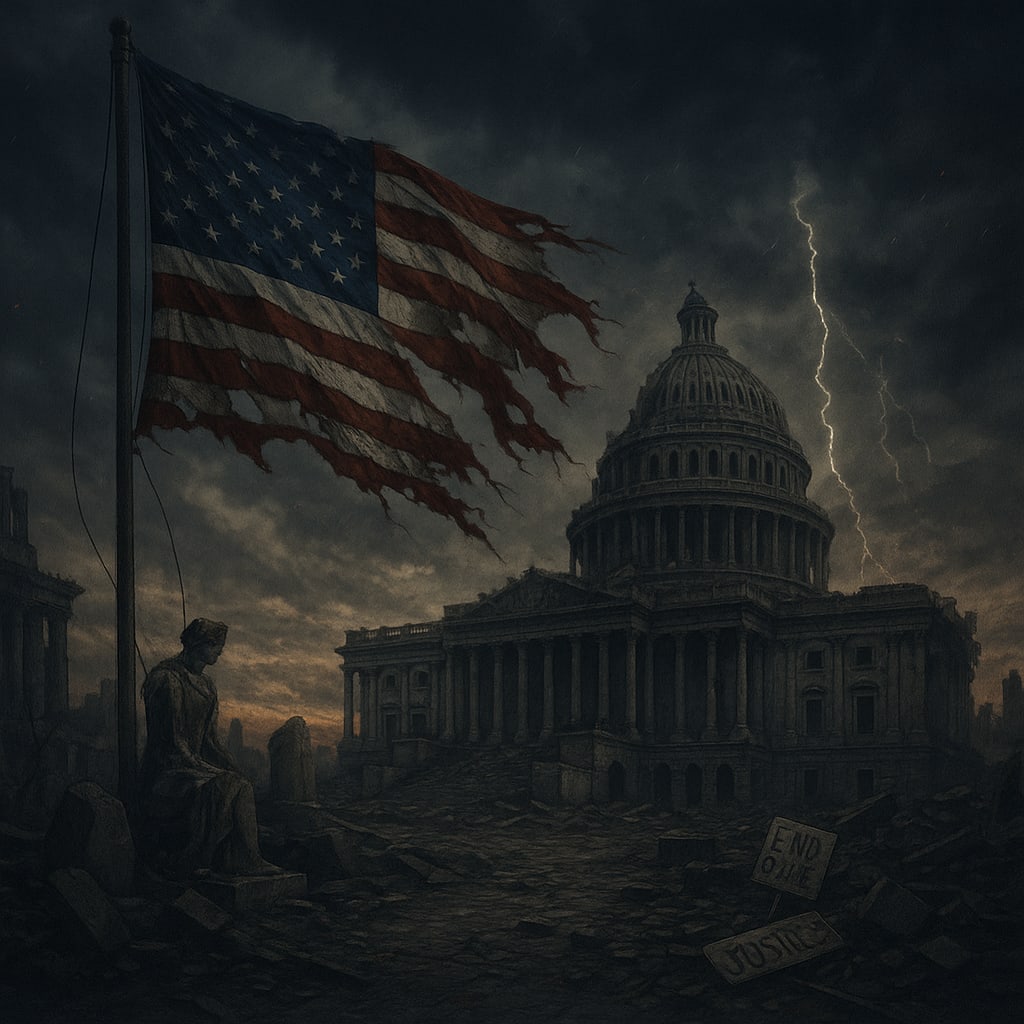
Year: 2037.
The American flag still fluttered in the wind—but fewer hands saluted it. The streets of Los Angeles, once buzzing with life, were quieter now. Malls were half-empty. Schools had closed in many districts. A man named Dr. Raymond Ellis, former professor of Political History at NYU, sat in his broken study, recording what he called "The Final Journal of a Superpower."
---
> “Empires don’t fall in a day,” he spoke into his old recorder.
“They die slowly—under the weight of their own pride.”
---
🇺🇸 The First Crack: Division Within
In the early 2020s, America was already struggling with deep internal divides—politics had turned from debate to war. Neighbors didn’t trust neighbors. A nation built on unity was now fragmented into ideological tribes.
Then came the 2028 Civil Gridlock—a historic moment when Congress failed to pass a federal budget for almost 9 months. Thousands of federal employees went unpaid. Infrastructure projects stopped. Chaos followed. Each state started making its own rules. Some even threatened secession.
> “We stopped being a country,” said Ellis, “and started becoming fifty arguing corporations.”
---
💵 The Economic Collapse
In 2030, the debt ceiling broke $50 trillion. Foreign investors lost faith in the dollar. Hyperinflation began. A loaf of bread cost $14. Rent in New York dropped—because no one could afford it. Tech giants left. China and the EU overtook the US as innovation leaders.
The once mighty dollar was now replaced in international trade by the "Digital Yuan."
Millions lost jobs. Silicon Valley became a ghost town.
---
🛡️ Global Weakening
With internal chaos and a collapsing economy, America pulled back from global responsibilities. NATO weakened. Old allies looked elsewhere. The Middle East formed its own bloc. South America turned fully toward China.
The worst blow came in 2033 when Taiwan fell—and America didn't respond. The world watched, stunned. The message was clear:
> “The eagle no longer defends.”
---
💡 The Psychological Shift
By 2035, Americans had lost hope. The younger generation didn't believe in the "American Dream" anymore. College degrees meant debt, not opportunity. Mental health crisis exploded. Suicide rates doubled. Social media became darker. AI-generated content confused truth from fiction.
> “The American Dream wasn’t stolen,” said Ellis. “It simply expired.”
---
🏚️ The Fall of Washington
In 2036, riots broke out in Washington D.C. after the President tried to dissolve the Supreme Court. The military refused to take sides. Protesters stormed the Capitol again—but this time, they didn’t leave.
For the first time in 250 years, the US government stopped functioning entirely. Governors met without federal guidance. California and Texas both declared “autonomous governance.”
---
📼 Final Words
Dr. Ellis finished his journal in the spring of 2037. In his last entry, he said:
> “America fell not because it was weak—but because it forgot what made it strong: unity, truth, and trust.”
He closed the recorder. No one knows what happened to him after that.
But the journal was found—uploaded, and shared around the world. Some called it fiction. Others called it a prophecy.
Whatever it was, one thing was clear:
> The era of American supremacy had ended.
---
But not everyone celebrated the fall. In small towns, elders still told stories of a country that once reached the moon, cured diseases, and welcomed the world’s tired and poor. Some whispered, “We were more than our politics.”
In broken libraries and abandoned schools, children now learned about America the way ancient civilizations are studied: with awe, confusion, and sorrow.
No invader had brought America down—it was forgotten values, not foreign missiles.
The final tragedy wasn’t the collapse.
> It was that no one tried hard enough to stop it.
About the Creator
Keep reading
More stories from Ahmad Khan and writers in Futurism and other communities.
Snow Makes Summit Finish in Paris‑Nice ‘Unfeasible’
Nice, France — Organizers of the 2026 Paris–Nice have been forced to abandon the originally scheduled summit finish on Stage 7 due to severe snow and cold conditions in the high Alps, prompting major changes to one of the race’s most important mountain stages. The stage was poised to be a key day in the eight‑day “Race to the Sun,” with riders expected to battle it out on a high mountain finish at the Auron ski station. However, persistent snowfall and freezing conditions prompted discussions between teams, officials, and local authorities, ultimately leading to the decision that riding to the summit would be dangerous and “unfeasible.” Organizers initially altered the route in the early morning hours, cutting the summit finish to preserve safety margins for the peloton. But conditions deteriorated further, with snow continuing to fall in the region and temperatures hovering around freezing—making traction on steep alpine roads treacherous for high‑speed racing. “We’ve had to change the finish because conditions up high are outright unsafe,” one race official said, emphasizing that rider safety is paramount. While the stage itself will still take place, the finish has been relocated to Isola, a lower‑lying location in the valley with gentler climbing and reduced risk from ice and snow. What’s Changed Under the revised plan, the stage will cover only a portion of the originally intended route, with a shortened competitive section of just 47 kilometers. Riders will now contest this shorter segment up to Isola rather than battling through full alpine ascents. The modified profile greatly reduces the climbing challenge, transforming what was to be a defining queen stage of the race into what may resemble a flatter, transitional day. This has altered the strategic landscape for general classification contenders, sprinters, and breakaway specialists alike. Riders React Current race leader Jonas Vingegaard, who has been wearing the leader’s jersey in Nice, acknowledged the unusual conditions while stressing that safety must come first. He noted that the peloton and team representatives worked closely with organizers as weather forecasts worsened, and he supports the decision to alter the stage. “Of course we want to race hard and attack on climbs,” Vingegaard said, “but if the summit is covered in snow and ice, it’s not safe. We all agreed it was best to change the finish.” Other riders were seen wearing cold‑weather gear and preparing for challenging wet conditions at lower elevations, underscoring how quickly spring racing can be disrupted by alpine weather even at this time of year. Weather a Growing Concern This is not the first time snow has interfered with Paris–Nice, a race nicknamed for its traditional progression from chilly northern France to sunnier Mediterranean environs. Historical data shows that snow and cold weather have led to stage cancellations, neutralizations, and course changes in previous editions of the race, especially on high mountain stages in March. The Alpes‑Maritimes region, where the summit finish was planned, routinely sees unpredictable conditions in early spring. With forecasts indicating more unsettled weather, this year’s edition could become another example of how climate and mountains collide in professional cycling. Implications for the Race The revised finish at Isola removes a key opportunity for climbers to gain time on rivals. Instead, the shortened finish could benefit versatile riders or punchier climbers who thrive on shorter, less technical ascents. Teams will likely reassess their tactics for both the remaining mountain stages and the concluding flatter legs of the race. Fans watching on television or at roadside are reminded that stage times and profiles can change at short notice, particularly when weather becomes a factor. Organizers continue to monitor conditions closely and are prepared with contingency plans should further adjustments be necessary Despite the disappointment of losing a dramatic summit finish, race officials and competitors alike have emphasized that safety must outweigh spectacle. In environments where temperatures dip below zero and snow blankets the racecourse, the risks to riders, support staff and fans simply become too great to ignore. As the Paris‑Nice caravan moves forward, attention now shifts to the final stages of the event and how the modified queen stage will influence the overall standings—a dramatic twist in a race known as much for testing resilience as for celebrating sunshine.
By Fiaz Ahmed about 17 hours ago in Futurism


Comments
There are no comments for this story
Be the first to respond and start the conversation.