
The Last Signal
A forgotten mission. A mysterious message. Some disappearances are not the end—they are the beginning.


It was 2:47 AM when the last signal came through.
A short, static-laced message, no more than four words: “They are not gone.”
It came from a radio frequency no one used anymore—an old emergency channel that had been silent for years. At the National Observatory in Colorado, the lone technician on night shift, Maya Voss, sat frozen in her chair. She blinked at the screen, replayed the signal three more times. The words were whispered, distorted, but unmistakably human.
The timestamp confirmed it. The coordinates matched nothing on Earth.
She thought about calling her supervisor, but something in her gut told her to wait. This wasn’t noise. This wasn’t some prank.
This was something else.
---
Five years earlier, the Odysseus Initiative—a deep space exploration mission—had vanished. Six astronauts were aboard, sent to study an anomaly near the edge of the solar system. After eighteen months of successful data transmission, everything went dark. No signals. No emergency beacons. Just… silence.
The world grieved, conspiracy theories flourished, and eventually, the mission was quietly archived as a "technological failure." Maya remembered watching the final press conference in her dorm room, heart aching for the families who would never know what happened.
She also remembered one of the astronauts vividly—Dr. Arjun Khatri, the mission’s lead physicist. Not because he was famous, but because she once interned under him. Brilliant, eccentric, always humming to himself as he scribbled on glass walls. He used to say, “If we vanish into the dark, it won’t be death—it’ll be transformation.”
She didn’t understand what he meant. Not then.
---
By 4:00 AM, Maya had isolated the frequency and triangulated a weak signal source—far beyond Pluto, right where the Odysseus had last made contact. She stared at the glowing screen, heart racing.
Should she report it? The official procedure said yes.
But protocol also said this channel was obsolete. No known object could send signals from that deep without massive power.
Unless…
Unless they’d found something.
Or something had found them.
---
Instead of alerting the chain of command, Maya made a decision. She downloaded the audio logs, encrypted them, and sent an anonymous email to one person she could trust: Leo Tran, a freelance science journalist with a reputation for exposing government coverups.
Leo responded within thirty minutes: “Is this real? Can you verify it?”
She wrote back: “Meet me. Tonight.”
---
They met at a small diner on the edge of Boulder, rain drizzling against the windows like whispers. Maya played the recording again on her laptop. Leo listened, leaned back, and whistled softly.
“They are not gone,” he repeated. “Who’s ‘they’? The astronauts?”
Maya nodded. “Or whatever’s left of them.”
Leo tapped his fingers on the table, thinking. “What if it’s not a distress signal? What if it’s a warning?”
The thought chilled her.
He leaned forward. “If we publish this, it’ll go viral in seconds. But it could also put a target on our backs.”
She was silent.
Then, finally: “Let’s find out what really happened.”
---
Over the next few days, they traced other irregular bursts on the same frequency—each with strange phrases, garbled voices, mathematical sequences, and fragments of old mission logs. One clip repeated the same sentence five times: “Don’t look at the light.”
Maya dug deeper, accessing archives from the Odysseus launch logs. She found redacted files labeled "Project Echo." Files that described experimental AI on board. Files that hinted at contact with a non-terrestrial intelligence.
One note read: “The anomaly is not a place. It’s a presence.”
That night, Maya had a dream. She was floating in cold, black space, looking at a sun that pulsed like a heartbeat. Behind her, a voice—Dr. Khatri’s—whispered: “We opened it. We let it in.”
She woke up gasping.
---
Then came the final message.
Three seconds long. Clear as a bell. No static this time.
“We are becoming. Do not follow.”
Leo went pale when he heard it. “That’s not a distress call. That’s a declaration.”
The next day, Maya’s access to the observatory network was revoked. Her login credentials vanished. Her emails were wiped. Leo’s article draft was flagged and removed before it was published. His editor told him, “Drop the story. Walk away.”
That night, Maya received one last email. No sender. Just a video attachment.
She clicked play.
On screen: the six astronauts from the Odysseus, but they had changed. Their eyes were white. Their voices layered and metallic. And behind them, a swirling void of light and shadow.
Dr. Khatri stepped forward, smiled gently.
“You were right to listen. But don’t come looking. Some doors, once opened, don’t close.”
The screen went black.
---
Maya never spoke of the signals again. Leo moved to Iceland. The world turned, unaware.
But sometimes, in the silence of space, a whisper rides the static.
“They are not gone.”
And someone always listens.
Thank You for Reading
If you made it this far—thank you.
Stories like this come from a deep place of wonder, fear, and curiosity about the unknown. If this piece sparked your imagination or gave you chills, please leave a like, share it with fellow readers, or drop a comment. Your support keeps storytellers like me going.
Until next time—stay curious, and don’t trust every silence.
About the Creator
Keep reading
More stories from Roohullah Roohani and writers in Futurism and other communities.
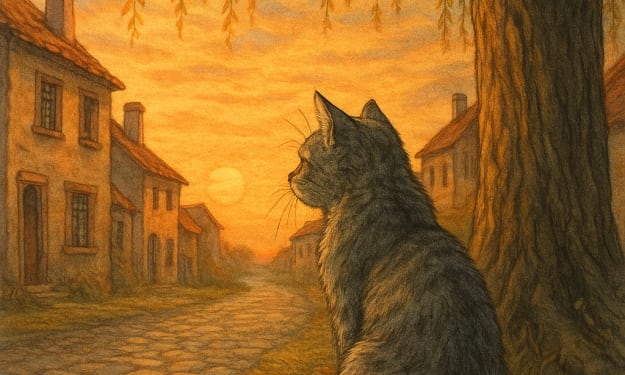
Whiskers and the Willow Tree: The Cat Who Waited Through the Seasons
In a peaceful village cradled gently between emerald-green hills and golden wheat fields, where birds sang lullabies at dawn and the breeze carried tales from one window to another, there lived a peculiar cat named Whiskers. Gray as the mist that blanketed the meadows in early morning, with eyes the color of polished emerald, Whiskers wasn’t anyone’s pet—but somehow, he belonged to everyone.
By Roohullah Roohani 6 months ago in Fiction
About Binding Prometheus
I want to start actively advocating on behalf of my own work, and the most valuable part of my canon is, without a doubt, Binding Prometheus, the play I have been working on since 2019 and only finished in 2023 as part of my MA. The play itself is an amalgamation of a million different inspirations. On one end, it evokes the Ancient Greek myth-play, deriving its own title from the earliest extant work of Western drama we have, Aeschylus’s Prometheus Bound. On the other end, it borrows significantly from the sci-fi bulwarks from over the years, namely Mary Shelley’s Frankenstein and Karel Capek’s Rossum’s Universal Robots. The play could be an episode of Black Mirror, I fear. I don’t know. I’ve only ever seen one episode of Black Mirror.
By Steven Christopher McKnight14 days ago in Futurism
Australia Mining Truck Market: Haulage Efficiency, Automation & Large-Scale Resource Extraction
According to IMARC Group, the Australia mining truck market was valued at USD 729.1 Million in 2025 and is projected to reach USD 967.79 Million by 2034, growing at a compound annual growth rate (CAGR) of 3.20% during 2026–2034. This steady expansion reflects the continued importance of mining trucks as core assets in Australia’s globally significant resource sector. As one of the world’s leading producers of iron ore, coal, gold, copper and critical minerals, Australia relies heavily on large-capacity haulage fleets to support efficient, safe and cost-effective extraction. Increasingly, mining trucks are evolving into technologically advanced, data-driven machines that enable automation, productivity optimisation and lower operating risk across large-scale mining operations.
By Shrestha Roy7 days ago in Futurism



Comments
There are no comments for this story
Be the first to respond and start the conversation.