
The International Space Station: Humanity’s Home Among the Stars
How the ISS became a symbol of science, cooperation, and the human desire to explore beyond Earth.

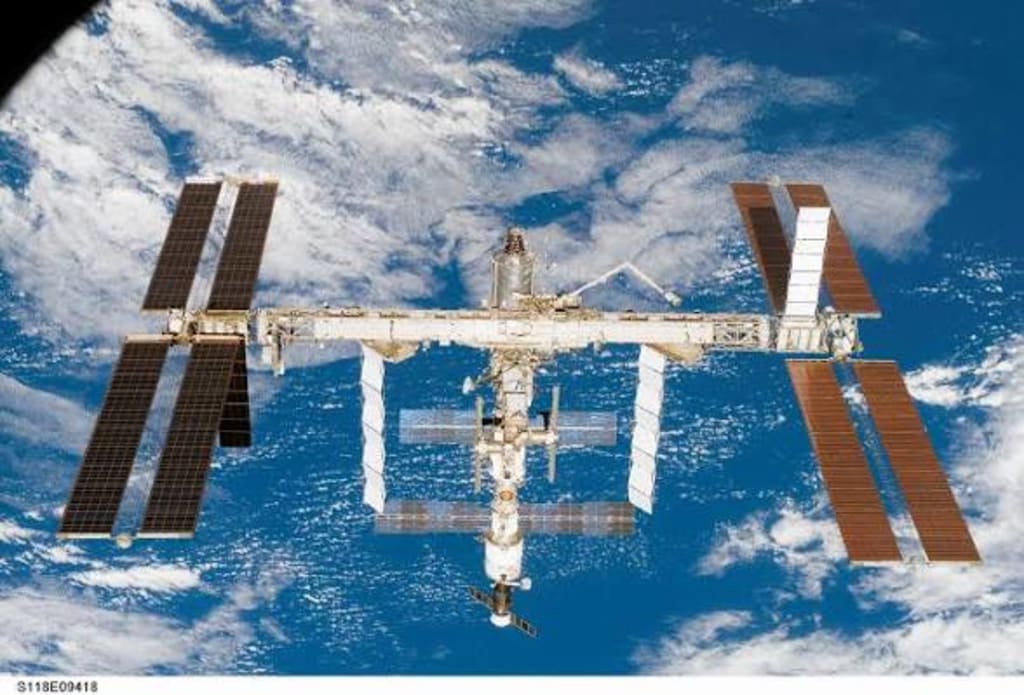
When you look up at the night sky, it’s easy to feel small. The stars seem impossibly far away, glowing quietly above the world we know. But somewhere among them — orbiting about 250 miles above Earth — there’s a home built by humankind: the International Space Station (ISS).
For more than two decades, the ISS has floated through space like a shining laboratory, where astronauts from around the world live and work together. It’s more than just a scientific outpost — it’s a symbol of unity, showing what humanity can achieve when nations choose to collaborate rather than compete.
---
Building the Impossible
The story of the International Space Station begins in the 1990s, when several nations decided to work together on one of the most ambitious projects ever attempted. The United States, Russia, Japan, Canada, and the member nations of the European Space Agency joined forces to design and build a permanent station in low Earth orbit.
Construction started in 1998, when the first two modules — one Russian and one American — were launched and connected in space. Over the years, new modules, solar panels, and laboratories were added piece by piece, like a giant puzzle orbiting Earth.
The result is stunning: a spacecraft the size of a football field, weighing nearly 420 tons, and visible from the ground with the naked eye. It travels around the Earth once every 90 minutes, moving at a speed of about 17,500 miles per hour. That means astronauts aboard the ISS see 16 sunrises and sunsets every single day.
---
A Truly International Effort
The International Space Station isn’t just one country’s achievement — it’s a global one. The crew includes astronauts from the United States (NASA), Russia (Roscosmos), Japan (JAXA), Canada (CSA), and the European Space Agency (ESA).
Despite differences on Earth, these nations work side by side in space. The ISS is a rare place where science and cooperation come before politics. When an astronaut from one nation helps another repair a solar panel or conduct an experiment, it reminds us that the pursuit of knowledge is something that belongs to everyone.
Even during times of political tension — such as between the U.S. and Russia — collaboration aboard the ISS has continued. That commitment to unity makes the station one of the most successful international partnerships in history.
---
Life Aboard the Station
Living on the ISS is like living in a science fiction movie — but with real challenges. There’s no gravity, so everything floats: pens, food, and even astronauts. Sleeping requires being strapped into a bag on the wall to avoid drifting away, and meals come in small packets that can be heated or rehydrated.
Astronauts spend their days conducting scientific experiments, maintaining equipment, and staying healthy through rigorous exercise. Because weightlessness weakens muscles and bones, each astronaut works out for about two hours every day using specialized machines.
Communication with Earth is constant, and thanks to technology, astronauts can even video call their families or post updates on social media. Still, it’s not always easy. The isolation, confined space, and distance from home can be mentally challenging — but the view of Earth from above makes it worth it.
---
Science in Orbit
The ISS isn’t just a floating home; it’s a research laboratory like no other. Scientists use it to study how space affects the human body, how materials behave in microgravity, and how plants grow without soil or sunlight.
Many experiments aboard the ISS have led to real-world benefits. Research on fluid dynamics has improved fuel systems, while studies on bone density have helped develop treatments for osteoporosis. The station has also tested technologies that will one day help astronauts travel farther — to the Moon, Mars, and beyond.
The ISS serves as a testing ground for humanity’s future in space exploration. Every lesson learned aboard helps engineers design better spacecraft and safer systems for deep-space missions.
---
The View from Above
One of the most profound parts of being on the ISS is the view. From the windows of the Cupola module, astronauts can see Earth in all its beauty — vast oceans, glowing cities, and swirling clouds.
Many astronauts describe this as the “Overview Effect” — a powerful emotional experience that changes how they see the world. From space, there are no borders or divisions. You can’t see countries or conflicts — only one planet, shared by all.
That perspective has inspired countless astronauts to become advocates for environmental protection and global cooperation once they return to Earth.
---
The Future of the ISS
The International Space Station has been continuously occupied since November 2000, making it one of the longest-running human missions in history. But its future is changing.
NASA and its international partners plan to retire the ISS in the early 2030s, gradually shifting research and crew missions to commercial space stations built by private companies. While the ISS may one day burn up as it reenters Earth’s atmosphere, its legacy will live on in the lessons learned and the partnerships formed.
The knowledge gained from two decades of life in orbit will guide the next generation of explorers — those who will build bases on the Moon or step foot on Mars.
---
A Legacy Beyond the Stars
The International Space Station represents the best of humanity — curiosity, cooperation, and courage. It’s a reminder that even in a world divided by politics and borders, people can come together to build something extraordinary.
Every time you spot that bright moving light in the sky, remember: it’s not just a machine. It’s a home — a home built by the hands of many nations, carrying the dreams of a planet that still dares to reach for the stars.
---
About the Creator
Fiaz Ahmed
I am Fiaz Ahmed. I am a passionate writer. I love covering trending topics and breaking news. With a sharp eye for what’s happening around the world, and crafts timely and engaging stories that keep readers informed and updated.
Keep reading
More stories from Fiaz Ahmed and writers in Futurism and other communities.
The Legend of the Mothman: America’s Most Mysterious Creature
When people think of American legends, they often picture Bigfoot, the Loch Ness Monster, or the Jersey Devil. But one of the most eerie and fascinating creatures ever reported in the United States is the Mothman — a mysterious winged being that terrified a small West Virginia town in the 1960s and continues to inspire curiosity and fear today.
By Fiaz Ahmed 5 months ago in Futurism
AI in Pulp and Paper Industry Market to hit USD 14.7 Billion By 2034
AI in Pulp and Paper Industry Market Overview The Global AI in Pulp and Paper Industry Market is projected to reach approximately USD 14.7 Billion by 2034, increasing from USD 7.1 Billion in 2024, reflecting a CAGR of 7.9% during the forecast period from 2025 to 2034.
By Roberto Crum3 days ago in Futurism
Generative AI In Insurance Market to Surpass USD 13,862.7 Mn By 2033
Generative AI in Insurance Market Overview The global Generative AI in Insurance Market is projected to reach approximately USD 13,862.7 Million by 2033, expanding from about USD 731.7 Million in 2023. This represents a strong CAGR of 34.2% during the forecast period from 2024 to 2033. Market growth is largely influenced by the increasing adoption of artificial intelligence technologies across insurance operations, including underwriting, claims management, fraud detection, and customer engagement.
By Roberto Crum7 days ago in Futurism



Comments
There are no comments for this story
Be the first to respond and start the conversation.