
The Human Thread in AI
Weaving Technology with Heart and Mind


The Human Fabric of AI
Artificial Intelligence (AI) often appears as a marvel of code and computation, a technology that seems to operate in a realm beyond human touch. Yet, at its core, AI is a vibrant tapestry woven by human hands—threaded with curiosity, creativity, and conscience. From the dreamers who first envisioned thinking machines to the artisans, storytellers, guardians, and connectors who shape them today, AI is a human endeavor, reflecting our deepest aspirations and toughest challenges. This article explores the human thread in AI, revealing how our passions, struggles, and values stitch together a technology that is as much about us as it is about innovation.
The Dreamweavers: Spinning AI’s First Threads
AI’s story begins with humans who wove bold ideas into reality. In the 1940s, Alan Turing spun a question that became a guiding thread: “Can machines think?” His vision of a machine mimicking human conversation sparked the field of AI. Meanwhile, scientists like Claude Shannon unraveled the mathematics of information, laying the groundwork for how machines process data. These dreamweavers weren’t just solving equations—they were imagining a future where machines could learn and reason.
With little more than early computers and boundless curiosity, they created the first patterns. In 1959, Arthur Samuel’s checkers-playing program learned from its mistakes, a simple but revolutionary step. These early efforts were like sketches on a loom, crafted by humans who believed machines could mirror the mind’s complexity.
Today’s AI—from language models crafting essays to systems predicting climate patterns—builds on these threads. Breakthroughs like DeepMind’s AlphaStar mastering StarCraft in 2019 or AI diagnosing diseases show the enduring power of human vision, with researchers tirelessly weaving new possibilities into the fabric of technology.
The Artisans: Stitching AI’s Structure
Building AI is like crafting a tapestry, requiring the skill of artisans. Data scientists, engineers, and experts stitch together datasets to create systems that think. Training an AI involves human judgment: labeling images, texts, or sounds to teach patterns. For instance, when developing an AI to monitor coral reefs, marine biologists tag thousands of underwater photos, distinguishing healthy coral from bleached. Their expertise shapes AI’s ability to protect ecosystems.
Programmers thread purpose into AI, deciding whether it maps disaster risks, translates ancient texts, or curates art exhibits. These choices reflect human priorities—preserving nature, unlocking history, or sparking joy. For example, AI in museum apps suggests personalized tours, a goal rooted in our love for culture.
But artisans face knots. Human biases can tangle AI’s outputs. In 2019, an AI credit-scoring tool was found to disadvantage certain groups due to biased data. Untangling this requires human skill—diverse teams auditing and refining systems to ensure fairness. These artisans aren’t just coding; they’re weaving integrity into AI, striving to make it a reflection of our best selves.
The Storytellers: AI as a Narrative Muse
Far from silencing creativity, AI is a muse for human storytellers. Artists, writers, and musicians use AI to spin new tales. Tools like Midjourney and Artbreeder generate visuals from prompts, letting illustrators craft fantastical worlds or designers prototype bold concepts. A 2025 art installation, Dreams in Code, blended AI-generated patterns with human sculptures, creating a narrative of collaboration that drew global crowds.
Writers use AI to spark stories. Platforms like StoryAI suggest plot outlines, but it’s the human author who weaves them into narratives with soul. A 2024 novel, Whispers of the Void, used AI to draft cosmic scenes, but its emotional resonance came from the writer’s personal touch. In music, AI tools like AIVA create melodies, but human composers add depth. A 2025 symphony, born from AI chords and human orchestration, moved audiences to tears.
AI also empowers everyday storytellers. Apps like Plotagon let anyone create animated shorts, while tools like Wordtune polish prose for bloggers. These platforms don’t replace creativity—they amplify it, letting more voices join the narrative. The storyteller’s role is to guide AI, threading human emotion into its outputs to craft tales that resonate.
The Guardians: Weaving AI’s Ethical Fabric
As AI’s influence expands, its ethical threads rely on human guardians. AI lacks a moral weave; its impact depends on those who guide it. For instance, AI in education can personalize learning, but who ensures student data stays safe? These choices are made by ethicists, policymakers, and advocates who prioritize human values.
Surveillance poses a challenge. AI-driven cameras in smart cities enhance safety but risk overreach. In 2024, London tightened AI surveillance rules after public debates, driven by human voices demanding privacy. Bias is another knot—AI hiring tools have favored certain demographics when trained on skewed data. In 2021, a tech firm halted such a tool after human researchers exposed its flaws, pushing for fairer systems.
Equity is a vital thread. AI’s benefits, like precision medicine, often skip marginalized communities. Guardians are weaving solutions—initiatives like AI for All train youth in underserved regions to use AI for local needs, like predicting floods. These efforts reflect a human commitment to justice, ensuring AI’s fabric includes everyone.
The Connectors: AI as a Bridge to Hearts
AI is a bridge to human connection, crafted by those who understand our need for bonds. Chatbots like me are designed to respond with warmth, built on insights from linguists and therapists. Apps like CompanionAI offer emotional support, using AI to mimic counseling techniques. A 2025 study found users felt less isolated after using such apps, thanks to human-crafted algorithms that prioritize care.
In entertainment, AI weaves immersive stories. Games like Elden Ring use AI to create worlds that adapt to player choices, making narratives feel alive. These experiences are spun by writers and designers who thread human emotions—wonder, fear, triumph—into code.
Education benefits, too. AI platforms like LearnSphere adjust lessons to each student, acting like a caring guide. These tools are built by educators who know the joy of learning, ensuring AI feels personal. Whether in therapy, gaming, or classrooms, AI’s ability to connect is woven by humans who value relationships.
The Trailblazers: Weaving AI’s Future
AI’s future is a canvas for human trailblazers. Researchers are using AI to tackle grand challenges—modeling ocean currents, curing rare cancers, or mapping distant stars. For instance, AI is optimizing reforestation efforts, while projects like Breakthrough Listen use it to search for extraterrestrial signals. These endeavors are driven by humans who see AI as a tool for discovery.
On a personal level, AI will become more intuitive—a companion that anticipates your needs or a mentor that senses your curiosity. These advancements will come from trailblazers who weave tech with empathy, ensuring AI enhances our lives.
But the future needs careful stitching. Humans must keep AI inclusive and accountable, diversifying its development to reflect global voices and crafting laws to prevent harm. The trailblazers shaping AI are not just technologists but weavers of hope, creating a fabric that uplifts humanity.
Conclusion: A Tapestry of Human Spirit
AI is not a machine apart from us—it’s a tapestry woven with human threads. From the dreamweavers who sparked it to the artisans, storytellers, guardians, connectors, and trailblazers who shape it, AI reflects our creativity, our struggles, and our dreams. Its knots are ours to untangle, and its patterns are ours to design. As we weave AI’s future, we’re not just coding technology—we’re crafting a tapestry of human spirit, one that will endure as a testament to our ingenuity and heart.
About the Creator
Shohel Rana
As a professional article writer for Vocal Media, I craft engaging, high-quality content tailored to diverse audiences. My expertise ensures well-researched, compelling articles that inform, inspire, and captivate readers effectively.
Keep reading
More stories from Shohel Rana and writers in Futurism and other communities.
The Algorithm’s Muse
The Human Song in AI’s Symphony Artificial Intelligence (AI) often feels like a creation of pure logic, a symphony of code played by machines. But beneath its digital surface lies a deeply human melody—a chorus of dreamers, tinkerers, artists, and guardians who compose its notes. AI is not a solitary force; it’s a collaboration between human creativity and computational power, a dance of imagination and innovation. This article tells a new story of AI, one that celebrates the human spirit driving its evolution. From its origins to its future, AI pulses with the creativity, passion, and responsibility of the people who shape it, making it a reflection of our collective soul.
By Shohel Rana10 months ago in Futurism
Australia Aerospace and Defense Market: Sovereign Defense Capability Development, Next-Generation Aerospace Systems & Integrated Security Infrastructure
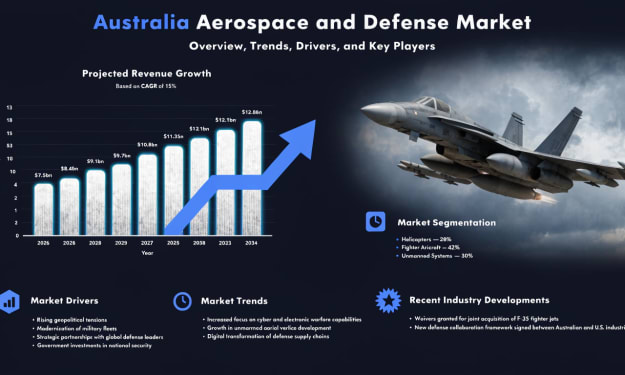
According to IMARC Group, the Australia aerospace and defense market reached a value of USD 13.6 Billion in 2025 and is projected to reach USD 21.4 Billion by 2034, growing at a compound annual growth rate (CAGR) of 5.04% during 2026–2034. The market is expanding as Australia strengthens its national security framework and invests in advanced aerospace technologies and defense capabilities. Rising geopolitical considerations and evolving security challenges are encouraging governments to increase defense budgets and modernize military infrastructure. Programs focused on sovereign defense capability development are encouraging domestic manufacturing of defense equipment, aircraft systems and advanced military technologies. At the same time, collaborations between Australian defense agencies and international contractors are accelerating innovation and enabling technology transfer. Investments in next-generation aerospace systems, cyber defense technologies and satellite communication infrastructure are further supporting the growth of the aerospace and defense sector.
By Kevin Cooperabout 22 hours ago in Futurism


Comments
There are no comments for this story
Be the first to respond and start the conversation.