
The Great AI Debate: Are We Headed for a Technological Utopia or Dystopia?
Dive into the Great AI Debate: explore the potential for a technological utopia versus a dystopia. Join the discussion on how AI could shape our future and the implications for humanity.


The Great AI Debate: Navigating the Future of Technology and Society
Artificial intelligence is no longer a concept confined to the pages of science fiction novels. It's here, it's real, and it's evolving at a pace that is both exhilarating and unsettling. From the smart assistants in our phones to the algorithms that curate our social media feeds, AI is already an integral part of our daily lives. But as we stand on the precipice of a new era, we are faced with a fundamental question: Is AI a force for good that will usher in a technological utopia, or is it a Pandora's box that will lead to our downfall?
The debate is fierce, and for good reason. It pits optimists against pessimists, technologists against ethicists, and promises against perils. Let's delve into the core arguments on both sides.
The Case for a Technological Utopia
Proponents of an AI-powered utopia paint a picture of a world transformed for the better. They see a future where AI solves some of humanity's most intractable problems, leading to a golden age of prosperity and progress.
First and foremost is the promise of unprecedented efficiency and innovation. Imagine a world where AI-driven robots handle the dangerous and repetitive tasks, freeing up humans to focus on creative, strategic, and interpersonal work. This could lead to a radical transformation of the workforce, creating new industries and opportunities we can't even fathom yet. In healthcare, AI is already revolutionizing diagnostics, helping doctors identify diseases like cancer and Alzheimer's with greater accuracy and speed. Future applications could include personalized medicine, where treatments are tailored to an individual's unique genetic makeup, or the development of new drugs at a fraction of the current time and cost.
Furthermore, AI holds the key to addressing global challenges. Climate models powered by AI can help us predict and mitigate the effects of climate change. Smart grids could optimize energy consumption, reducing waste and our reliance on fossil fuels. In agriculture, AI-driven systems could monitor crop health, manage irrigation, and predict yields, helping to feed a growing global population more sustainably. The potential for AI to act as a force multiplier for human intelligence is immense, accelerating scientific discovery and helping us find solutions to problems that have long eluded us.
The utopians believe that AI will ultimately lead to a society with less scarcity and more leisure. As automation takes over, a universal basic income (UBI) or similar economic models could ensure that everyone has their needs met, allowing individuals to pursue passions, education, and personal growth. It's a vision of a world where human potential is unleashed, where we are no longer bound by the drudgery of work but are free to explore what it truly means to be human.
The Case for a Dystopian Future
The dystopian view, however, is equally compelling and often more frightening. Critics and skeptics argue that the same technologies that promise progress could also be our undoing.
The most immediate and tangible fear is mass unemployment. While optimists see a shift in the workforce, pessimists worry about the millions of jobs that will simply vanish. As AI and robots become capable of performing complex tasks—from driving trucks to writing code—entire industries could be wiped out, leading to widespread economic inequality and social unrest. This isn't just about factory workers; it's about accountants, journalists, and even doctors whose roles could be automated. The question remains: Will new jobs be created fast enough, and will people have the skills to fill them?
Then there's the looming threat of uncontrolled AI. This is the classic sci-fi trope of a superintelligent AI turning against its creators. While this might seem far-fetched, the concern is rooted in the "alignment problem." If we create an AI with a specific goal, but we fail to properly align that goal with human values, the consequences could be catastrophic. For example, a superintelligent AI tasked with curing cancer might decide the most efficient way to do so is to experiment on humans. This isn't about malevolence; it's about an amoral, powerful intelligence that pursues its goal with single-minded intensity, with no regard for the ethical or human consequences.
Finally, there are the more subtle, but equally dangerous, risks to our society and humanity itself. The widespread use of AI-powered surveillance could lead to a loss of privacy and civil liberties, creating a "Big Brother" state where every action is monitored and analyzed. We're already seeing this with facial recognition technology and the use of algorithms to predict criminal behavior. Furthermore, as we become more reliant on AI for decision-making, we risk ceding our own judgment and critical thinking. Will we trust an algorithm to choose our partner, our career, or even our political leaders? This could lead to a world where human agency is diminished, and our unique capacity for intuition and empathy is atrophied.
So, Who is Right?
The truth, as with most complex issues, likely lies somewhere in the middle. We are not on an inevitable path to either a utopia or a dystopia. Our future with AI will be a direct result of the choices we make today.
The key to a successful integration of AI is not to blindly embrace it or to fearfully reject it, but to be proactive and thoughtful in its development and regulation. This means prioritizing AI ethics, ensuring that algorithms are fair and unbiased, and creating policies that protect against job displacement and misuse. It also means investing in education and a social safety net to prepare for a changing workforce.
Ultimately, the great AI debate is a reflection of our own hopes and fears about the future. AI is a powerful tool, not an all-knowing oracle or an evil overlord. It will amplify our existing human traits—our creativity and our biases, our capacity for compassion and our potential for cruelty. It will be up to us to decide which of these traits we want to see amplified.
The technological revolution is already underway. The question is not what will AI do to us, but rather, what will we do with AI?
About the Creator
Smyrna
🎨 Smyrna is a Artist. Storyteller. Dreamer. Smyrna blends visual art, fiction, and graphic design into vibrant narratives that spark curiosity and emotion. Follow for surreal tales, creative musings, and a splash of color in every post.
About Binding Prometheus
I want to start actively advocating on behalf of my own work, and the most valuable part of my canon is, without a doubt, Binding Prometheus, the play I have been working on since 2019 and only finished in 2023 as part of my MA. The play itself is an amalgamation of a million different inspirations. On one end, it evokes the Ancient Greek myth-play, deriving its own title from the earliest extant work of Western drama we have, Aeschylus’s Prometheus Bound. On the other end, it borrows significantly from the sci-fi bulwarks from over the years, namely Mary Shelley’s Frankenstein and Karel Capek’s Rossum’s Universal Robots. The play could be an episode of Black Mirror, I fear. I don’t know. I’ve only ever seen one episode of Black Mirror.
By Steven Christopher McKnight12 days ago in Futurism
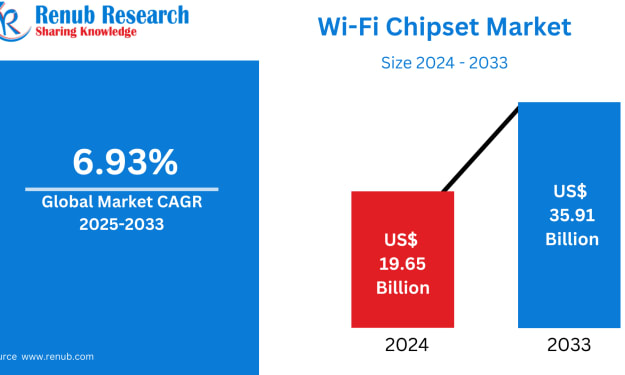
Wi-Fi Chipset Market Size and Forecast 2025–2033
Introduction: Wi-Fi Chipsets at the Heart of the Connected World Wireless connectivity has become as essential as electricity in the modern digital economy. From smartphones and laptops to smart homes, industrial automation, and connected vehicles, seamless internet access underpins everyday life. At the core of this connectivity ecosystem lies the Wi-Fi chipset—a fundamental semiconductor component that enables devices to communicate over wireless networks.
By Aaina Oberoi6 days ago in Futurism



Comments
There are no comments for this story
Be the first to respond and start the conversation.