
The Ghost in the Code: A Search for the Unpolished Self
Finding the Human Heartbeat in an Optimized World
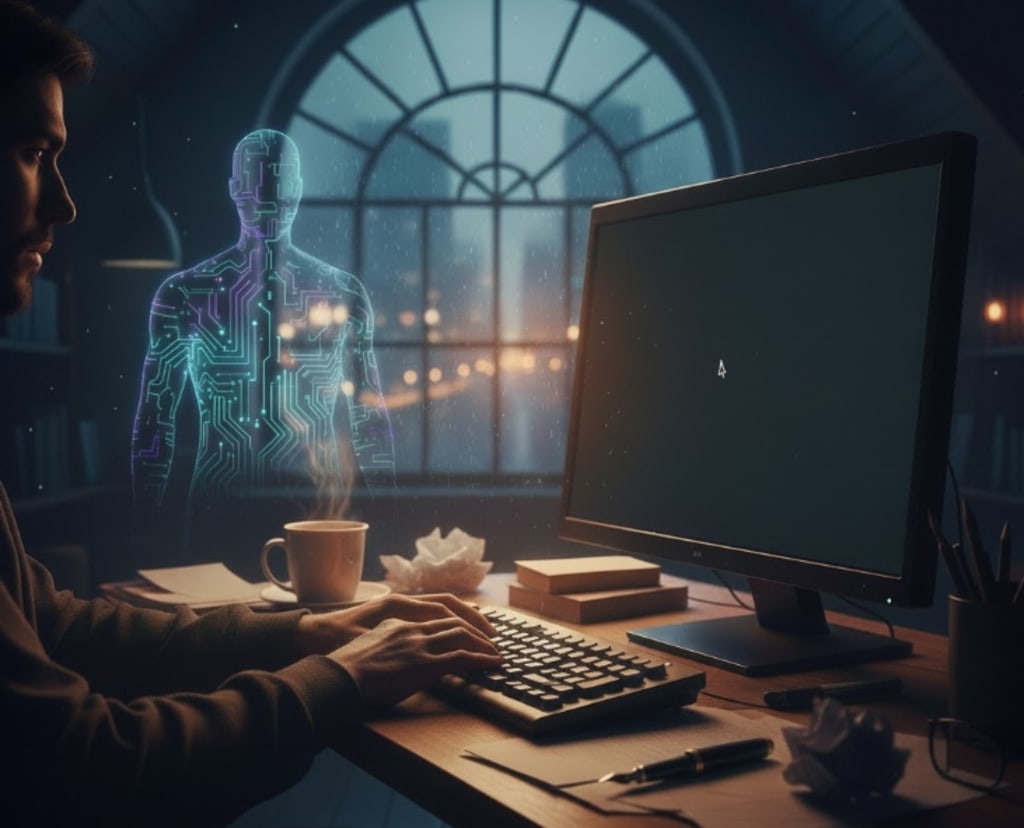
I spent twenty minutes yesterday staring at a blinking cursor, trying to find the right way to describe the smell of rain on hot asphalt. You know that scent — earthy, metallic, and heavy with memory. For twenty minutes, I struggled. My mind felt like a rusted gear, grinding against itself.
Then, a thought flickered in the back of my mind, tempting and cool: I could just ask the AI. In five seconds, it would give me ten "evocative" options. It would use words like "petrichor" and "sensory symphony." It would be grammatically perfect. It would be efficient. And it would be, in every sense that matters, utterly hollow.
We are living in an era where the gap between thought and expression is shrinking to zero. AI has become the great smoother of edges. It fixes our syntax, predicts our emails, and generates art from the scraps of our collective data. It is a marvel of human ingenuity, yet there is a growing, quiet ache that comes with using it — a feeling that in removing the friction of creation, we are accidentally removing ourselves.
The "problem" with AI isn't that it’s not smart enough; it’s that it's too "correct." It lacks the beautiful, erratic failure of a human heartbeat. When I finally found my words for the rain — comparing it to the smell of a dusty basement being washed clean — it wasn't "perfect." It was mine. It came from a specific Tuesday in my childhood, a specific porch, and a specific feeling of loneliness.
AI can mimic the result of a life, but it cannot experience the process of living. It doesn't know what it’s like to have a lump in your throat while writing a letter. It doesn't know the shame of a secret or the quiet thrill of a private joke. It operates on probability, whereas the most resonant human moments are often the most improbable.
I see people leaning more and more on AI productivity tools to "optimize" their creativity, and I understand the lure. We are tired. We are busy. Efficiency is the currency of our age. But I worry that if we let machines do our feeling for us, we will eventually forget how to feel for ourselves.
True resonance doesn't come from polished surfaces; it comes from the cracks. It’s the slight tremor in a singer's voice, the smudge on a painting, the weird, non-linear logic of a poem written in the middle of a fever dream. These are the things that say, "I am here, and I am alive."
The challenge of the AI age isn't how to master the prompt, but how to protect the parts of us that are un-promptable. It's about recognizing that the "waste of time" spent struggling with a sentence is actually where the soul of the work lives.
As we move forward, I hope we use these tools as telescopes — to see further — rather than as surrogates — to live for us. I want to keep the blinking cursor. I want to keep the struggle. Because at the end of the day, I don’t want to be efficient; I want to be known. And to be known, I have to be willing to be messy, imperfect, and stubbornly, inconveniently human. Perhaps the real genius isn't in the rapid-fire answers provided by a machine, but in the courage to remain silent until our own truth emerges. We must remember that while an algorithm can predict the next word, it can never feel the weight of the silence that precedes it. Our flaws are not bugs to be fixed; they are the fingerprints of our existence, the only proof we have that we were truly here.
About the Creator
Keep reading
More stories from writers in Futurism and other communities.
About Binding Prometheus
I want to start actively advocating on behalf of my own work, and the most valuable part of my canon is, without a doubt, Binding Prometheus, the play I have been working on since 2019 and only finished in 2023 as part of my MA. The play itself is an amalgamation of a million different inspirations. On one end, it evokes the Ancient Greek myth-play, deriving its own title from the earliest extant work of Western drama we have, Aeschylus’s Prometheus Bound. On the other end, it borrows significantly from the sci-fi bulwarks from over the years, namely Mary Shelley’s Frankenstein and Karel Capek’s Rossum’s Universal Robots. The play could be an episode of Black Mirror, I fear. I don’t know. I’ve only ever seen one episode of Black Mirror.
By Steven Christopher McKnight16 days ago in Futurism
Saudi Arabia Cancer Immunotherapy Market Advancing Treatment Adoption and Healthcare Innovation
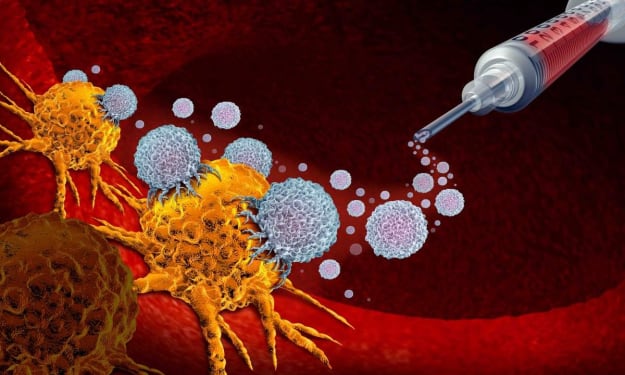
According to IMARC Group's latest research publication, Saudi Arabia cancer immunotherapy market size reached USD 1,303.4 Million in 2025. The market is projected to reach USD 2,611.6 Million by 2034, exhibiting a growth rate (CAGR) of 8.03% during 2026-2034.
By Suhaira Yusufa day ago in Futurism


Comments
There are no comments for this story
Be the first to respond and start the conversation.