
The Future of Virtual Reality: Immersive Experiences and Beyond
Exploring the Boundless Potential of Virtual Reality and Its Impact on Entertainment, Education, and Beyond
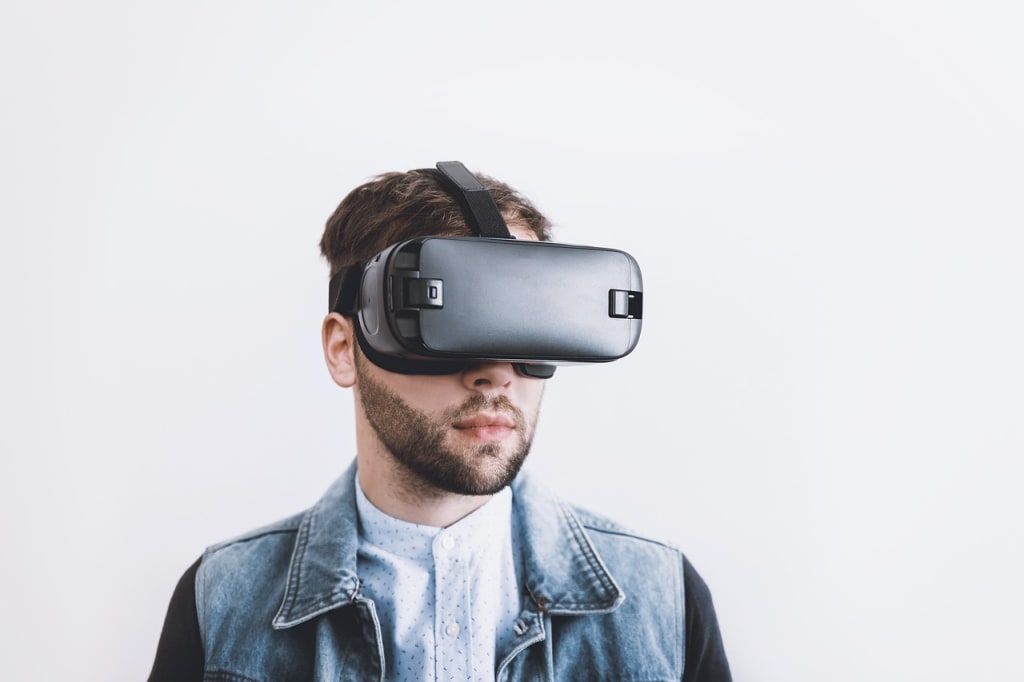
Dive into a virtual realm where reality blends with imagination, unleashing endless possibilities for immersive experiences.
Introduction:
Virtual Reality (VR) has emerged as a groundbreaking technology, transporting users to interactive and immersive digital environments. With its ability to create realistic simulations and sensory experiences, VR has captured the imagination of individuals across various industries. In this article, we delve into the exciting world of virtual reality, exploring its boundless potential and the transformative impact it has on entertainment, education, and beyond.
1. The Basics of Virtual Reality: How It Works
Virtual Reality creates an artificial digital environment that simulates real-world experiences. VR typically involves wearing a headset or goggles that display a three-dimensional virtual world to the user. This immersive experience is enhanced by motion tracking sensors and controllers that enable users to interact with and navigate within the virtual environment. Through the use of specialized software and hardware, VR replicates sensory experiences, including visuals, sounds, and even haptic feedback.
2. Entertainment: Redefining Gaming and Cinematic Experiences
Virtual Reality is revolutionizing the world of entertainment, offering gamers and movie enthusiasts an unprecedented level of immersion. VR gaming allows players to step into virtual worlds and interact with them firsthand. From thrilling adventures to realistic sports simulations, VR gaming takes the gaming experience to a whole new level. Moreover, VR is also transforming the way we consume media, providing immersive cinematic experiences where users can feel like they are a part of the story, creating a truly unforgettable journey.
3. Training and Education: Simulating Real-World Scenarios
Virtual Reality has tremendous potential in the field of training and education. VR simulations provide a safe and controlled environment for individuals to practice complex tasks or scenarios. For example, medical students can perform virtual surgeries, allowing them to gain hands-on experience without the risk associated with real patients. Similarly, VR can be used to train pilots, firefighters, and even astronauts, preparing them for high-stakes situations. Through realistic simulations, VR enhances learning outcomes and bridges the gap between theory and practice.
4. Architecture and Design: Visualizing Concepts in 3D
Virtual Reality is transforming the way architects and designers conceptualize and present their ideas. By creating immersive virtual environments, architects can walk clients through realistic 3D representations of buildings and spaces before construction even begins. This allows for better visualization, improved communication, and faster decision-making. VR is also being used in interior design, allowing clients to virtually experience different layouts, materials, and lighting conditions, aiding in the design process.
5. Healthcare: Enhancing Therapy and Medical Training
Virtual Reality has found its way into the healthcare industry, providing innovative solutions for therapy and medical training. VR therapy is being used to treat conditions such as phobias, PTSD, and anxiety disorders. By exposing patients to virtual environments that simulate their fears or triggers, therapists can guide individuals through controlled exposure therapy. VR also proves useful in medical training, allowing aspiring healthcare professionals to practice procedures, enhance surgical skills, and experience medical simulations in a safe and controlled environment.
Immerse yourself in the limitless possibilities of Virtual Reality, where imagination becomes reality and experiences come to life.
6. Social Interaction: Connecting People Across Distances
Virtual Reality has the potential to revolutionize social interactions by bridging geographical distances. With VR, individuals can gather in virtual spaces and engage in shared experiences, regardless of their physical locations. Social VR platforms allow users to communicate, collaborate, and engage in activities together, fostering a sense of presence and connection. Virtual meetings, conferences, and even virtual classrooms are becoming a reality, offering new opportunities for remote collaboration and learning.
Conclusion:
Virtual Reality is transforming the way we experience entertainment, education, training, and even social interactions. By creating immersive and interactive digital environments, VR opens up new realms of possibilities and unlocks a world where imagination becomes reality. As technology advances and VR becomes more accessible, we can anticipate even greater advancements and applications across various industries. Brace yourself for the extraordinary journey into the future of Virtual Reality.
Step into a world where the boundaries between reality and imagination blur, as Virtual Reality unlocks a new era of immersive experiences.
About the Creator
Alzheimer’s Drugs Market Outlook: Neurodegenerative Therapy Innovation and Growth Opportunities
According to IMARC Group's latest research publication, The global Alzheimer’s drugs market size reached USD 8.1 Billion in 2024. Looking forward, IMARC Group expects the market to reach USD 12.9 Billion by 2033, exhibiting a growth rate (CAGR) of 5.07% during 2025-2033.
By James Whitman5 days ago in Futurism
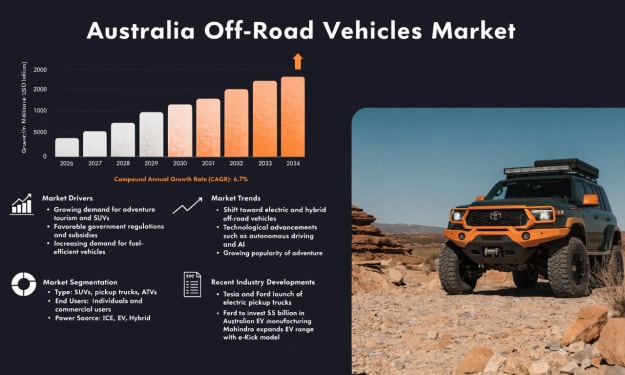
Australia Off-Road Vehicles Market: Adventure Tourism, Electric Models & Rural Utility Demand
According to IMARC Group, the Australia off-road vehicles market reached a value of USD 490.28 Million in 2024 and is projected to reach USD 861.59 Million by 2033, growing at a compound annual growth rate (CAGR) of 5.80% during 2025–2033. The market is experiencing steady growth as recreational, agricultural and commercial users increasingly adopt off-road vehicles for both adventure and practical applications. The expansion of adventure tourism across Australia’s remote landscapes is driving demand for rugged 4WD vehicles, all-terrain vehicles (ATVs) and utility task vehicles (UTVs) capable of navigating challenging terrain. At the same time, rising adoption of electric off-road vehicles supported by environmental regulations and battery technology advancements is transforming the industry. Additionally, growing demand from agriculture, mining and rural operations is strengthening the market as these sectors rely on off-road vehicles for transportation, equipment handling and operational efficiency.
By Shrestha Roy5 days ago in Futurism



Comments
There are no comments for this story
Be the first to respond and start the conversation.