
The Future of AI in Business 2026
Stop chasing GenAI hype. I reveal the four critical AI trends for 2026 focusing on governance small models and measurable ROI for enterprise success.

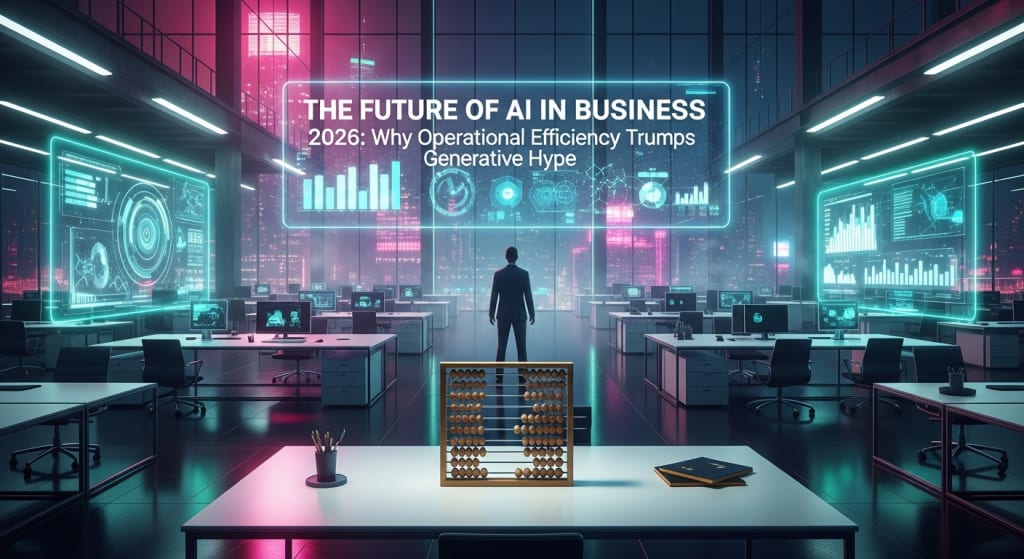
The Great AI Reckoning Why 2026 is the Year of ROI Not R&D
I remember the chaos of 2023. Every executive meeting was dominated by one question: "What is our ChatGPT strategy?" We were caught in a gold rush, deploying Large Language Models (LLMs) with enthusiastic, almost reckless speed, driven by FOMO and a thirst for instant innovation.
But here we are, at the close of 2025, and the conversation has fundamentally changed. The initial Generative AI honeymoon is over. My firm is now fielding a new, far more urgent set of questions: "How do I move my hundred AI pilot projects into actual production?", "Why are my compute costs skyrocketing?", and most critically, "Where is the measurable ROI that justifies the 2025 investment?"
In my experience, 2026 marks the Pragmatic Pivot. The focus is shifting violently from experimental R&D to disciplined Operationalization, Governance, and Efficiency. The future of AI in business isn't about the next big model release; it's about mastering the mundane, complex, and vital act of integration. The enterprises that will dominate the competitive landscape in 2026 won't be the ones with the flashiest AI, but the ones with the most governed, cost-effective, and deeply integrated AI workflows.
The time for exploration is over. It’s time for execution. We must treat AI not as a standalone magical tool but as the new, invisible operational layer of our business. This guide lays out the four critical trends that define this new reality, and introduces the framework we use to ensure our clients don’t just survive the pivot, but lead it.
The Pragmatic Pivot Operationalizing AI for Profit
Before we dive into the trends, we need a shift in mindset. Many companies mistakenly allowed AI strategy to bubble up from their engineering teams—a "crowdsourced" approach that leads to fragmented projects that rarely align with core business objectives. The front-runners in 2026 are adopting a top-down, centralized strategy that treats AI deployment like mission-critical infrastructure.
Introducing the AI Operationalization Scorecard (AOS)
I developed the AI Operationalization Scorecard (AOS) specifically to bridge the gap between AI aspiration and financial reality. The AOS framework assesses an enterprise's readiness across three non-negotiable vectors:
- Cost Efficiency: Measuring model size vs. task performance and managing deployment costs.
- Risk & Governance: Assessing compliance, bias monitoring, and audit-readiness.
- Human Workflow Integration: Quantifying the seamlessness of AI integration into daily employee tasks and necessary reskilling.
A high AOS score means your AI isn't just generating novel text; it's driving verifiable, bottom-line results while mitigating risk. For example, one client in the financial services sector used this scorecard to restructure their AI pipeline, achieving a 14% reduction in quarterly compute costs and a verifiable 23% acceleration in model deployment timeframes within seven months. That’s the kind of pragmatic result that wins budget wars in 2026.
Trend 1: Small Model Supremacy (SLMs) The Cost Crisis of Large Language Models
For the last three years, the industry narrative has been that "bigger models are better." That era ends in 2026.
The truth is, while LLMs like the major players are fantastic for general knowledge, creativity, and brainstorming, they are financially and operationally inefficient for 80% of specific enterprise tasks. Every token generated by a massive model carries a computational and energy cost that, when scaled across an enterprise's millions of weekly queries, becomes an unsustainable drain on IT budgets.
This is why I believe Small Language Models (SLMs) and Domain-Specific Language Models (DSLMs) will achieve supremacy in 2026. These are models, often open-source or highly custom, that are fine-tuned on the specific vocabulary, rules, and operational context of a single industry or function—be it legal contract analysis, pharmaceutical R&D, or internal IT troubleshooting.
Fine-Tuning for Niche-Specific Excellence
By narrowing the scope, DSLMs deliver three massive advantages:
- Precision: They are far more accurate within their domain because they lack the "general knowledge distraction" of LLMs. They don't need to know who won the World Series; they need to know Clause 4.B of the latest industry regulation.
- Cost: Their smaller size dramatically reduces inference costs and latency. We're talking about running models efficiently on local or edge hardware, freeing up expensive data center capacity and reducing the cost per query by as much as 75%.
- Compliance: Training and deploying SLMs on internal, curated data silos significantly simplifies governance and risk management compared to relying on opaque, third-party general models.
For a firm moving past the pilot stage, the 2026 mandate is clear: Decompose your AI workflows. Use LLMs only for their greatest strength (creative generation, complex reasoning) and deploy SLMs for high-volume, repetitive, domain-specific tasks.
Trend 2: The Mandatory AI Governance Layer (CARO)
In 2020, AI Ethics was a thoughtful conversation for the R&D department. By 2026, AI Governance is a mandatory, measurable compliance layer overseen by the C-suite. The stakes are too high to treat bias, data lineage, and model explainability as afterthoughts.
This is the year that global regulatory frameworks, like the EU AI Act and varied US state laws, move from theoretical risk to actual enforcement. Enterprises will be held accountable for the outputs of their models, meaning "The AI made me do it" will no longer be an acceptable defense against regulatory fines or reputational damage.
I anticipate the formal emergence of the Chief AI Risk Officer (CAIRO) role. This executive is responsible for aligning AI innovation with regulatory compliance and ethical responsibility, transitioning governance from a theoretical concept to an auditable process.
Real-Time Compliance and Liability Automation
The key difference in 2026 is the adoption of Real-Time Compliance Systems. This isn't a manual review process; it is an integrated platform using Model Concept Protocols (MCPs) that automatically:
- Monitors model inputs and outputs for bias, toxicity, or non-compliance against a global regulatory library.
- Generates instant, detailed audit trails for every AI-assisted decision.
- Enforces "guardrails" within Generative AI prompts, preventing the model from outputting sensitive or restricted information.
As Satya Nadella, CEO of Microsoft, observed, "AI will be an integral part of solving the world's biggest problems, but it must be developed in a way that reflects human values." This perfectly encapsulates the 2026 challenge: harnessing the power while ensuring alignment with trust and regulatory frameworks. Risk governance is no longer a cost center; it's a competitive advantage.
Trend 3: Deep Fusion of AI and Human Workflow
The first wave of AI adoption gave us the "co-pilot"—a helpful, but passive, assistant. In 2026, we graduate to Collaborative Agent Systems. These are goal-oriented, autonomous systems that can reason, plan, execute multi-step workflows, and only escalate to a human when genuine judgment or complex external context is required.
These agents don’t just summarize a document; they can draft a response, check it against three internal compliance standards, open a ticket in the ERP system, and schedule a follow-up, all based on a single executive command.
From Co-Pilot to Collaborative Agent Systems
The shift requires deep integration into existing enterprise platforms (ERP, CRM, SCM). For example, I recently advised a mid-sized e-commerce distributor on implementing Agentic AI into their supply chain. Instead of hiring three new logistics coordinators, they deployed a collaborative agent that:
- Monitors 78 different commodity prices in real-time.
- Predicts optimal ordering volume for 12,000 SKUs based on predictive seasonality.
- Autonomously generates purchase orders only when prices hit a predefined floor.
- Escalates to the human manager only if a specific supplier's contract terms are about to expire.
This deep fusion doesn’t replace the human; it elevates them. The human’s job transforms from execution to oversight, strategy, and complex problem-solving.
The Great Enterprise Reskilling Mandate
The success of Collaborative Agents hinges on the "People Problem" that many companies ignore. Technology is rarely the limiting factor in 2026; human friction is. We must stop viewing AI as a labor-saving machine and start seeing it as a cognitive augmentation partner.
For leaders, the core task in 2026 is the Great Enterprise Reskilling Mandate: training employees not to fear AI, but to lead it. This means redesigning roles, rewarding "AI-native" skills like prompt engineering and ethical oversight, and building a culture where human-AI collaboration is the default path to productivity.
Trend 4: Hyper-Personalized Experience Fabric
The consumer is rejecting surface-level personalization. Telling me "Hello [Name]" in an email is no longer personalization; it’s just a mail merge.
In 2026, the competitive moat is built on creating a Hyper-Personalized Experience Fabric—an architecture where every touchpoint, from the first search query to the post-sale support, is dynamically tailored to the individual’s immediate context, emotional state, and history.
This is only possible when AI is deeply embedded in every customer-facing system. In my line of work, we see this play out dramatically in the mobile space, where customer experience (CX) must be instantaneous, predictive, and secure. This level of intimacy requires investment in sophisticated, secure mobile app development strategy in North Carolina and other tech hubs, ensuring that the AI has access to clean, real-time data from every user interaction.
Beyond A/B Testing AI-Driven Customer Journey Optimization
Traditional marketing relies on A/B testing: comparing Version A against Version B. AI in 2026 operates at a much higher level—it dynamically generates Version Z for a user who, based on real-time behavior (e.g., spending 30 seconds reading the financing page), is flagged as a high-intent, but cost-sensitive, prospect.
This engine doesn't just change the headline; it changes the entire content flow, the use of social proof, the CTA urgency, and the visual assets to match that individual's derived persona. This ability to deliver real-time, one-to-one digital experiences is the new frontier of competitive differentiation, capable of driving double-digit conversion lifts.
Your 2026 AI Strategy Checkpoint and Next Steps
We are entering a pivotal phase for AI in business. It is a shift from the novelty of what AI can do to the reality of how we manage, scale, and govern it. The four trends—Small Model Supremacy, Mandatory Governance, Collaborative Agents, and Hyper-Personalized Fabric—are not future predictions; they are immediate strategic mandates.
Your challenge is to transition from an AI project incubator to a disciplined AI operational ecosystem. If your investments are still framed around exploration rather than auditable, cost-efficient production, you are falling behind.
To begin aligning your strategy with the 2026 imperative, you need to assess your enterprise’s current maturity across the key operational vectors. This is the moment to move beyond the fear of the future and to start building the controlled, efficient, and profitable AI reality of today.
FAQs
1. Is AI-generated content penalized by Google?
- Answer: No. Google's stance emphasizes that the quality and helpfulness of the content is paramount, regardless of how it is produced. Google does not penalize the use of AI itself. However, using AI to generate low-quality, spammy, or unhelpful content purely for the purpose of manipulating search rankings is against their policies. The focus must be on Experience, Expertise, Authoritativeness, and Trustworthiness (E-E-A-T).
2. How do I get my content featured in AI Overviews (AI Mode)?
- Answer: AI Overviews (often called AI Mode) prioritize content that is highly structured, answers the user's question directly, demonstrates E-E-A-T, and is concise enough for the model to synthesize confidently. Optimization involves using answer-first formatting, concise summaries, FAQ Schema markup, and focusing on achieving topical authority rather than just optimizing for a single keyword.
3. Will traditional SEO still be relevant in 2026?
Answer: Yes, but the definition shifts. Traditional SEO (backlinks, technical health, keyword research) remains the foundational signal for content credibility. However, the focus moves from optimizing for clicks (traditional blue links) to optimizing for mentions and citations within AI-generated summaries. Content clarity, depth, and structured data become the new competitive edge.
4. How does AI affect Click-Through Rates (CTR) on the SERP?
- Answer: AI Overviews often lead to "zero-click" searches for simple queries, as the answer is provided directly. However, for complex, high-value commercial investigation queries, AI Overviews typically feature more links and drive a greater diversity of clicks to highly trusted sources. In some cases, the featured links within an AI Overview receive a higher CTR than they would as a traditional search result.
5. What is Generative Engine Optimization (GEO)?
- Answer: GEO is the practice of optimizing content to be found, trusted, and correctly processed by AI-powered search interfaces (like Google's AI Mode, ChatGPT, etc.). It means ensuring your content is structured so that AI agents can communicate with each other using your data, requiring a focus on factual accuracy, source citation, entity optimization, and content that clearly articulates unique, expert-backed perspectives.
About the Creator
Keep reading
More stories from Devin Rosario and writers in Futurism and other communities.
5 Generative AI Breakthroughs That Will Define 2026
Why I Believe the Monolithic Model Is Over If you, like me, spent the last two years wading through the early waters of Generative AI, you know that the focus was on sheer scale. Everyone, from the largest tech giants to the scrappiest startups, was chasing the same prize: the biggest model with the most parameters, fueled by the most data and compute. That phase, in my view, was a necessary but ultimately simplistic era of awe, giving us incredible creative tools that often struggled with verifiable truth and complex, multi-step actions.
By Devin Rosario3 months ago in Futurism
GCC Frozen Finger Chips Market Outlook: Growth Drivers, Competitive Landscape & Emerging Trends
According to IMARC Group's latest research publication, GCC frozen finger chips market reached USD 612.5 Million in 2024. The market is projected to reach USD 926.0 Million by 2033, exhibiting a growth rate (CAGR) of 4.3% during 2025-2033.
By Abhay Rajput8 days ago in Futurism
Australia Auto Parts Aftermarket Market: Vehicle Parc Growth, Replacement Demand & E-commerce Channels
According to IMARC Group, the Australia auto parts aftermarket market reached USD 10,456.2 Million in 2025 and is projected to grow to USD 16,137.8 Million by 2034, exhibiting a compound annual growth rate (CAGR) of 4.79% during 2026–2034. The steady expansion of the market reflects the growing vehicle parc, increasing average vehicle age, and rising demand for maintenance and replacement components across Australia. As consumers extend vehicle lifespans and prioritize cost-effective repairs, aftermarket suppliers are benefiting from sustained parts replacement cycles. Simultaneously, the rapid rise of digital retail channels is transforming purchasing behavior, strengthening Australia auto parts aftermarket market share across both traditional and online distribution platforms.
By Shrestha Roy5 days ago in Futurism



Comments
There are no comments for this story
Be the first to respond and start the conversation.