
The Evolution of Medical Imaging: From X-Rays to AI-Driven Diagnostics
by Braxton Norwood

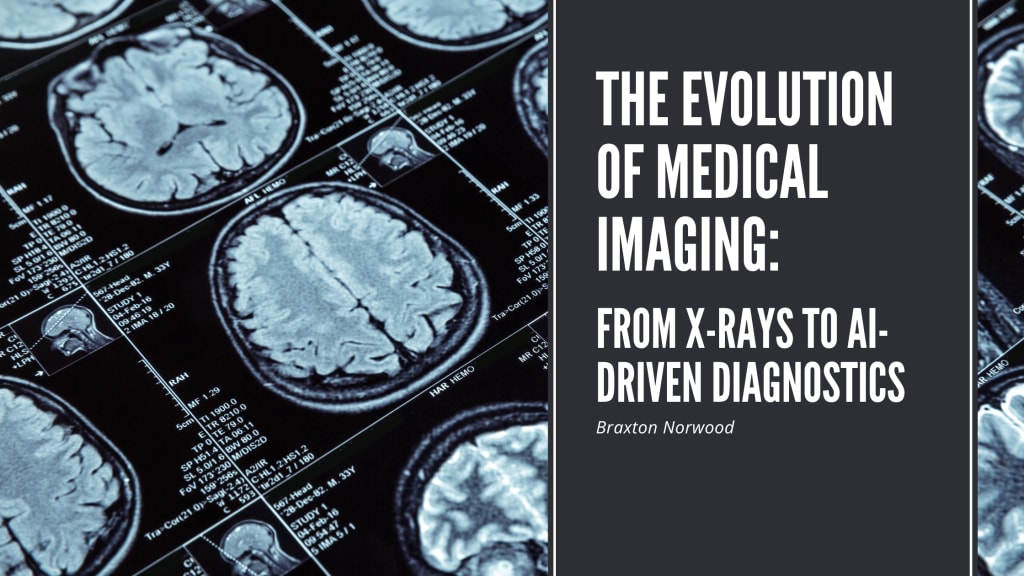
It's amazing how far medicine has come in the last 100 years. This is especially true regarding medical imaging, which has advanced by leaps and bounds. That said, we often take the history of medical imaging for granted.
Here, you'll find a brief overview of the evolution of medical imaging techniques, from x-rays to PET imaging, and where it’s likely headed: Artificial Intelligence/Machine Learning. To learn more, please visit the embedded links.

X-ray
The discovery of X-rays dates back to 1895, when German physicist Wilhelm Conrad Roentgen stumbled upon this groundbreaking form of electromagnetic radiation while experimenting with cathode rays. He observed that these rays could pass through solid objects and produce images of internal structures on photographic plates, leading to the first X-ray image, which was his wife Anna Bertha’s hand, showing her bones and wedding ring. Roentgen's discovery revolutionized medicine, providing the first non-invasive method to see inside the human body, which was rapidly adopted for medical diagnostics. This earned Roentgen the first Nobel Prize in Physics in 1901. The development of x-rays opened the door to modern radiology, laying the foundation for advancements like fluoroscopy, computed tomography, and other imaging technologies. While x-rays let doctors check the condition of our bones, they aren’t very useful for soft tissues like muscle or tendons. This shortcoming led to the development of our next piece of technology.
Ultrasound
Ultrasound is based on sonar, which was used during World War II to detect submarines. As mentioned above, its primary utility is in viewing soft tissue. The technology is relatively inexpensive and portable, especially when compared with other techniques like MRI and CT. It is also completely harmless, unlike x-rays, which involve ionizing radiation. While many doctors and scientists were involved in this technology's development and eventual perfection, Dr. Karl Theodore Dussik enabled some of the most significant breakthroughs. More specifically, Dr. Dussik's studies focused on transmission ultrasound investigation of the brain via medical ultrasonics. Today, medical ultrasound is used routinely in many soft-tissue diagnostic and therapeutic procedures, ranging from cardiac function to prenatal exams.
Computed Tomography (CT)
CT was developed in the early 1970s and marked a significant advancement in medical imaging. The invention is primarily credited to British engineer Sir Godfrey Hounsfield and South African physicist Allan Cormack, who independently contributed to the underlying technology. Hounsfield, working at EMI Laboratories in the UK, built the first practical CT scanner, which was first used to scan a person in 1971. Cormack's earlier theoretical work on reconstructive techniques laid the groundwork for this innovation. Their contributions were recognized with the Nobel Prize in Physiology or Medicine in 1979. Initially, CT scans were limited to the brain, but advances in technology quickly expanded their use to other parts of the body.
CT works by using x-rays to take multiple cross-sectional images of the body from different angles. The patient lies on a table that moves through a rotating x-ray machine, which takes numerous x-ray images as it rotates around the body. These images are then processed by a computer to create detailed 3D images of the internal structures, allowing doctors to examine bones, organs, and tissues with high precision. While CT scans are particularly useful for diagnosing conditions like fractures, tumors, and internal bleeding, they involve relatively high radiation exposure.
Magnetic Resonance Imaging (MRI)
MRI has its roots in the early 1970s, building on principles of nuclear magnetic resonance (NMR), a technique discovered in the 1940s by physicists Felix Bloch and Edward Purcell. The idea of using NMR for medical imaging was pioneered by Dr. Raymond Damadian, who demonstrated that malignant and normal tissues have different NMR signals. In 1973, Paul Lauterbur expanded on this by introducing the concept of using gradients in the magnetic field to create two-dimensional images, which was further refined by Sir Peter Mansfield, who developed the mathematical techniques for fast imaging. The first human MRI scans were performed in the late 1970s, and by the 1980s, MRI had become a powerful, non-invasive tool for imaging soft tissues, particularly the brain, spinal cord, and joints, revolutionizing diagnostic medicine. In recognition of their contributions, Lauterbur and Mansfield were awarded the Nobel Prize in Physiology or Medicine in 2003.
MRI works by using strong magnetic fields and radio waves to generate detailed images of the body's internal structures. The magnetic field causes protons to align. Brief pulses of radio waves are then used to disrupt the alignment. As the protons return to their original state, they emit signals that are detected by the scanner. These signals are processed by a computer to create detailed cross-sectional images of organs and tissues, which are particularly useful for imaging soft tissues like the brain, muscles, and joints.
Position Emission Tomography (PET)
PET imaging emerged in the mid-20th century as a powerful tool for observing metabolic processes in the body. What sets PET apart from the other imaging techniques mentioned in this article is its ability to evaluate the function of tissues, rather than their anatomy/structure. The concept of PET imaging was developed through the pioneering work of scientists like David E. Kuhl, who in the 1950s and 60s, explored the potential of radioactive tracers to visualize and measure physiological functions. Lutroo Imaging is developing a PET radiotracer for pain diagnosis, which is in early clinical development.
The first PET camera was built for human studies by Edward Hoffman, Michael M. Ter-Pogossian, and Michael E. Phelps in 1973 at Washington University, with US Department of Energy and National Institutes of Health support. Phelps, who is often credited with inventing PET, received the 1998 Enrico Fermi Presidential Award for his work. The first whole-body PET scanner appeared in 1977.
The PET scanner allows for the indirect detection of positrons emitted by the radioactive tracers, called “radiotracers”. When positrons collide with electrons, two gamma rays are produced, which are detected by the PET scanner and used to localize and quantify the radiotracer. PET imaging revolutionized medical diagnostics by providing a way to observe cellular-level processes, such as glucose metabolism and blood flow, contributing to early disease detection and personalized treatment strategies.
AI Diagnostics
These days, there is much talk about how artificial intelligence (AI) will influence the medical world. One such example is how it can impact diagnostics via medical imaging. AI has great potential in medical imaging because it can rapidly analyze large volumes of data, enhancing the accuracy and efficiency of diagnosis. By using machine learning algorithms, AI can detect patterns and abnormalities in images that might be missed by the human eye, leading to earlier and more accurate detection of diseases. Additionally, AI can assist in reducing the workload for radiologists by automating routine tasks, allowing them to focus on more complex cases. As AI technology continues to evolve, it promises to improve diagnostic accuracy, personalize treatment plans, and ultimately enhance patient outcomes.
About the Creator
Braxton Norwood PhD
I am a scientist-entrepreneur, passionate about revolutionizing the diagnosis and treatment of human health disorders. I am co-Founder of Lutroo Imaging and Unbreakables Foundation. Profiles: Medium, Twitter, Crunchbase, LinkedIn.
Keep reading
More stories from Braxton Norwood PhD and writers in Futurism and other communities.
Unusual Ways to Volunteer: 10 Ways to Make a Difference Beyond the Ordinary
Volunteering is a powerful way to give back to your community, meet new people, and make a positive impact on the world. While traditional volunteering roles like serving meals at a soup kitchen or cleaning up parks are incredibly valuable, there are many other creative and unusual ways to get involved that might better align with your interests or skills. Here are some unique volunteering opportunities that go beyond the ordinary and offer different ways to make a difference.
By Braxton Norwood PhDabout a year ago in Humans
About Binding Prometheus
I want to start actively advocating on behalf of my own work, and the most valuable part of my canon is, without a doubt, Binding Prometheus, the play I have been working on since 2019 and only finished in 2023 as part of my MA. The play itself is an amalgamation of a million different inspirations. On one end, it evokes the Ancient Greek myth-play, deriving its own title from the earliest extant work of Western drama we have, Aeschylus’s Prometheus Bound. On the other end, it borrows significantly from the sci-fi bulwarks from over the years, namely Mary Shelley’s Frankenstein and Karel Capek’s Rossum’s Universal Robots. The play could be an episode of Black Mirror, I fear. I don’t know. I’ve only ever seen one episode of Black Mirror.
By Steven Christopher McKnight24 days ago in Futurism
📢 Raise Your Voice Thread: 01/22/2026
Our “Raise Your Voice Threads” are hosted most alternating Thursdays at 12PM ET to offer creators more avenues to uncover exceptional stories on Vocal. As we are continuously searching for fresh creators and inspiring stories, this thread provides an opportunity to exchange and discuss the stories that have moved and motivated us on Vocal.
By Raise Your Voice by Vocal2 days ago in Resources




Comments