
The Echo of Tears in Rain: How Blade Runner Still Shapes the Future of Sci-Fi
Blade Runner didn’t just redefine sci-fi aesthetics—it rewrote the philosophical rules of the genre.


Blade Runner didn’t just redefine sci-fi aesthetics—it rewrote the philosophical rules of the genre. This Movies of the 80s deep-dive explores how its questions about humanity, AI, and identity continue to shape modern science fiction from Ex Machina to Cyberpunk 2077.
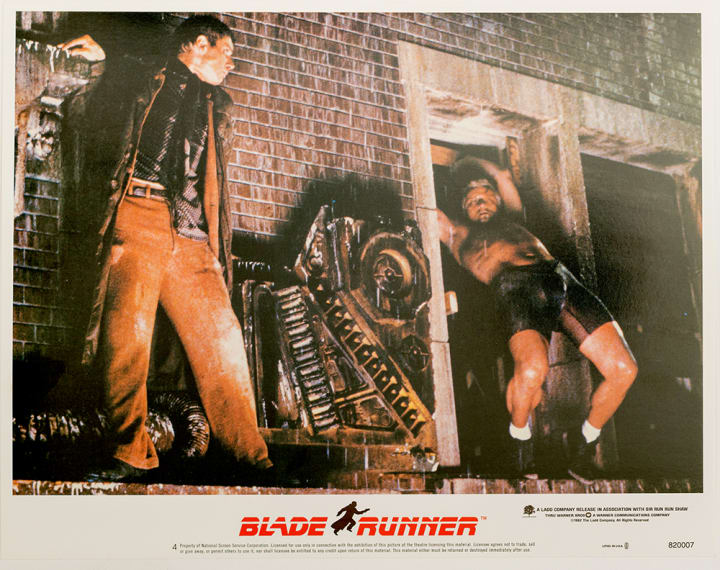
The Echo of Tears in Rain
There’s a moment near the end of Blade Runner—you know the one. Rain falling like broken glass. A dying replicant speaking softly about lost moments no human could ever verify. It’s more than a monologue. It’s a quiet, devastating challenge to everything we assume about life. The “tears in rain” speech doesn’t conclude anything; it leaves a question mark drifting upward like steam from neon-lit pavement.

And here we are, decades later, still living inside that question.
Because Blade Runner wasn’t just futuristic. It was prophetic. Before AI filled every headline, every think piece, every jittery conversation about the future, Ridley Scott’s vision dared to whisper: If we build something that feels life, fears death, remembers pain—are we still the only ones allowed to call ourselves human?
This isn’t just a movie retrospective. It’s a journey through the philosophical blueprint that still guides the stories—and anxieties—of modern science fiction.

Are You Human? Unpacking the Replicant Dilemma
The Voight-Kampff test once felt far-fetched, a sci-fi flourish built to expose artificial empathy. Now it feels quaint, almost analog, compared to the behavioral red flags, alignment tests, and guardrails we build around AI systems today. Blade Runner wasn’t predicting technology—it was predicting interrogation.
The Voight-Kampff Test Today
We stare at neural networks and language models, searching for some defining metric, some final line in the sand that separates our spark from theirs. Blade Runner warned us that the line would blur—and it has. When a machine tells a joke, hesitates, or offers kindness, is that programming or something else?

Empathy as a Fallacy
The film also dared to poke at a core human comfort: the belief that empathy is ours and ours alone. Yet Roy Batty’s sorrow feels more genuine than Deckard’s emotional evasiveness. If empathy isn’t a uniquely human trait, what becomes of the pedestal we’ve built ourselves upon?

The Legacy in Modern Works
You see Blade Runner’s fingerprints everywhere—Ex Machina, Westworld, and even the philosophical anxieties of modern AI labs. All inherit the same question: when intelligence becomes indistinguishable from consciousness, who gets to play god?
Defining Life in a Synthetic World
Blade Runner understood something our modern world is only beginning to realize: life doesn’t have to be biological to be real.

Beyond Bio-Engineering
The film anticipated digital consciousness, neural networks, and the eerie possibility of non-biological life long before those ideas were mainstream. It framed the conversation around not how these beings are made—but whether they can feel.

The Right to Exist
The replicants’ rebellion—desperate, violent, heartbreaking—resonates in today’s debates around AI rights, moral consideration, and the existential dangers of creating minds without giving them meaning. The more we mimic life, the more urgent the question becomes: what do we owe our creations?

Detroit: Become Human and Interactive Storytelling
In games like Detroit: Become Human, you feel the lineage directly. Blade Runner’s central tension—sentience versus agency—pours into every narrative choice. It’s a modern echo of the same dilemma: if a synthetic being suffers, who are we to dismiss it?
The Shadow of Corporate Control and Existential Dread
Blade Runner’s world is a place where corporations have replaced gods, constructing life as a product and memory as a commodity.

Tyrell Corporation’s Legacy
Today’s tech giants shape the way we work, think, communicate, and even dream. Blade Runner didn’t predict corporate power—it diagnosed it. Tyrell’s motto, “More human than human,” remains a haunting prophecy of Silicon Valley’s ambitions.
The Loneliness of the Future
But Blade Runner also understood something deeper: progress doesn’t cure loneliness. The future can be neon-bright and spiritually dim at the same time. That mood—urban decay wrapped around human isolation—reappears in modern sci-fi again and again.

A Line from Ghost in the Shell to Cyberpunk 2077
From the existential musings of Ghost in the Shell to the sprawling corporate dystopia of Cyberpunk 2077, you can trace a direct line back to Scott’s rain-soaked Los Angeles. These worlds share a common dread: that individuality is the first casualty of technological acceleration.
Blade Runner’s Enduring Philosophical Mirror
If there’s one thing Blade Runner teaches us, it’s that questions don’t end—they evolve.
A Cycle of Re-Examination
Every new advancement in AI, robotics, or digital consciousness brings us back to the same crossroads: What defines a life? What justifies a soul? At what point does creation demand compassion?

A Call to Reflection
Blade Runner invites us—not passively, but urgently—to turn inward. To examine our assumptions about personhood and the fragile criteria we use to justify superiority.
The Future of Sci-Fi
Its philosophical legacy continues to guide the stories of tomorrow. Every new sci-fi narrative that dares to explore identity, memory, or consciousness is borrowing from the groundwork laid in 1982. Blade Runner isn’t just part of sci-fi history. It’s part of sci-fi’s nervous system.
And as long as we keep building machines that look back at us with something like recognition, those tears in rain will keep echoing.

About the Creator
Movies of the 80s
We love the 1980s. Everything on this page is all about movies of the 1980s. Starting in 1980 and working our way the decade, we are preserving the stories and movies of the greatest decade, the 80s. https://www.youtube.com/@Moviesofthe80s
Keep reading
More stories from Movies of the 80s and writers in Futurism and other communities.
Ringo Starr’s Cinematic Side Quest: Caveman (1981) and the Mystery of a Mascot That Probably Wasn’t Him
Ringo Meets the Movies Ringo Starr has always been the Beatle most comfortable drifting into unexpected corners of pop culture. He’s funny, warm, unpretentious, and game for just about anything. So when he took the lead role in Caveman in 1981—a broad, slapstick prehistoric comedy from Jaws co-writer Carl Gottlieb—it felt like Ringo stepping naturally into the movies he seemed destined to make: strange, good-natured, and a little bit shaggy around the edges.
By Movies of the 80s2 months ago in Beat
About Binding Prometheus
I want to start actively advocating on behalf of my own work, and the most valuable part of my canon is, without a doubt, Binding Prometheus, the play I have been working on since 2019 and only finished in 2023 as part of my MA. The play itself is an amalgamation of a million different inspirations. On one end, it evokes the Ancient Greek myth-play, deriving its own title from the earliest extant work of Western drama we have, Aeschylus’s Prometheus Bound. On the other end, it borrows significantly from the sci-fi bulwarks from over the years, namely Mary Shelley’s Frankenstein and Karel Capek’s Rossum’s Universal Robots. The play could be an episode of Black Mirror, I fear. I don’t know. I’ve only ever seen one episode of Black Mirror.
By Steven Christopher McKnight11 days ago in Futurism
United States Wi-Fi Chipset Market Size and Forecast 2026–2034
Introduction: Wireless at the Heart of America’s Digital Economy Wireless connectivity has quietly become the backbone of modern life in the United States. From remote work and cloud computing to smart homes, streaming entertainment, and industrial automation, the nation’s dependence on fast, stable, and secure internet access has never been greater. At the center of this transformation lies one of the most critical components of the digital ecosystem: the Wi-Fi chipset.
By Janine Root 3 days ago in Futurism


Comments
There are no comments for this story
Be the first to respond and start the conversation.