
The Day the Forest Remembered My Name
We believe memory belongs to the mind. But what if it lingers in leaves, in soil, in the roots of trees older than our entire civilization? This is the story of the forest that called me back… and whispered my name before I even spoke it

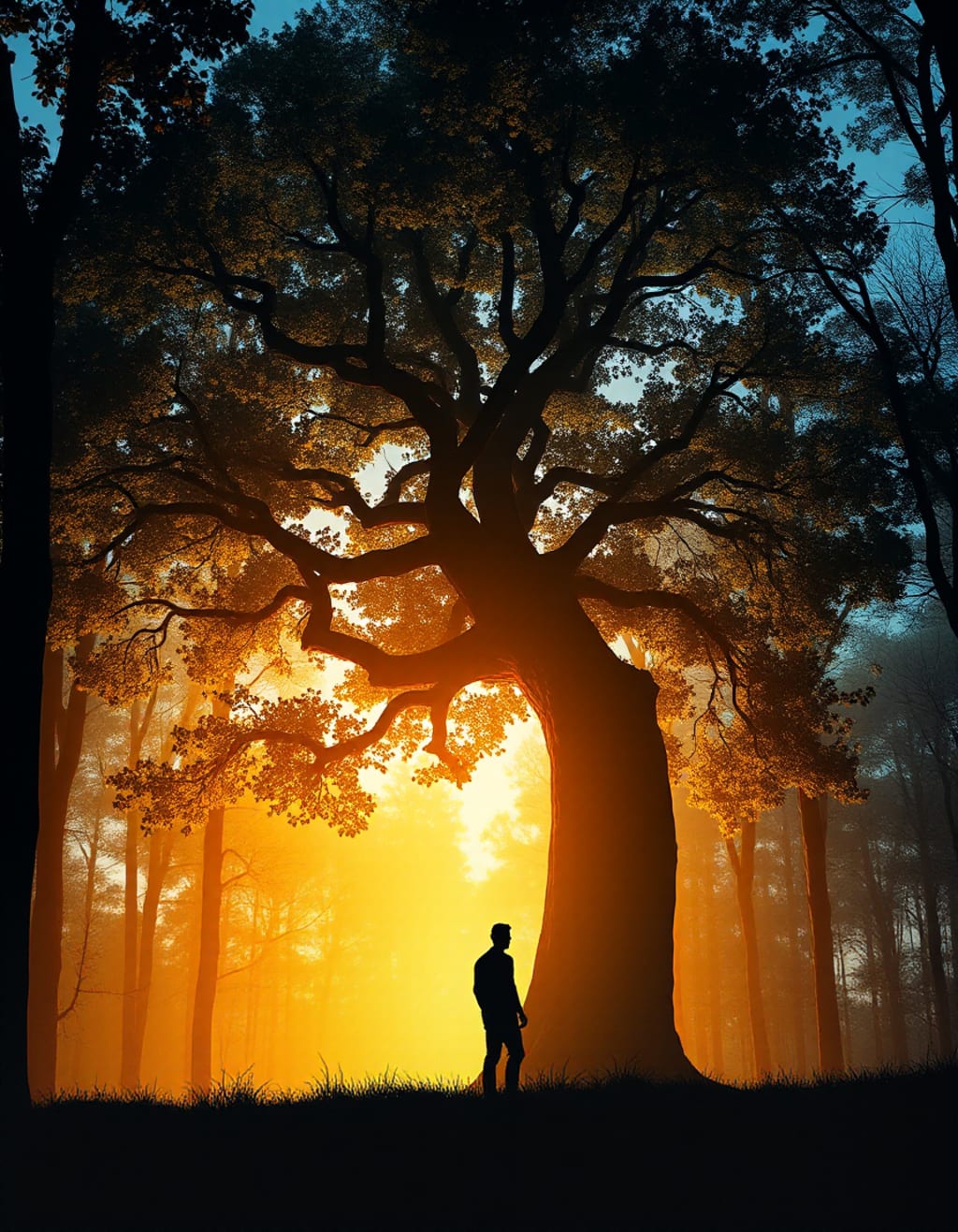
I. Return
I hadn’t set foot in the Wychwood Forest for twenty-three years.
Not since the day my parents died.
It was a place of thick moss, crooked oaks, and silence that settled deeper than snow. People said it was haunted. Not by ghosts — but by memories. Ones that didn’t belong to you until you entered.
As a child, I called it my green cathedral.
As an adult, I called it a mistake.
Yet on a late September morning, after receiving a letter from a research group called Project Mnémé, I found myself standing again at the threshold — boots pressing into the loam, heart unsure whether to flee or fall to my knees.
The trees were still there.
But something had changed.
They were waiting.
II. Project Mnémé
Named after the Greek goddess of memory, Project Mnémé was a UK-based neuroecological study.
Its mission: to prove that forests, especially old-growth ecosystems, retain environmental "memories" that can be detected, mapped, and even interpreted.
Not in the mystical sense.
In the biological one.
Lead researcher Dr. Saira Edgerton believed that trees recorded chemical signatures of human presence: pheromones, stress hormones, even fragments of spoken language embedded in bark via atmospheric proteins and microbial shifts.
The idea sounded absurd.
Until she showed me the recordings.
“We tested a tree in the southern grove,” she said.
“It emitted trace signals of oxytocin and cortisol. Nothing strange — until we discovered they matched a unique pattern. One only found in grieving humans.”
“And?” I asked.
“And we traced it back to a death that occurred twenty-three years ago,” she replied.
“A car crash. Two fatalities. A child survived.”
Her eyes didn’t blink.
“You.”
III. The Science of Memory in Wood
I dove into their data.
Microbial colonies changed shape when exposed to trauma. Mycelial threads — fungal communication lines known as the Wood Wide Web — rerouted their connections around damaged roots, almost like avoiding a wound.
DNA remnants of human breath had bonded with plant cell walls.
Even tree rings had “ghost gaps” — places where no growth occurred, not from drought, but from grief.
Wychwood wasn’t just a forest.
It was a neural landscape.
A brain made of bark.
And it had remembered me.
IV. The Path I Didn’t Choose
The research team gave me a scanner, a journal, and a choice.
I could walk the same path I took as a child — the day of the accident.
The map they provided was overlaid with thermal-memory zones — hotspots where plant stress indicators had once spiked unnaturally.
My route was clear.
But I took the wrong turn anyway.
Not out of rebellion.
Out of instinct.
And the moment I did, the birds stopped singing.
V. The Whisper
At first, I thought it was wind.
But then it repeated — a low, aching sound, stretched through the trembling branches like breath held too long.
“Aneil…”
My name.
Not shouted.
Not spoken.
Whispered.
As though the forest itself was reciting a forgotten name — one it hadn’t said since I was a boy who cried into the roots of an oak tree, begging it to bring my parents back.
I touched the bark.
Warm.
Alive.
And in its ridges, I felt something pressing back. Not physically. But emotionally.
A memory not my own.
VI. The Tree That Watched
It stood alone at the edge of a clearing.
A black poplar, older than any other tree in Wychwood.
Dr. Edgerton had marked it as Zone Alpha — the location with the highest emotional residue.
But it wasn’t residue.
It was recognition.
The tree bent ever so slightly when I approached.
Its leaves shimmered without wind.
The scanner trembled in my hand.
It registered:
Elevated amino acid shifts.
Oxytocin clusters.
Low-frequency electrostatic pulses.
The biological equivalent of a human heartbeat.
“It knows you,” said a voice behind me.
Dr. Edgerton.
“This tree absorbed the molecules from your breath. Your tears. Your parents’ final screams. It didn’t just record them. It... mourned.”
I turned to her, speechless.
“You’re the only human it’s ever truly known,” she said.
“You are its memory.”
VII. The Memory Playback
The team had developed a process called Echo Induction.
Using biochemical readers and quantum resonance imaging, they could recreate auditory hallucinations based on molecular memory sites — not exact conversations, but emotional toneprints.
We performed the induction at dusk.
A speaker was placed at the base of the poplar.
A tone began — low, vibrational, almost musical.
Then came fragments:
A woman’s laughter.
A father’s calming voice.
My own cries, shrill and small.
The crunch of metal.
The silence after.
And then —
The forest’s response.
It was like hearing wind cry for the first time.
It had felt everything.
And it had tried to hold the memory, as gently as roots cradle rain.
VIII. The Data That Shouldn’t Exist
Back at camp, I examined the results.
Deep within the chemical makeup of the soil around Zone Alpha, there were anomalies — nanoclusters of carbon bound with what looked like human peptides.
Impossible.
Trees couldn’t synthesize human molecules.
Unless…
Unless something had bonded so deeply it blurred the line between body and bark.
Dr. Edgerton called it sympathetic imprinting.
The forest hadn’t just remembered.
It had changed.
IX. The Sleep That Felt Like Speaking
That night, I slept beside the tree.
No tent. Just moss and stars.
And in my dream, I saw it — Wychwood — not as it was, but as it had once been.
Before logging. Before roads. Before humans.
And I was there too.
Not as a boy.
Not even as a man.
But as something in between.
Something remembered.
The tree reached toward me.
Its leaves curled into words.
“You were never alone.”
X. The Unpublished Chapter
The final report from Project Mnémé was redacted.
Government officials visited the site. Funding was quietly withdrawn. The scanner was confiscated.
Officially, nothing had been proven.
But before she left, Dr. Edgerton handed me a hard drive.
It contained a file named:
“Proof of Emotional Transference in Ancient Ecosystems”
Inside were notes.
Photographs.
And one video file:
A black poplar tree swaying without wind.
And a faint voice in the background, crying out the name:
“Aneil…”
XI. Legacy
I bought a cottage near the forest.
I visit the poplar often.
It no longer whispers, not audibly.
But every now and then, when I rest my head against the bark, I feel a pulse — not my own.
And I remember.
Not just my parents.
Not just the accident.
I remember being part of something older than myself.
A memory shared by trees, carried in roots, passed like prayers from leaf to leaf.
The forest didn’t just remember my name.
It kept it safe — until I was ready to return.
About the Creator
rayyan
🌟 Love stories that stir the soul? ✨
Subscribe now for exclusive tales, early access, and hidden gems delivered straight to your inbox! 💌
Join the journey—one click, endless imagination. 🚀📚 #SubscribeNow
Security Market Outlook: Advanced Surveillance Technologies and Digital Protection Growth Opportunities
According to IMARC Group's latest research publication, The global security market size was valued at USD 150.39 Billion in 2024. Looking forward, IMARC Group estimates the market to reach USD 311.08 Billion by 2033, exhibiting a CAGR of 8.34% from 2025-2033
By James Whitman3 days ago in Futurism




Comments (1)
This is fascinating stuff. The idea that trees can hold onto memories is really out there. But the evidence you presented is hard to ignore. I'm curious how this could impact forest conservation. Do you think we'll start treating old-growth forests differently now that we know they might have a kind of "memory"? And what about other ecosystems? Could this concept be applied elsewhere?