
The Dark Empire Rises
How 'Empire Strikes Back' is at the Heart of Star Wars
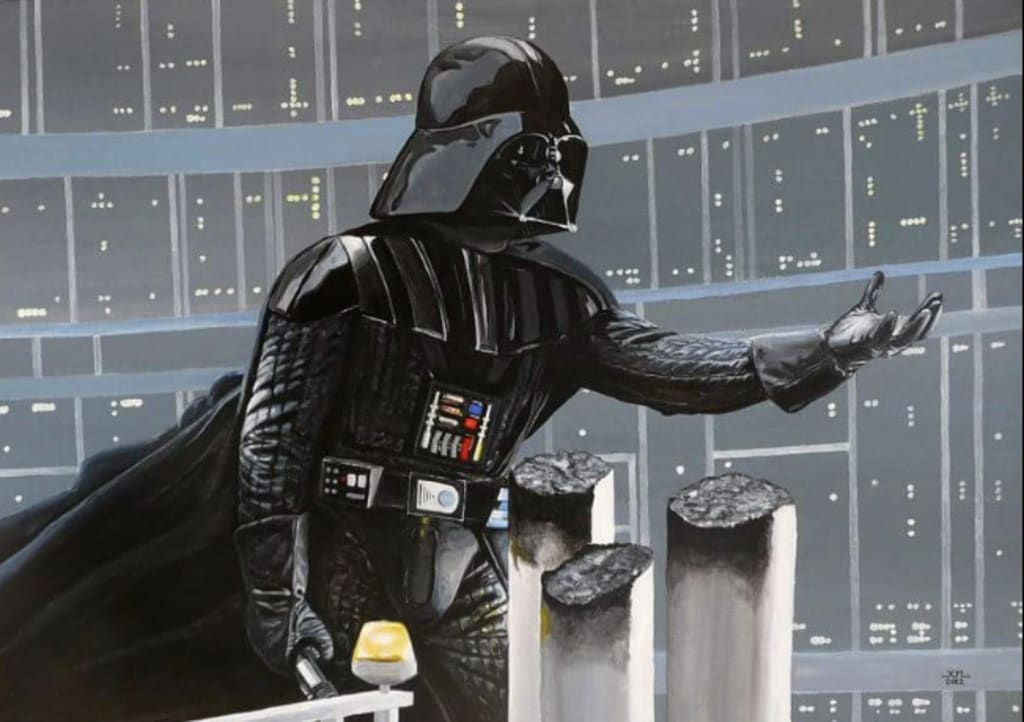
Arguably, The Empire Strikes Back is the greatest of the entire series - the litmus test against which each subsequent movie continues to be judged by die-hard Star Wars fans (and which nearly every movie installment since has in some way or other come up short.) Ask any of these die-hard fans why it's their favorite and the answers may vary, or not always make a whole lot of sense. ("George had no control over it whatsoever," "It's way darker," "Boba Fett!")
While I maintain that Empire is the high-water mark of the great space saga that has established itself as a modern mythology, I'd have to say that all those reasons are only about half-right at best - that something else lurks below the surface in the appeal of Star Wars: Episode V, as it was titled in its 1981 theatrical re-release. Although George Lucas ultimately was unhappy with the movie upon its release to the degree that he severed his long-term relationship with producer Gary Kurtz, ironically, the prequels, at least in terms of style, owe a sizable debt to Empire - Clones also had a scene that involved a chase through an asteroid belt, a mysterious, unseen villain, a subplot involving (and introducing) Boba Fett, and also like Empire, Sith had a dark ending - "literally ending in hell," as Lucas promised. Both prequels were also dark, yet watching them produces hardly the same effect or emotional satisfaction that comes from watching Empire.
So why all the recognition and reverence for Episode V? Why does it still attract the fans that so sharply denounced George and his prequels? After having watched yet again (on my 1993 LaserDisc copy of course), I believe the answer has to do more than anything with the human elements of Empire, in which the Star Wars universe transcends the bounds of light-hearted escapism, becoming essentially a modern tragedy, with the characters we've come to like in the previous film, suffering from evil and how they ultimately confront and overcome it - if only to briefly get out of harm's way. No longer are they characters, they become real. We immediately feel the plight of the rebels forced to hide in an apocalyptic ice world - from the first glimpse of Luke riding a tauntaun, we can feel the unbearable cold of Hoth, the weakness and ill-preparedness of the Alliance against a vast and calculating Empire, the betrayal of Han Solo, and throughout is the fear that Luke's own life calling may destroy him, a possibility he realizes upon learning that Darth Vader (who in this movie earns his iconic status as one of the greatest movie villains of all time) is his father.
Although it follows a genre-defining movie, like all great sequels, Empire does something different. While New Hope was set primarily in space and a heavy emphasis was placed on the spectacle of epic intergalactic battles, Director Irvin Kershner further explores the Star Wars universe - giving us two new planets - Hoth and Dagobah, environments that essentially become their own characters in the film – the icy world of Hoth echoes what seems to be the hopelessness of the rebels in their struggle and the mysterious swamp planet of fog suggesting the dark unknown that Luke must enter in order to complete his training, to realize his worst fears and overcome his uncertainty. In short, the movie shows his transformation from a young novice soldier to becoming the last of the Jedi knights, choosing to rescue his friends at his own peril. Twice in the series we saw him saved by Han Solo at the last possible minute, now he has grown “to take on the whole Empire himself” by confronting Vader alone, having overcome his fears. Doing so, however, is far from an easy decision, as he must disobey the warnings of his new master, veering off the path he was destined for, and the first step that leads to the dark side.
As this movie continues to impart more great Jedi wisdom and furthering many of its great principles, “size matters not,” Vader and the Empire also evolve into entities more ominous than in the previous film. While Vader had an ominous presence throughout New Hope, he was largely an archetype villain who commanded little respect with the imperial officers who mocked his belief in the ancient Jedi religion. Instead, we now see a being driven by obsession as he relentlessly pursues the Falcon across the galaxy, determined not only to capture Luke but also his friends, making a deal that for Lando, gets worse by the minute.
Throughout the previous film, the fear of Vader was largely due to his intimidating appearance, and the fear of what he might do if driven to anger – here we see him strangle two imperial officers without a second thought and nearly kill his own son at the film's climactic scene, chopping off his hand and hurling him from the cloud city while demonstrating the awesome power the dark side of the force has given him, and officially proving that the power of last film's Death Star is insignificant compared with that of the force. At the same time, he makes promises power and the rule of the galaxy, although following the orders of a much more vast and sinister empire, a large and ever expansive machine that seeks to wipe out liberty wherever it exists. How appropriate it is that at the helm of this large imperial machine is a deformed, isolated man kept alive and breathing by the same machine that conceals his face, taking orders from a holographic figure – a faceless and bureaucratic system that stifles individual thought. Almost the polar opposite of when Luke turns off his computer at the end of the last film to trust his feelings.
Indeed, the Empire, as we first meet its ruler Palpatine, a remote and cruel overlord, is at its most evil in this film – as we see it on the attack, wantonly crushing the rebels who stand in its way with tanks and usurping Cloud City after the betrayal of Leia and Han Solo. The taking of Bespin is also significant in the arc of Lando Calrissian – caught in a moral dilemma that involves betraying either his best friend Han (who has ultimately decided to fight for the rebellion instead of settling the price currently on his head), or betraying his city to the Empire, a hard decision he reluctantly makes and gradually regrets, driving him to take up the cause of the Rebel Alliance. The film concludes with little being achieved by either the protagonists or the rebellion itself. They barely escape as stormtroopers seize Cloud City and Boba Fett sets off to collect his bounty. Evil and suffering exist as a medium through which good and heroic deeds can be accomplished, and without which, they have no meaning. The greater the challenges are, the stronger the characters must become in order to prevail. For the heroes of the saga, Empire is that defining challenge.
About the Creator
Keep reading
More stories from writers in Futurism and other communities.
About Binding Prometheus
I want to start actively advocating on behalf of my own work, and the most valuable part of my canon is, without a doubt, Binding Prometheus, the play I have been working on since 2019 and only finished in 2023 as part of my MA. The play itself is an amalgamation of a million different inspirations. On one end, it evokes the Ancient Greek myth-play, deriving its own title from the earliest extant work of Western drama we have, Aeschylus’s Prometheus Bound. On the other end, it borrows significantly from the sci-fi bulwarks from over the years, namely Mary Shelley’s Frankenstein and Karel Capek’s Rossum’s Universal Robots. The play could be an episode of Black Mirror, I fear. I don’t know. I’ve only ever seen one episode of Black Mirror.
By Steven Christopher McKnightabout a month ago in Futurism
UAE Building Materials Market Outlook: Industry Trends, Key Players & Forecast
According to IMARC Group's latest research publication, the UAE building materials market size reached USD 6.75 Billion in 2024. The market is projected to reach USD 11.44 Billion by 2033, exhibiting a growth rate of 5% during 2025-2033.
By Abhay Rajput5 days ago in Futurism




Comments
There are no comments for this story
Be the first to respond and start the conversation.