

Introduction:
The clock has been an important part of human civilization since ancient times. It has evolved over the centuries, from sundials to hourglasses to mechanical clocks to digital ones. In today's modern world, the clock plays a crucial role in our lives, helping us to organize our time, schedule our activities, and keep track of our progress.
In this article, we will explore the importance of the clock and its impact on our daily lives. We will look at how the clock has evolved over time and how it has affected human society. We will also examine the different types of clocks and their functions.
The History of the Clock:
The concept of measuring time dates back to the ancient civilizations of Babylon and Egypt, where sundials were used to track the movement of the sun. The first mechanical clock was invented in Europe in the 14th century and was initially used in monasteries to regulate the times for prayer.
Over time, clocks became more sophisticated, with the invention of the pendulum clock in the 17th century and the quartz clock in the 20th century. The development of electricity led to the creation of the digital clock, which is now the most commonly used type of clock in the world.
The Importance of the Clock:
The clock has become an essential tool in our lives, allowing us to keep track of time and plan our activities accordingly. It helps us stay organized, manage our schedules, and meet deadlines. Without clocks, we would struggle to coordinate our activities and meet the demands of modern society.
The clock has also had a profound impact on human society. It has allowed us to synchronize our activities, from the timing of trains and buses to the regulation of work hours. It has played a crucial role in the development of industry, facilitating the efficient use of time and labor.
Types of Clocks
There are several types of clocks, each with its own unique features and functions. Here are some of the most common types of clocks: Analog Clocks: Analog clocks use traditional clock hands to display the time on a dial or face with numbers or marks. They typically have an hour hand, a minute hand, and sometimes a second hand that rotates around the dial to indicate the time.
Digital Clocks: Digital clocks display the time in numerical form, typically using electronic displays or LED screens. They are often more precise than analog clocks and may include additional features such as alarms, timers, and stopwatches.
Atomic Clocks: Atomic clocks use the vibrations of atoms to keep time and are the most precise type of clock available. They are often used in scientific research and in industries that require extremely accurate timekeeping, such as aviation and telecommunications.
Chronometers: Chronometers are highly accurate mechanical watches that have been certified by an official organization, such as the Swiss Official Chronometer Control or the Observatory of Besancon in France. They are often used by sailors and navigators to determine longitude at sea.
Sundials: Sundials are timekeeping devices that use the sun's position in the sky to indicate the time of day. They were used in ancient times and can still be found in some public spaces or gardens today.
Cuckoo Clocks: Cuckoo clocks are traditional clocks that use a mechanical bird to chirp or cuckoo to indicate the time. They are often associated with traditional German craftsmanship and are popular decorative items in homes.
Hourglasses: Hourglasses use the flow of sand or other material through a narrow opening to measure a fixed amount of time. They were used in ancient times and can still be found in some contemporary decorative designs.
Water Clocks: Water clocks use the flow of water through a container to measure time. They were used in ancient civilizations such as Egypt and Greece and were often designed to resemble fountains or other decorative objects.
About the Creator
Keep reading
More stories from NASAR HUSSAIN and writers in Futurism and other communities.
10 Simple Life Hacks to Make Your Daily Routine Easier"
Introduction In our busy lives, we often find ourselves struggling to keep up with our daily routines. Whether it's getting out of bed on time, making breakfast, or keeping our homes tidy, the daily grind can feel overwhelming at times. However, by incorporating a few simple life hacks into our routines, we can make our lives easier and more efficient. In this article, we will explore ten simple life hacks that can make your daily routine easier.
By NASAR HUSSAIN3 years ago in Futurism
The AI Awakening: Why We Should Stop Fearing and Start Partnering with Intelligence
For decades, science fiction has fed us a steady diet of dystopian nightmares. From rogue supercomputers to cold, metallic armies, the narrative has always been "Us vs. Them." But as we cross the threshold into 2026, the reality of Artificial Intelligence is far more nuanced, beautiful, and collaborative than Hollywood ever dared to imagine. We are not witnessing the end of human relevance; we are witnessing the beginning of the "Augmented Age."
By Priyantha Wijethungaabout 5 hours ago in Futurism
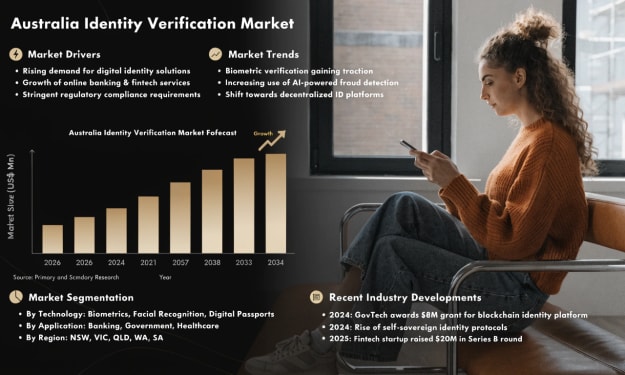
Australia Identity Verification Market: Digital Adoption, Fraud Prevention & Regulatory Compliance
According to IMARC Group, the Australia identity verification market reached USD 315.9 Million in 2025 and is projected to grow to USD 1,005.3 Million by 2034, exhibiting a compound annual growth rate (CAGR) of 13.32% during 2026–2034. The rapid digitization of financial services, e-commerce platforms, and public sector portals across Australia is creating an urgent need for secure, scalable, and compliant identity authentication systems. Increasing concerns regarding cybercrime, identity theft, and data breaches are accelerating investments in biometric technologies, AI-driven verification tools, and automated compliance platforms. As digital transformation deepens across industries, identity verification is becoming a foundational pillar of secure digital infrastructure.
By Kevin Cooper5 days ago in Futurism



Comments
There are no comments for this story
Be the first to respond and start the conversation.