
The Child at the Edge of Time
A child, a diner, and a connection across time

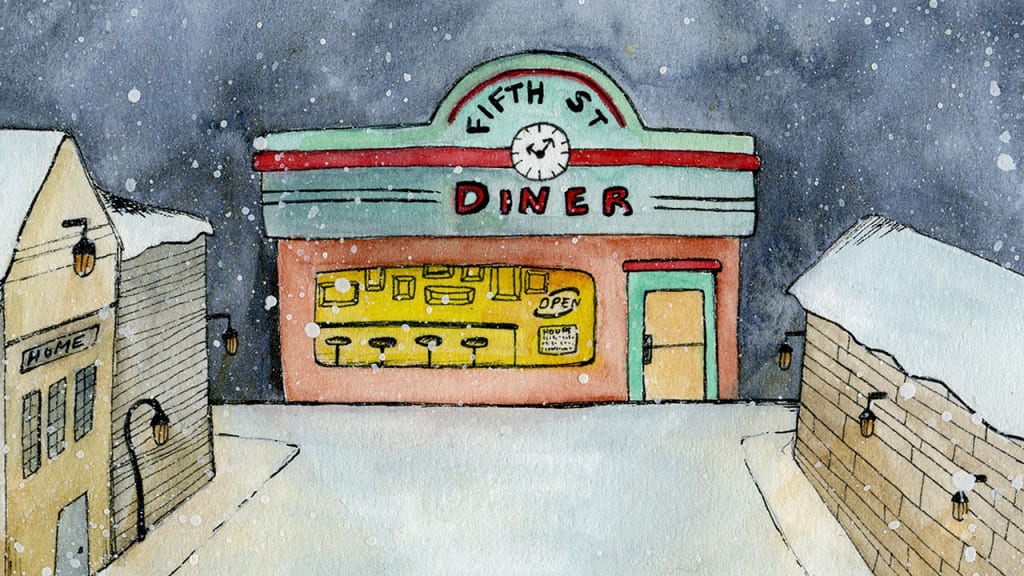
The child stepped out of time and into the frosted embrace of a dark winter’s night. She shivered as the excess heat of travel wore off; it was late evening, and an invigorating crispness hung on the air. Bundling her cloak about her, she started from the clearing, her boots leaving impressions in the freshly fallen snow.
She had emerged in the forested park just beyond the town centre—its old gazebo, imposing trees, and quaint street lamps, which loomed over the paths and bathed them in a hazy amber glow, the same as ever. Finding the path to the diner was, as always, not too difficult. She hadn’t passed this way for many years, but nevertheless her feet guided her without hesitation. The child crunched through frosted leaves until she found the smooth dirt path that led out of the park and onto the main street.
When she drew closer to town, the child marked all the changes—a new playground, different storefronts—and also all the familiar features. Most importantly, at the far end of the main street her beloved diner still stood, a bright beacon of warmth and comfort. She quickened her pace, knowing she wouldn’t have long before it closed for the night.
She stopped just shy of the entrance and peered through the glass. Her stomach rumbled at the sight of the pastries in the displays. Travelling for so long and far had depleted her and left her ravenous. There was a man inside, wiping down booths and mopping the floor; a slow, deep jazz melody oozed out of the diner. This scene calmed her, but it had to contend with an immense and pervasive weariness that momentarily immobilized her. Pausing for a moment on the stoop, the child swayed almost imperceptibly to the music, letting the cold seep into her bones and flush her cheeks.
She knew she could still leave—though there wasn’t time for much, there was enough for another escape. Any delay, though, and it wouldn’t be long until they found her. But this time, unlike previous visits, the child cast aside failsafes and contingencies, and entered.
Neil had cultivated his tireless work ethic and diligence from his father, who, in turn, had inherited the same from his father. Three generations had run the diner on Fifth Street—a true local staple for residents and travellers alike, even if the crowds didn’t come in as often as they used to.
This was Neil’s favourite time of the night: With no customers and no orders, he threw on some music and settled into the nightly cleaning routine, tapping his feet along to Miles Davis, Chet Baker, and Ella Fitzgerald. He wiped down the counters and displays, sprayed the booths, and cleaned the menus, and was about to mop the floor when a sudden chill jolted him from his jazz-soaked reverie.
Neil glanced across the diner and noted that a young girl now occupied the booth closest to the door. The girl had dark, frizzy hair that fell languidly upon the collar of the deep blue cloak she wore. She was shivering slightly. Her eyes passed over various parts of the diner, a thin smile playing at the corners of her mouth.
A brief and frustratingly vague flash of recognition illuminated his mind. Neil was certain that he had met everyone in this lonely town by now, and few people, if any, moved here permanently; yet, for a fleeting moment, he was also certain he knew this girl. He caught her eyes and wandered over.
“Warm enough, miss?” he asked. She nodded.
“Can I get you anything? Hot chocolate? Tea?”.
“Coffee.”
Neil raised an eyebrow at the girl, who couldn’t have been older than ten or eleven. She clarified: “Not decaf. Please.” Then she added, “And a slice of cherry pie.”
“Coming right up,” he said with a casual shrug.
He poured himself a coffee, too, and brought it over with the girl’s order. “Mind if I join you?” he asked. “Need a few moments off my feet.”
The girl shrugged. “It’s all right with me.”
Grabbing some sugar packets and the cream from the serving tray, Neil noticed the girl staring at him disapprovingly.
“You shouldn’t put that stuff in there,” she said, “Better to drink it black.”
“Offering me life advice already? We’ve only just met.”
The girl eyed him curiously, then looked down at her cup. “Actually, we’ve met a few times over the years. Whenever I have a chance to stop by this pocket.”
Neil laughed. “Over the years? This pocket?”
The girl’s eyes twinkled, as she sat back in the booth, took a big gulp of coffee, and let out a satisfied sigh. “A temporal pocket, to be exact.”
Having interacted with hundreds and hundreds of customers, listening politely when they offered any kind of commentary on the world or believed they had an amusing story to tell, Neil knew how to recognize when conversations took a strange turn.
He laughed again, nervously. “Better get back up on these feet. The diner won’t clean itself,” he said with a wry smile. Neil collected his empty cup and swung the rag he carried with him back over a shoulder, then moved behind the counter. The girl’s gaze on his back unnerved him. Not wanting to cause a customer to feel put out, especially one so young and precocious, Neil decided to humour her a little longer. “So, are your parents travelling with you to this—uh—pocket?”
He turned back to find that the girl was no longer sitting in the booth. She had wandered over to the back wall of the diner and was inspecting the gallery of framed photos. She stood up on her tippy toes and reached out a finger to delicately trace the outline of a photo: a black-and-white shot from the ‘50s, when the diner looked much like it did today, except newer, shinier, and bustling. Customers crowded the counter and crammed into the booths lining the big windows, and outside groups of people milled about on the sidewalk, smoking and leaning against old cars.
Neil strode over to the girl and stood beside her. “Those were the days,” he said, and then pointed out a gallant man with thick glasses and a pencil tucked behind an ear. “That’s my old man there, running the place.”
The girl nodded slowly, almost appraisingly, and said with a wistful air, “Those were the days.”
He pointed again to the photo, this time to an area behind the counter where a narrow window peered in on the kitchen. “And that’s—"
“Alan,” she interrupted. Her gaze was fixed on the old photo, a finger lingering gently on Neil’s grandfather.
Neil wasn’t sure how to respond, how to even begin to comprehend this girl’s charade. Maybe she had nowhere to go, and Neil was loath to kick her out, but the clock was ticking towards closing time and he suddenly felt exhausted.
Taking up position once again behind the counter, Neil polished some glasses. The girl returned and occupied one of the counter stools. The maturity of a few minutes ago vanished, replaced by a more playful, childish display of wonderment as she swivelled back and forth on the stool.
“It’s just as I remember,” she said. “After all these years, it hasn’t changed a bit. They would be proud.”
Neil froze. “If this is some kind of prank—”
The girl met his gaze. “No prank, I promise.” She propped her elbows up on the counter. “I’ve visited this pocket dozens and dozens of times. It’s my favourite across all timestrands.”
There she goes talking about time again, thought Neil. “Temporal pockets? Timestrands?” he asked.
The girl reached into her cloak and pulled out a battered notebook. It was black, compact, and unassuming. She opened it, flipped to a random page, and turned it to show Neil.
“This is how I keep track of where I am—in time, that is,” she said.
She held the notebook out towards him. Neil grabbed it, both curious and nervous to see what the pages held, but what he saw only puzzled him further: There were various symbols and some kind of written code—all completely unintelligible to him, though it seemed deceptively simple—as well as lots of arrows and curved lines looping and branching off of a series of straight lines running horizontally across the page. Neil flipped through the notebook’s contents; each page contained more of the same.
“You keep track of your—uh—time travels in this?” Neil asked, holding up the notebook with one hand. “Seems a little—”
“Rudimentary?” the girl said. “I’m old-fashioned. Feels good to get it out of the mind and down on paper.”
A few moments passed in contemplative silence, then the girl reached into her cloak again and gently laid a thick yellow envelope on the counter. She looked up at Neil. The exuberant and energetic child had disappeared, and now the girl seemed weary and forlorn—as if she hadn’t slept in ages. There were lines and creases on her face that Neil would’ve sworn hadn’t been there before.
Neil gestured towards the bulky envelope. “What’s this?”
“A gift.”
“From whom?”
“From me. I stole it for you.”
The girl slid the envelope across the counter towards Neil, who grabbed it, peered inside, and then put it back down. He levelled his gaze at the girl. “Where did you get this?” She needed to tell him how she ended up in a lowly diner in a middle-of-nowhere town with this kind of money—about $20,000, Neil guessed, judging by the bundles—or else he’d be sending her on her way out in the cold, child or not.
“I told you,” said the girl. “I stole it. From some people who don’t need it and won’t miss it.”
Like hell, thought Neil. “Is this some kind of time travel thing?”
“No—well, yes. I don’t really have the time to explain.”
“Seems to me that you have all the time in the world, seeing as how you can travel through time,” Neil said, increasingly exasperated.
The girl stiffened. “Not this time,” she said.
Neil couldn’t take any more mysteries. “Look, is someone after you? I can call your parents or the police and maybe we can get this all sorted out…” he said, starting towards the phone.
The girl tugged at his arm and shook her head. “Please.”
She had been on the run for a long time, too long to recall what real rest or stability felt like; keep moving or face the consequences were her only options. She observed the sum of the man before her, comprised of many parts and qualities that reminded her of his father and grandfather, both of whom she had loved fiercely, as any fatherless daughter would have—even as time and her pursuers threatened to rip them apart—men who, when she needed it most, offered her shelter, clothes, and a hot cup of coffee with a slice of pie.
“Consider it a debt repaid. For the diner.”
Neil stared at the girl in utter disbelief. He put the phone down. He wanted to help this girl however he could, yet he also longed for her to leave, for this strange night to be over.
Sensing his awkwardness, the girl gathered her battered notebook and eased off the stool. “I should go,” she said. She headed for the door, paused, turned back to Neil, and gestured to the envelope on the counter. “No one will come for it. You won’t get into any kind of trouble. It’s yours.”
The girl scanned the diner, soaking in its homely details one final time. She’d miss this place. “For the diner,” she repeated, barely a whisper, and with that, pushed the door open and ventured into the snowy night.
About the Creator
Keep reading
More stories from writers in Futurism and other communities.
About Binding Prometheus
I want to start actively advocating on behalf of my own work, and the most valuable part of my canon is, without a doubt, Binding Prometheus, the play I have been working on since 2019 and only finished in 2023 as part of my MA. The play itself is an amalgamation of a million different inspirations. On one end, it evokes the Ancient Greek myth-play, deriving its own title from the earliest extant work of Western drama we have, Aeschylus’s Prometheus Bound. On the other end, it borrows significantly from the sci-fi bulwarks from over the years, namely Mary Shelley’s Frankenstein and Karel Capek’s Rossum’s Universal Robots. The play could be an episode of Black Mirror, I fear. I don’t know. I’ve only ever seen one episode of Black Mirror.
By Steven Christopher McKnight29 days ago in Futurism
🅼🅸🅳🅽🅸🅶🅷🆃 🆂🅽🅰🅲🅺🆂
"It's 10 in Tuscon! We all know what that means... It's Time for Midnight Snacks with your man, Gerald Gee! Ready to spend the night together? Me too! I'm full of snacks and can't wait to regurgitate them all back into your hungry ears. Crack a brew! Pop some corn! Anything to get ready for one hell of a show where the talk maybe cheap but the words cut deep...
By Lamar Wiggins7 days ago in Fiction




Comments
There are no comments for this story
Be the first to respond and start the conversation.