

I was nine years old when I first saw him. I was standing on a makeshift stage in my school’s gym. Before me was a sea of distracted parents, tired teachers, and bored classmates fidgeting in their seats and quietly chattering amongst themselves. Behind me was a hand painted banner that read, “Winfield Elementary’s 1987 Talent Show”.
With knots in my stomach, I pulled out a poem I’d slaved over for days. In a small, trembling voice, I started to recite it. After the first few lines, I peeked at the audience from under my bangs to gauge their interest. That’s when I saw him.
There he sat in the third row, watching me keenly with pride and a hint of wonder and sadness in his eyes. He looked about the same age as my grandfather. He had light olive skin, short salt and pepper hair, and a remarkably kind face. His most notable feature was a small birthmark above his right eyebrow, with an abstract shape that resembled a butterfly.
When I finished reciting my poem, he clapped louder than anyone else in the room. After the talent show, I peered around the room hoping to find him, but he had disappeared as quickly as he had appeared.
In the years after that, I would see him every now and then. Once, I caught a glimpse of him walking by in a local park. Another time, I spotted him sitting alone at a restaurant as we celebrated my grandmother’s 75th birthday. Right after I got my first job at the mall, he came into my store, warmly smiled at me, lazily browsed the store, and then strolled out without buying anything.
The most curious sighting, though, was near my family’s summer home a few hours away. It was right after I graduated high school. On a quest to satisfy my craving for mint chocolate chip ice cream — my most favorite flavor of all time — I visited the little ice cream shop around the corner. As I hastily entered the shop, I bumped into him and knocked his bowl of mint chocolate chip ice cream out of his hand.
“I’m so sorry,” I squeaked. “I’ll buy you another one.”
He looked up at me and all the color drained from his face. After a moment of stunned silence, he opened his mouth to say something, but nothing came out. Before I could insist on replacing his spilt ice cream, he slipped out of the door and out of sight.
His presence never frightened me. The small glimpses of him throughout the years oddly comforted me. He was always a familiar, friendly face in a cursory and preoccupied world. The butterfly-shaped birthmark above his right eyebrow made him instantly recognizable. But what really held my attention, though, was his disposition. It never matched anybody else’s around him.
When everyone else hastened, he sauntered about. When everyone else smiled politely, he beamed. When everyone else glanced, he gazed. He seemed to spend his days leisurely soaking in his surroundings, free of any obligations or worries. He had on a wedding ring, but I never saw him interact with anybody.
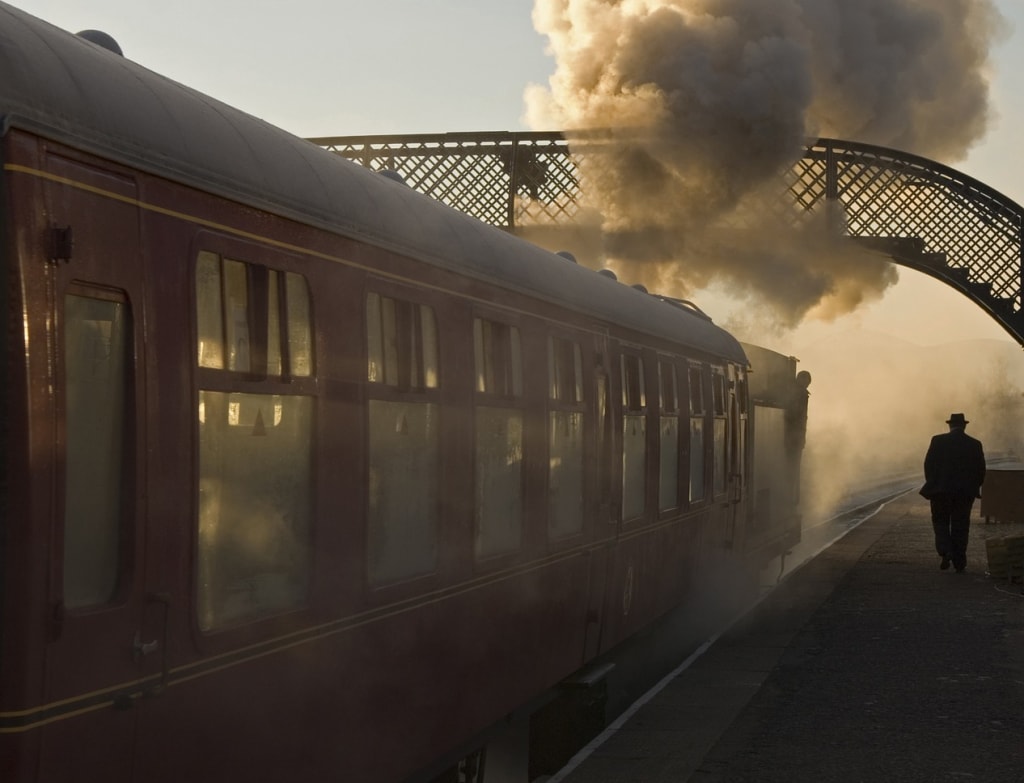
One balmy summer day when I was 21 years old, I woke up at the crack of dawn and boarded the train downtown with my SLR camera in tow. The only thing on my agenda was to take abstract photos around the city. My train car was empty, aside from a couple of teenagers at the other end.
I was sleepily gazing out of the window when the train arrived at the next stop. A passenger came in and then sat directly in front of me. It was him.
In my half-asleep stupor, I stared at him. Something was off about him, but I couldn’t quite put my finger on it. He sat straighter than usual. His warm and easy smile was gone. Clutched in his hands was a fancy black notebook. For a brief moment, a hint of wonder and sadness flashed across his face. And then he finally said something. “I, uh, I have that camera. The same one.”
I looked down at the SLR camera in my lap.
“My son uses it a lot,” he continued. “It’s one of our treasured possessions.”
“You have a son?” I hoped he didn’t notice my surprised tone.
He let out a chuckle — almost a relieved one. His usual warm smile crept across his face, and he relaxed his posture. “Yes, and a granddaughter. She’s 4 years old, and her hair color —“ his voice trailed off. I stared at him, waiting for him to finish his sentence. He shook his head. “Never mind.”
An awkward silence ensued, so I asked the first question I could think of. “What were you doing at that ice cream shop?”
To my surprise, he knew what I was talking about. He paused for a moment, rubbed his neck uncomfortably, and then told me that he grew up vacationing in that town, where he frequented the ice cream shop. To affirm his story, he shared a few childhood memories in that little nautical town, and then I excitedly shared mine. Before I knew it, I was in a full blown conversation with him.
As the train chugged on, he regaled me about his wife, son, and granddaughter. I shared my dream of owning an art gallery one day. He explained his quantum engineering career in layman’s terms, and doubled over in laughter when I stared at him blankly with no comprehension. I quizzed him on pop culture, and doubled over in laughter when he didn’t get a single answer right. He told me that he was turning 57 in a couple of months. He let me take a picture of his smiling, kind face with my camera.
As a random moment rolled around while I was reveling in his company — I found him quite fun and easy to talk to — it finally hit me. There was something off about him. I jolted up and squinted at him. He hadn’t aged a bit. He looked exactly the same all those years. Not one extra wrinkle or strand of gray hair. He now looked closer to my father’s age than my grandfather’s age.
He immediately noticed my uneasiness. His smile disappeared, and a mixture of defeat and dread washed over his face. He looked down at his black notebook, and then clutched it harder. “I can explain.”
“You haven’t aged,” I said haltingly.
“I can explain,” he repeated. “But first, do you feel safe?”
I didn’t quite feel safe, but I nodded out of intrigue.
“I’ll get off at the next stop if you don't feel safe.”
I nodded again.
He took a deep breath. “You’re an important part of my life.” He hesitated. “But you haven’t met me yet.”
I stared at him bemusedly.
“Right now, where you are in your life, you haven’t met me yet.”
It started to click in my head, but it still seemed too ridiculous. “Someone has been watching too much Back to the Future,” I chuckled.
He didn’t crack a smile. “Please believe me.” he whispered. “I can’t tell you who I am, or when you will meet me. But you were very, very important to me. I had wanted to see you again for a long time.”
“So you’re a time traveler?” I felt silly saying those words, but I pressed on because he had piqued my curiosity. “Aren’t you messing up the future by talking to me right now?”
“Time travel doesn’t work the way you think.” He looked down at the black notebook in his hands and then handed it to me. “This is for you.”
I opened the book and a lottery ticket almost fell out.
“I want to prove that all this is true. You’ll win $20,000 tomorrow night. Use that money however you like. And these,” he gestured to the first page, which had a list of future dates, “will be some of the most important dates in your life. Some are good, and some are bad.”
I flipped through the pages. Throughout the notebook were encouraging quotes, kind notes about my qualities and character, and a child’s doodles.
“My granddaughter helped me put this together,” he chuckled. “I wrote all these things. If you’re feeling down, I hope my words will help you through whatever you’re going through.”
Stunned and a little skeptical, I could only muster up a half-hearted “thank you”. In that moment, the train pulled into the Union Station. It was the last stop.
A few minutes later, we were standing outside. He smiled at me. “I need to go.”
“This will be the most memorable train ride of my life. Till we meet again!” I half joked.
He hugged me, and didn’t let go for a long time. When he finally pulled back, his eyes were full of tears. “It was really, really great to see you again,” his voice cracked. He reluctantly turned around and then disappeared into the city.
In the years that came, I looked for him. When I won the lottery the following night and used the money to travel around Europe, I looked for him. When I went to college, I looked for him. When I fell in love and got married, I looked for him. When I started a new job, I looked for him.
I read the black notebook from cover to cover often. Like he’d hoped, his words of wisdom helped me through many difficult times. He always seemed to know the right things to write. For years, I anxiously anticipated meeting him again.
Like he said, the dates he had written down in the notebook were important. September 11, 2001. The date I graduated college. The date of my grandmother’s death. The date I met my husband. The date we elected our first Black president. My wedding date. The date I gave birth to my child.
When I saw my baby’s face for the first time, my eyes welled up with tears. Staring back at me was a beautiful baby boy with a butterfly birthmark above his right eyebrow.
Owen was the love of my life. He adored cars, trains, and animals. He often sang until his throat burned, danced until his legs collapsed, and laughed until he cried. He hugged and comforted any upset person he saw. He sauntered about, beamed, and gazed.
When the last date in the notebook rolled around, I was diagnosed with stage 4 cancer. Owen helped me through the battle, both with his sweet, silly, and innocent presence and the wise and reassuring words he would write in the black notebook decades later.
Right after Owen turned six, I lost my battle with cancer. In the weeks before I took my last breath, I wrapped the black book and left explicit instructions to give it to Owen on his 57th birthday.
On the last page, along with the photo I took of Owen on the train with my SLR camera, I wrote a poem:
In the brief overlap of our times on earth,
You were a bright little boy who brought so much joy.
I’ve loved you with all my heart since your birth.
I would have wondered who you would be today
If you hadn’t visited me that one day.
You gave me the greatest gift one could ever receive.
My time came too soon as I still had much to achieve,
But I can rest easy knowing what a remarkable man you’ve turned into.
I’m proud of you.
About the Creator
Chiara
When I write, everything feels all right.
Keep reading
More stories from writers in Futurism and other communities.
About Binding Prometheus
I want to start actively advocating on behalf of my own work, and the most valuable part of my canon is, without a doubt, Binding Prometheus, the play I have been working on since 2019 and only finished in 2023 as part of my MA. The play itself is an amalgamation of a million different inspirations. On one end, it evokes the Ancient Greek myth-play, deriving its own title from the earliest extant work of Western drama we have, Aeschylus’s Prometheus Bound. On the other end, it borrows significantly from the sci-fi bulwarks from over the years, namely Mary Shelley’s Frankenstein and Karel Capek’s Rossum’s Universal Robots. The play could be an episode of Black Mirror, I fear. I don’t know. I’ve only ever seen one episode of Black Mirror.
By Steven Christopher McKnight29 days ago in Futurism
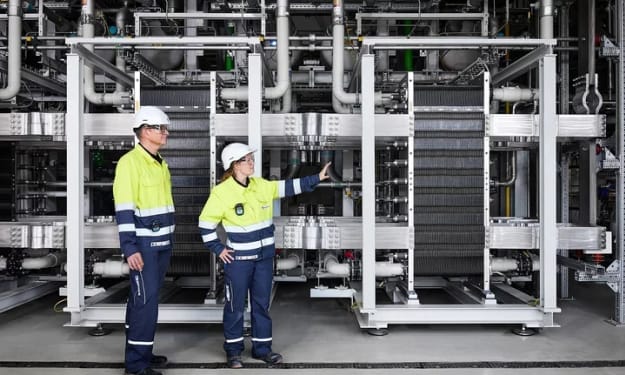
Electrolyzer Market: Net-Zero Targets, Hydrogen Economy & Growth Outlook
Rising focus on clean energy transition, decarbonization goals, and green hydrogen adoption is driving growth in the electrolyzer market. Government incentives, renewable energy integration, and falling renewable power costs support large-scale deployment. According to IMARC Group's latest research publication, The global electrolyzer market size reached USD 544.8 Million in 2024. Looking forward, IMARC Group expects the market to reach USD 1,067.5 Million by 2033, exhibiting a growth rate (CAGR) of 7.14% during 2025-2033.
By James Whitman7 days ago in Futurism



Comments
There are no comments for this story
Be the first to respond and start the conversation.