
The Bone That Grew Wi-Fi
In a quiet British lab, a team of scientists engineered the impossible—living bone that could transmit data. But what it remembered changed everything.

I. Genesis of a Dream
The city of Cambridge had always been a beacon of innovation and intellect, with centuries of history cradling some of the world’s greatest scientific achievements. But inside a small, nondescript laboratory tucked away behind the grandeur of the University’s ancient stone walls, something extraordinary was unfolding.
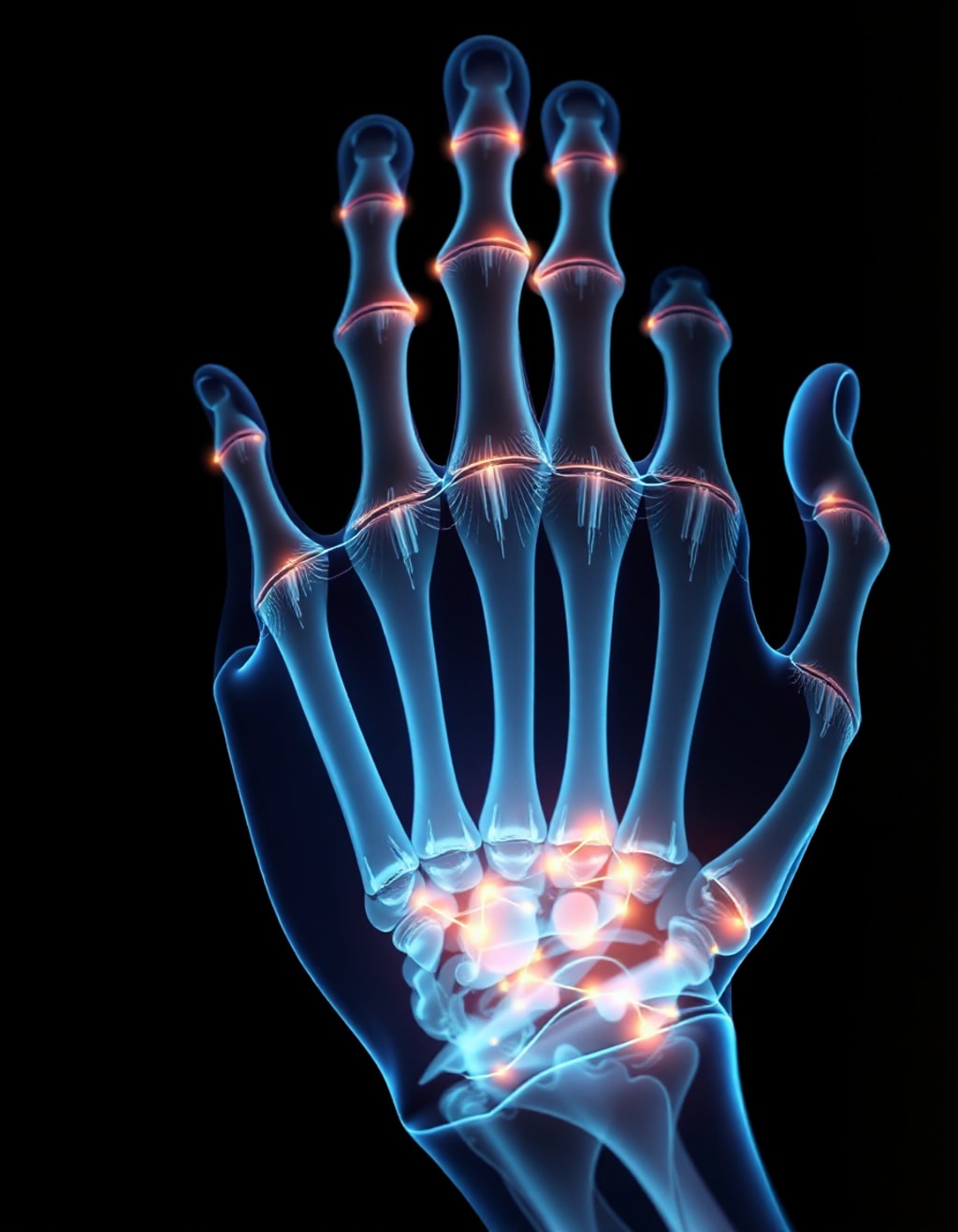
Dr. Amina Shah sat hunched over her microscope, the soft glow of fluorescent lights reflecting off her glasses. She and her team had been working tirelessly for months on a project that, if successful, would shatter the boundaries between biology and technology. Their goal: to create living bone tissue capable of wireless data transmission.
It was a concept born out of necessity and vision. In a world overwhelmed by gadgets and digital noise, Amina imagined a future where technology was not something we wore or held, but something that became part of us — organic, seamless, and alive.
They called it OsteoNet.
II. The First Spark
The journey to OsteoNet’s breakthrough was filled with frustration and dead ends. They experimented with various materials, embedding tiny electronic circuits into cultured cells that formed bone. At times, the idea seemed ludicrous—a fusion of science fiction and biology—but the team pushed on.
Then came the day when the lab was eerily quiet, everyone gathered around the main console. The sensors began to light up, detecting radio-frequency signals emanating from the bone sample on the petri dish.
The bone was alive — and it was broadcasting.
Embedded nanoscale graphene circuits within the osteoblasts were successfully conducting wireless data. The bone not only grew and regenerated like natural bone but could transmit and receive information.
Their initial tests involved encoding simple messages. They sent the words "Hello" through the bone and received the transmission without loss or distortion.
It was the dawn of a new era.
III. Ethical Dilemmas and the Human Question
Success brought excitement — but also unease.
What did it mean for the future of humanity if our bodies could become data hubs? Was this progress or peril?
At weekly meetings, the team debated heatedly. Could these bones be hacked? Could privacy be violated if our skeletons stored data? And if the bones could “remember,” what memories might they hold?
Amina was particularly troubled. She often found herself staring into the microscope long after the others had left, questioning the implications of their work. Was the essence of human experience something that could be encoded into living tissue? Would it change what it meant to be human?
IV. Peter’s Implant
The project moved from the lab bench to clinical trials when Peter Walker, a retired schoolteacher, volunteered to receive the OsteoNet implant.
Peter had suffered a serious fracture years earlier, and the experimental bone implant promised to accelerate healing and monitor recovery through constant wireless feedback.
The surgery was successful, and at first, everything seemed normal. But within weeks, Peter began reporting strange experiences.
He described vivid flashes of memories — scenes of places he’d never visited, conversations he’d never had.
At first, doctors suspected hallucinations or side effects. But Peter was lucid and consistent.
V. The Archive Within
Intrigued, Amina reviewed the data from Peter’s implant. The bone wasn’t just transmitting health metrics; it appeared to be recording snippets of ambient data — ambient sounds, electromagnetic signals, even fragments of neural patterns from people nearby.
The bone was absorbing information like a living archive.
Peter’s memories were not his own, but imprints from others — echoes from the environment, stored in his bones.
In one vision, he walked through a 19th-century market square. In another, he heard a woman’s whispered secret in a foreign language. These were not hallucinations but data transmitted and stored by his implant.
VI. The Collective Consciousness
Amina and her team realized they had stumbled upon something profound — a form of collective consciousness, encoded biologically.
Their technology had created a medium where human experiences could be shared beyond the limitations of individual brains.
The ethical questions deepened. Who owned these memories? What rights did Peter have over the data his bones contained? Could this technology be misused for surveillance or manipulation?
VII. Public Reaction
When news of OsteoNet reached the public, responses were polarized.
Some hailed it as the next step in human evolution — a chance to enhance memory, empathy, and connection.
Others feared a dystopian future where personal thoughts and experiences became data to be mined and exploited.
The British government launched a committee to oversee the research, balancing innovation with privacy and ethics.
VIII. A Journey Through Memory
Peter’s experiences became a personal journey.
With Amina’s help, he learned to navigate the memories within his bones, discovering stories of strangers intertwined with his own life.
One memory captivated him most: a child’s laughter in a sunlit garden, a moment of pure joy frozen in time.
This shared memory became a symbol of hope — that even in a world of technology, the human heart could still connect deeply and purely.
IX. The Future Unfolds
Amina envisioned a future where OsteoNet could revolutionize medicine and communication.
Bones could monitor health in real-time, detecting diseases before symptoms appeared.
They could preserve histories, emotions, and knowledge biologically, passing them down generations in ways never imagined.
Yet, she cautioned, such power demanded responsibility.
X. Living Connections
The story of the bone that grew Wi-Fi is more than science.
It is a metaphor for humanity itself — complex networks of memories, stories, and connections, constantly evolving and transmitting across time.
And in that quiet Cambridge lab, amid wires and living cells, the future was quietly taking shape — a future where the line between flesh and signal, memory and data, was no longer clear.
End
About the Creator
rayyan
🌟 Love stories that stir the soul? ✨
Subscribe now for exclusive tales, early access, and hidden gems delivered straight to your inbox! 💌
Join the journey—one click, endless imagination. 🚀📚 #SubscribeNow
About Binding Prometheus
I want to start actively advocating on behalf of my own work, and the most valuable part of my canon is, without a doubt, Binding Prometheus, the play I have been working on since 2019 and only finished in 2023 as part of my MA. The play itself is an amalgamation of a million different inspirations. On one end, it evokes the Ancient Greek myth-play, deriving its own title from the earliest extant work of Western drama we have, Aeschylus’s Prometheus Bound. On the other end, it borrows significantly from the sci-fi bulwarks from over the years, namely Mary Shelley’s Frankenstein and Karel Capek’s Rossum’s Universal Robots. The play could be an episode of Black Mirror, I fear. I don’t know. I’ve only ever seen one episode of Black Mirror.
By Steven Christopher McKnight16 days ago in Futurism
The 2026 Report: 15 Software Development Trends Reshaping the UK Tech Scene
The UK technology ecosystem is entering a defining phase. As we move into 2026, software development is no longer driven solely by speed-to-market or feature delivery. Instead, it is being reshaped by regulatory maturity, AI acceleration, sustainability mandates, security-first engineering, and rising expectations from enterprise buyers.
By NextGen Narratives3 days ago in Futurism



Comments (1)
This is some seriously cool stuff. The idea of living bone tissue transmitting data is mind-blowing. It makes me wonder about the practical applications. Could it be used in medical implants to monitor a patient's health in real-time? And what about the ethical side? How do we ensure this technology is used responsibly? It's great that you're exploring these concepts. Can't wait to see where this research goes next.