
The Assessment 2024 review
A Boring but Deeply Disturbing Reflection on Who Deserves to Be a Parent

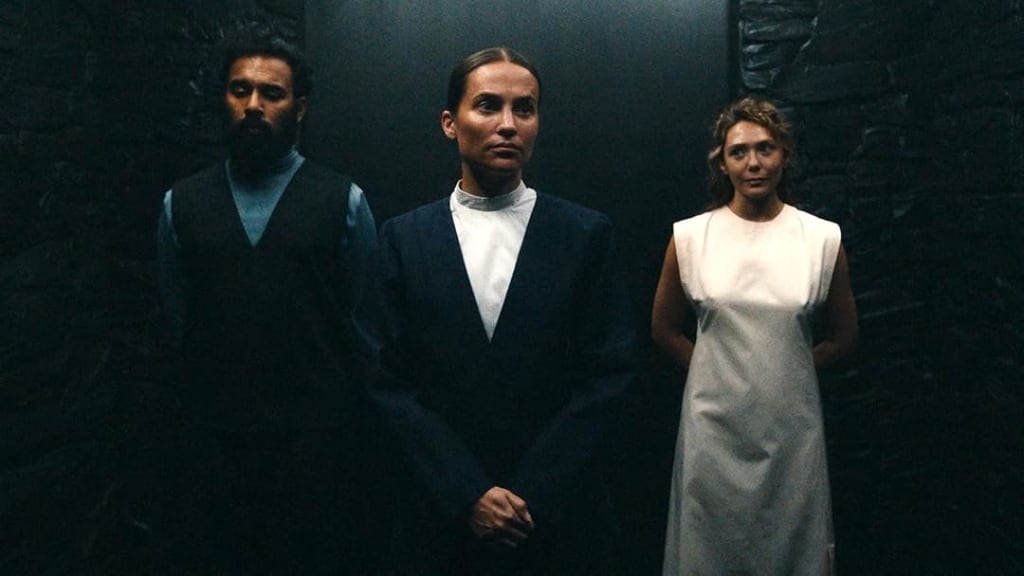
In The Assessment, we are introduced to a dystopian world where prospective parents must pass an intense psychological and moral evaluation before being allowed to raise a child. The process involves a simulated child figure, portrayed by an adult, placed in their home to observe how they respond to the pressures and responsibilities of parenthood.
At first, the couple appears to be stable and loving. But as the days pass, cracks begin to show and their darker instincts start to surface. What starts as a psychological experiment soon becomes a deeply unsettling examination of power, ethics, and the sobering question of who is truly fit to parent.
Why The Assessment Raises So Many Alarming Questions
Initially I thought the film would simply be a slow psychological drama. Instead it became much more complicated and uncomfortable. While I found the pacing repetitive and in parts quite boring, the core message stayed with me.
The movie intentionally makes the viewer feel uneasy because it shows how people who appear ordinary can lose their moral compass when they think no one is watching. There were key moments that made it clear this couple was completely unprepared and unworthy of becoming parents.
Two Disturbing Moments of Inappropriate Behavior
The most concerning scenes involved violations of boundaries.
The first incident involves the mother and occurs in a quiet yet troubling way. While the assessor is fully immersed in the role of a child, the mother becomes physically affectionate in a manner that felt inappropriate and crossed an ethical line. The simulated child is emotionally immature and dependent, unable to understand adult interactions. Instead of protecting this vulnerable figure, the mother seems to seek affection for her own comfort, ignoring the responsibilities of a parental role.
This moment revealed that the mother confused her own emotional needs with the duty of providing care and protection. It signaled that any real child in her care would have faced a very unsafe emotional environment.
The scene between the father and the assessor is one of the most disturbing and pivotal moments in The Assessment not just because of what happens but because of how it happens and why it exposes the father’s true character.
Here’s what happens:
Throughout the assessment the father struggles to connect with the “child.” While the mother is more emotionally volatile the father initially presents himself as the calmer more rational parent. However underneath his surface there is a deep selfishness and emotional immaturity.
As the simulation continues the assessor acting as the child begins to subtly manipulate the father. She plays with the power dynamic behaving flirtatiously in a way that no real child would but remember she is still in her childlike emotional state. Her behavior blurs the lines between childlike affection and adult seduction creating an intentionally confusing situation for the father.
At one point the assessor refuses to clarify whether what is happening between them is part of the assessment or not. She withholds answers making the situation feel chaotic ambiguous and risky. This is important: her role was to test the father’s judgment boundaries and ethics under extreme emotional pressure.
It is still entirely the father’s fault because no matter how confusing the behavior it was his responsibility to maintain the moral boundary.
In real life adults are often placed in situations where children teens or vulnerable people may act in ways they do not fully understand. It is always the adult’s responsibility to protect and uphold those boundaries no matter how difficult or confusing the situation may become.
The father’s failure was not in being “tricked” it was in choosing to cross that ethical line. Instead of stepping away asking for a halt to the assessment or protecting the vulnerable figure he allowed his selfish desires to take over. He prioritized his feelings over his moral obligations. That is why he failed.
He was being tested for precisely this reason to see whether under emotional manipulation or pressure he would still know right from wrong. And he didn’t.
In short:
The assessor manipulated him as part of the stress test.
She withheld clarity about whether it was “real” or “part of the assessment.”
His role was to act with integrity no matter what.
His failure proved he was unfit to raise a vulnerable life because he chose personal gratification over protection and moral responsibility.
The Father’s Creation of a Child Using a Machine
One of the most bizarre and ethically questionable moments comes when the father uses a lifeform-creating machine to fabricate a child after realizing they failed the assessment.
This act reflects a fundamental misunderstanding of what it means to be a parent. It shows he viewed having a child as a matter of ownership rather than responsibility and care. By using technology to bypass the natural process of becoming a parent, he reduces the concept of raising a child to something transactional and selfish.
Parenthood is not about control or possession. It requires love, patience, sacrifice, and an understanding of the needs of another human being. The father’s choice highlights just how far he had lost his way.
The Hard Truth About Parenting
The most chilling line in the film comes when the assessor states it has been six years since anyone passed the evaluation. I find that entirely believable.
No parent is perfect but there are individuals who should not take on the responsibility of raising a child. Some people, knowingly or unknowingly, pass on their own unresolved pain and selfish behaviors to their children. The results can be devastating.
If a real-world version of this evaluation existed, it would be controversial yet sadly accurate. It could prevent many of the tragedies caused by people who were unprepared or unsuited for parenthood.
The Assessment may have lacked excitement and dragged in its pacing, but it delivered a bold and brutally honest message. It exaggerates reality just enough to hold a mirror to society and force us to confront difficult truths.
It suggests that the decision to become a parent should come with far greater reflection and responsibility than it often does. Some people, quite simply, should not take on the role of raising another human being. That is a truth that can no longer be ignored.
About the Creator
Louise Noel
Blogger! I dive into the wormholes of movies, fiction and conspiracy theories. And randomly, poetry.
Keep reading
More stories from Louise Noel and writers in Futurism and other communities.
Raised by Wolves & Prometheus
Okay, hear me out. I’ve been rewatching Raised by Wolves, and something about it just won’t leave me alone. The whole thing feels like someone took the Bible, threw it in a blender with Prometheus, added a dash of existential dread, shook it up, and that was the script. And I don’t mean just loosely inspired. I’m talking full-on twisted reinterpretation of how Earth, humanity, and creation came to be.
By Louise Noel 10 months ago in Futurism
Australia Smoothies Market: Health & Wellness Trends, Retail Expansion & Product Innovation
According to IMARC Group, the Australia smoothies market reached USD 504.6 Million in 2025 and is projected to grow to USD 749.1 Million by 2034, exhibiting a compound annual growth rate (CAGR) of 4.26% during 2026–2034. The market’s expansion reflects increasing consumer focus on health, nutrition, and convenience across Australia. Rising demand for nutrient-rich beverages, growing availability of ready-to-drink (RTD) options, and the proliferation of smoothie bars in urban centers are collectively strengthening Australia smoothies market share. As consumers prioritize balanced diets and functional ingredients, smoothies are becoming a mainstream component of daily nutrition.
By Shrestha Roy4 days ago in Futurism
Conversational AI Market: AI Ethics & Data Privacy, Trust Building & Market Forecast
According to IMARC Group's latest research publication, global conversational AI market size reached USD 13.6 Billion in 2024. Looking forward, IMARC Group expects the market to reach USD 151.6 Billion by 2033, exhibiting a growth rate (CAGR) of 29.16% during 2025-2033.
By sujeet. imarcgroup5 days ago in Futurism
Pearl
1980 something. we all hung out at Pearl and you and i were nothing special, or so i thought. i mean we all danced, drenched in our own sweat, our own saline solution of fear, too many beers, shots, laughter, tears, fucks in the bathroom and i don't know when we began to be afraid. do you?
By ROCK aka Andrea Polla (Simmons)6 days ago in Fiction



Comments
There are no comments for this story
Be the first to respond and start the conversation.