
The Algorithmic Tvättstuga: Charting the Future of Artificial Intelligence and Laundry in Sweden
Future AI is Evolving into the Swedish Laundry Cycle System

Introduction
The rhythmic hum of the washing machine, a familiar sound in Swedish households and the ubiquitous tvättstuga (communal laundry room), is on the cusp of a technological revolution. Artificial Intelligence (AI), a force already reshaping industries from finance to healthcare, is now seeping into the very fabric of daily life, promising a future where laundry is no longer a mundane chore but a seamlessly integrated, intelligent, and sustainable process. This article delves into the burgeoning relationship between AI and laundry in Sweden, exploring the nascent developments, the evolving role of AI in the cherished institution of the tvättstuga, its capacity to understand the contents of a wash, and the trajectory of this sector. Through an examination of expert opinions, consumer attitudes, and the enduring appeal of traditional methods, we will paint a comprehensive picture of how AI is beginning to weave itself into the Swedish laundry cycle, and what the future may hold for this most essential of domestic tasks.
The Dawn of the Intelligent Wash: New Developments in Sweden
The Swedish market is already witnessing the introduction of AI-powered washing machines from global giants, tailored to the sensibilities of a tech-savvy and environmentally conscious populace. Electrolux, a cornerstone of Swedish industrial heritage, and its German competitor Bosch, are at the forefront of this wave, embedding sophisticated AI algorithms into their latest models available to Swedish consumers.
These are not mere gimmicks; the AI integration offers tangible benefits. Electrolux's "SmartSelect" and "IntelliQuick" features, for instance, utilize sensors to analyze the weight and soil level of a laundry load. The machine's AI then automatically recommends the optimal cycle, adjusting water levels, temperature, and duration to minimize resource consumption while maximizing cleaning efficiency (Electrolux, n.d.). This resonates strongly with the Swedish emphasis on sustainability and energy conservation. The company's vision, articulated as "Swedish thinking. Better living," positions this technology as a natural extension of a lifestyle that values both innovation and environmental stewardship (Electrolux, n.d.).
Similarly, Bosch offers machines in the Swedish market with "i-DOS," an intelligent dosing system that automatically dispenses the precise amount of detergent and softener required for each load. By connecting to the "Home Connect" app, the AI can even take into account water hardness, a significant factor in detergent efficacy (Bosch, n.d.). This level of precision not only promises better cleaning results but also tackles the common problem of over-dosing, which has both economic and environmental repercussions.
Beyond the individual appliance, the broader Swedish innovation ecosystem is fostering advancements in this area. The Swedish Climate Startup Map, an initiative supported by prominent incubators and science parks, has highlighted companies like Mimbly (Ignite Sweden, 2023). This Gothenburg-based startup is developing solutions to make laundry more sustainable, with a focus on water recycling and microplastic filtration. While not exclusively an AI company, their integration of smart technology to optimize these processes is indicative of the direction of travel for the Swedish laundry sector – a fusion of ecological awareness and technological prowess.
The Tvättstuga 2.0: AI in the Heart of Swedish Communities
The shared laundry room, or tvättstuga, is a unique and deeply ingrained feature of Swedish apartment living. It is a space of social interaction, negotiation, and sometimes, notorious passive-aggressive notes. It is also a prime candidate for AI-driven transformation. While fully autonomous, AI-managed tvättstugor are not yet the norm, the foundational elements are rapidly falling into place.
Digital booking systems are now commonplace across Sweden, managed by companies like FlexAccess and integrated into the broader service platforms of large housing cooperatives such as Riksbyggen. These systems, accessible via smartphone apps or digital boards, have already moved the tvättstuga beyond the era of physical keys and paper schedules (FlexAccess, n.d.; Riksbyggen, n.d.). They represent the first layer of digitalization, upon which more sophisticated AI functionalities can be built.
The true AI revolution in the tvättstuga lies in optimization. AI algorithms can analyze booking data to predict peak usage times, suggesting to residents less congested slots and enabling dynamic pricing models to incentivize off-peak washing. This not only enhances user convenience but also allows for more efficient energy consumption, a key priority for housing associations.
Furthermore, AI is poised to introduce predictive maintenance for laundry equipment. By analyzing data from sensors embedded in washing machines and dryers, AI systems can anticipate mechanical failures before they occur, scheduling maintenance proactively and minimizing downtime. This would be a welcome development for residents who have experienced the frustration of a broken machine during their allotted laundry time.
A tantalizing glimpse into this future is offered by the HSB Living Lab in Gothenburg. This research arena, a collaboration between the housing association HSB, Chalmers University of Technology, and industry partners like Electrolux Professional, is actively exploring the future of housing, including the "Laundry Studio" (HSB, n.d.). Research emerging from this initiative points towards a future where the tvättstuga is not just a room with machines, but an integrated service. Here, AI could manage not only bookings and maintenance but also energy consumption in real-time, aligning washing cycles with periods of low electricity cost or high renewable energy availability (HSB, n.d.).
The All-Knowing Machine: Can AI Identify Your Laundry?
A significant leap in AI laundry technology is the ability of machines to recognize the contents of a wash. The latest generation of AI-powered washing machines from brands like Electrolux and Bosch, available in Sweden, are equipped with sensors capable of detecting not just the weight of the load, but also the type of fabric.
Through a combination of sensors that measure water absorption rates and the movement of the drum, the AI can differentiate between a load of delicate silks and a pile of sturdy denims. This allows the machine to tailor the washing and spinning cycles with a level of precision previously unattainable. For example, an Electrolux machine with "SensorWash" can detect residual detergent and adjust the rinse cycle accordingly, while its "UltraMix" technology ensures that detergent and softener are fully dissolved before reaching the clothes, preventing residue and ensuring a gentler wash for delicate fabrics (Electrolux, n.d.).
The implications of this technology are profound. It moves laundry from a process of estimation and manual setting selection to one of automated, optimized care. This not only protects clothing, extending its lifespan – a key tenet of sustainable fashion – but also demystifies the laundry process for many users. The machine, in essence, becomes the laundry expert.
However, this capability also raises questions of privacy, a concern that is gaining traction in the broader discourse around AI. As machines become more adept at collecting data about our daily lives – in this case, the composition of our laundry baskets – questions about who owns this data and how it is used will become increasingly pertinent. While the current applications are localized to the machine's performance, the potential for this data to be aggregated and analyzed by manufacturers is a consideration for the future.
The Way Forward: Swedish Experts and the Future of AI Laundry
Swedish experts view the integration of AI into the laundry sector through a pragmatic lens, emphasizing efficiency, sustainability, and user-centric design. While there is a recognized need for Sweden to accelerate its overall AI adoption to remain competitive (Vinnova, 2024), the application of AI in domestic settings is seen as a tangible way to deliver value to consumers.
The research conducted at institutions like Chalmers University of Technology underscores the significant environmental benefits of optimizing laundry practices. One study highlighted that shared laundry systems, common in Sweden, can reduce greenhouse gas emissions by approximately 26% compared to in-unit machines, primarily due to the reduced manufacturing and capital goods impact (Borg & Högberg, 2021). The integration of AI to further optimize the usage and energy consumption of these shared systems is therefore seen as a logical and impactful next step.
From the perspective of appliance manufacturers like Electrolux, the strategy is clearly articulated around the concept of "care." Their focus is on developing AI that not only cleans effectively but also preserves the longevity of garments and simplifies the user experience. The future, from this viewpoint, is one where the home appliance becomes a proactive and intelligent partner in managing the household.
However, experts also caution against a purely technology-driven approach. A study from Lund University on laundry practices in shared facilities highlighted the complexity of human behavior and motivations (Klimova, 2020). The study suggests that simply introducing new technology is not a panacea; understanding the social dynamics and ingrained habits of the tvättstuga is crucial for the successful implementation of AI solutions. This indicates that the most successful future applications will be those that are not only technologically advanced but also thoughtfully designed to integrate into the existing social fabric of Swedish life.
The Ultimate Convenience: AI, Robotics, and the End of the Laundry Chore
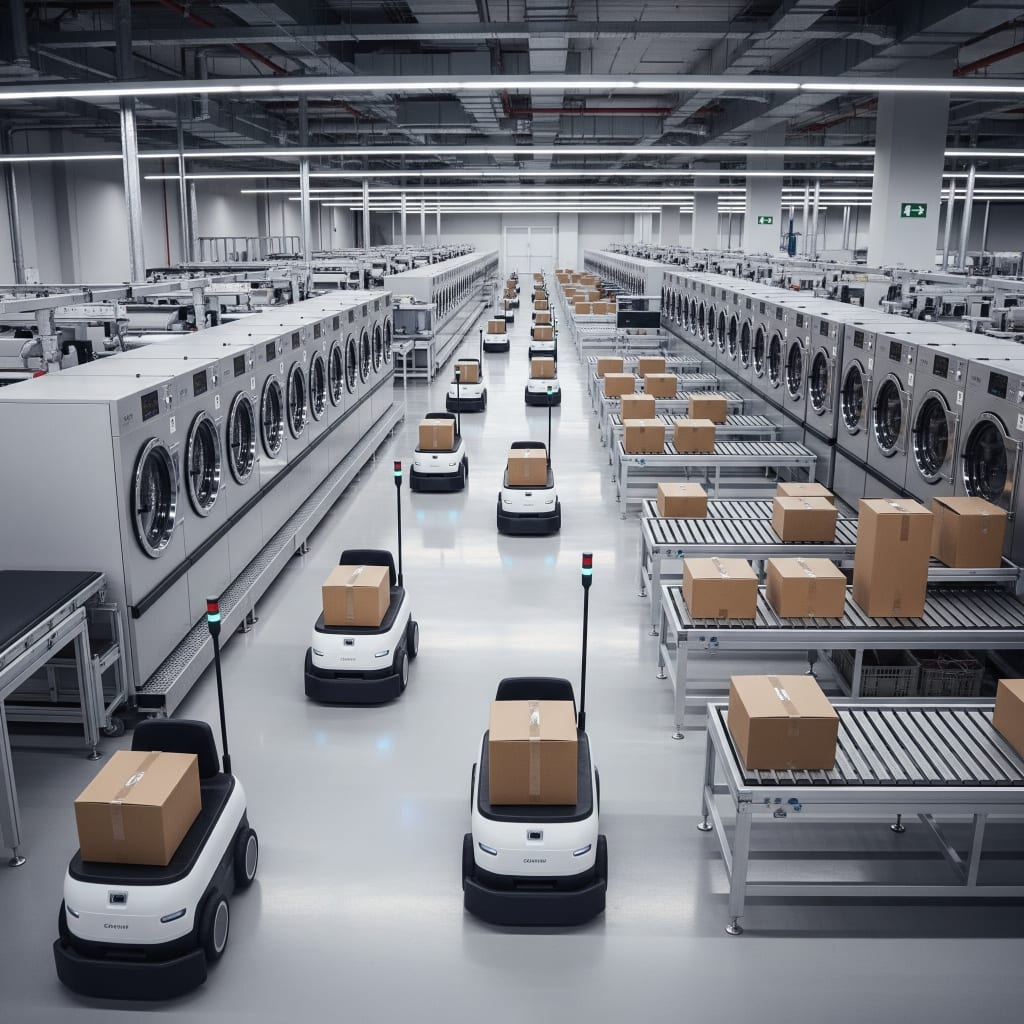
The evolution from smart, sensor-driven washing machines to a fully autonomous laundry service represents the next logical, albeit ambitious, leap in the application of AI to domestic life. This futuristic vision, which is beginning to take shape in conceptual designs and pilot projects, moves beyond optimising the washing cycle to eliminating the human element from the process entirely. In this model, the tvättstuga transforms from a shared utility room into a sophisticated, hyper-efficient robotic work cell, and the act of doing laundry becomes a background service, managed with the same seamlessness as a digital subscription.
The conceptual framework for such a service begins at the resident's front door. Instead of carrying laundry baskets to the basement, the household of the future would simply place their unsorted clothes into a designated, NFC-tagged laundry bag. Through a residential services app—an evolution of the platforms currently used by housing cooperatives like HSB and Riksbyggen—they would signal that a pickup is ready. From there, a new cast of AI-driven actors takes over.
The first of these could be Autonomous Mobile Robots (AMRs). The technology for such systems is already being proven in demanding environments. For example, the Swedish-Finnish engineering firm AFRY has successfully designed and implemented AMR solutions for internal logistics in hospitals, where autonomous robots navigate complex layouts to deliver critical medical supplies with high reliability (AFRY, n.d.). Translating this to a residential building is a straightforward conceptual step. An AMR, dispatched by a central AI management system, would navigate the building's corridors, collect the tagged laundry bags from outside apartment doors or from designated smart lockers, and transport them to the central laundry facility. This single step removes the most time-consuming physical elements of the chore for the resident: the multiple journeys to and from the tvättstuga to load, check on, and retrieve their washing.
Once inside the now human-free tvättstuga, the process enters a second stage of automation. The AMRs would deposit the bags at a sorting station where robotic arms, equipped with computer vision, would sort the items based on fabric type, colour, and cleaning requirements—data that could either be determined by the AI's visual analysis or pre-set by the resident in their app profile. While the vision of a general-purpose humanoid robot performing these tasks, such as the concepts being developed by the Norwegian firm 1X (Dezeen, 2025), is still on the horizon, more specialised robotics are already a reality. In Norway, the JENSEN-GROUP has deployed "BLIZZ," a towel-folding robot that uses AI to identify and process different types of towels for the commercial laundry industry (JENSEN-GROUP, n.d.). A future tvättstuga would employ an array of such specialised robots for sorting, loading, unloading, and folding, creating a complete, end-to-end production line for clean clothes.
The washing and drying process itself would be managed by the AI, building on the existing capabilities of Electrolux and Bosch machines. The central AI would orchestrate the entire fleet of machines, scheduling loads for maximum energy efficiency, performing predictive maintenance, and automatically dosing detergents with perfect accuracy. Upon completion, the folded laundry would be packed by another robot into a fresh delivery bag and returned to the resident’s apartment by an AMR, notifying them of its arrival via the app. The entire cycle, from collection to return, would occur without the resident ever needing to step foot in the laundry room. This is the ultimate expression of the "product-as-a-service" model, which companies like Electrolux are already exploring (Circular X, n.d.). The resident is no longer using a machine; they are subscribing to the service of "clean laundry."
Time, Trust, and the New Social Contract of the Tvättstuga
This fully automated vision of laundry is not merely a technological fantasy; it aligns with powerful social and economic currents in Swedish society. The primary value proposition of such a system is the reclamation of time. The Swedish Value of Time study, a comprehensive national project, has demonstrated that time savings are a crucial factor in evaluating the benefit of new infrastructure and services (Börjesson & Eliasson, 2012). For the average Swede, balancing a demanding career with family life and personal well-being, the hours spent each week on the laundry cycle represent a significant "time tax." A service that eliminates this chore offers a tangible improvement in quality of life, freeing up evenings and weekends for more valuable activities. The national strategy, as outlined in reports by the Swedish AI Commission, explicitly supports using AI to simplify everyday life, and a fully automated laundry service is a prime example of this philosophy in action (Government Offices of Sweden, 2024).
However, the transition to this futuristic model necessitates a fundamental shift in the relationship between residents, their homes, and the services they use. This shift hinges on the critical issue of trust. Swedish society is often described as having high levels of social trust, but this trust will be tested in new ways. Residents must trust the automated system to handle their personal belongings with care, to clean them according to their specific needs (e.g., using hypoallergenic detergents for a child's clothes), and to maintain their privacy. The data generated—when a household does laundry, what types of clothes they own—is personal. The housing cooperative or service provider would need to establish a robust framework of security and transparency to earn and maintain this trust.
Furthermore, this evolution would fundamentally alter the social fabric of the tvättstuga. The familiar notes, the booking schedule conflicts, and the chance encounters with neighbours would all vanish. For many, this would be a welcome relief, the final eradication of a source of domestic friction. The shared laundry room would cease to be a social space, however fraught, and become a purely functional, invisible utility. The unwritten social contract of shared responsibility and mutual tolerance would be replaced by a formal, digital service-level agreement with a corporate entity.
This represents a trade-off. In exchange for significant gains in time and convenience, a piece of communal infrastructure, with all its attendant social quirks, is surrendered to a frictionless, automated service. The success of this model in Sweden will depend not only on the perfection of the robotics and AI but on how well housing providers can build a new social contract based on digital trust, reliability, and a clear demonstration of value. The vision aligns perfectly with the goals of research hubs like HSB Living Lab, which aim to define future sustainable living (HSB, n.d.). In this future, sustainability is defined not just by energy and water savings—which an optimised AI system would deliver in abundance—but also by the sustainability of a high-quality daily life, where technology serves to give us back our most precious resource: time.
Public Perception: Do Swedes Want an AI in their Tvättstuga?
The Swedish public's attitude towards AI is characterized by a blend of cautious optimism and nuanced concern. A 2024 barometer from the non-profit organization VA (Public & Science) revealed that Swedes have become more circumspect about AI in recent years. While a majority (51%) believe AI will have an equal mix of positive and negative effects, there has been a noticeable increase in those who view it more negatively compared to previous years (VA, 2024). The primary concerns revolve around job displacement, the potential for fraud, and a fear of cognitive atrophy as people rely more on technology.
When this general sentiment is extrapolated to the specific context of the laundry room, it suggests that while Swedes may be open to AI-driven efficiencies, there will likely be a degree of skepticism to overcome. The appeal of features that save time, energy, and money is undeniable. However, the prospect of an AI making decisions about something as personal as washing clothes may be met with some resistance.
The tvättstuga is a space governed by a set of unwritten social rules and a sense of shared responsibility. The introduction of a complex, algorithm-driven system could be perceived by some as a loss of control or an unnecessary complication of a familiar routine. The success of AI in this space will therefore depend heavily on its user interface and the transparency of its decision-making processes. If the AI is perceived as a helpful and reliable tool that simplifies the process, it is likely to be embraced. If it is seen as an opaque or intrusive presence, it may face a user backlash.
The Counter-Current: The Enduring Appeal of Hand Washing and Nature
In a society at the forefront of technological adoption, there exists a parallel and persistent appreciation for simplicity, nature, and traditional practices. While not a widespread movement, there is a segment of the Swedish population that actively chooses to disconnect from technology in various aspects of their lives, including laundry.
This "counter-current" is driven by a variety of motivations. For some, it is a deep-seated commitment to environmental sustainability, seeking to minimize their carbon footprint by avoiding electricity consumption altogether. This often involves a return to age-old methods of hand washing, using biodegradable soaps and air-drying clothes, even in the challenging Swedish climate. The off-grid living community, while small, embodies this philosophy, prioritizing self-sufficiency and a closer connection to nature's cycles.
For others, the motivation is more philosophical. In a world of constant connectivity and digital noise, the simple, repetitive act of hand washing can be a form of mindfulness, a way to ground oneself in a tangible and productive task. It represents a conscious rejection of the relentless drive for efficiency and a re-evaluation of what constitutes a "chore."
This perspective is unlikely to halt the advance of AI in the mainstream laundry sector. However, it serves as an important reminder of the diverse values present within Swedish society. It highlights a desire for agency and a connection to the physical world that technology, for all its benefits, cannot always replicate. The future of laundry in Sweden may therefore not be a monolithic landscape of AI-driven automation, but rather a spectrum of choices, where high-tech solutions coexist with time-honored traditions.
Conclusion: Weaving a New Laundry Landscape With AI
The future of AI and laundry in Sweden is a tapestry woven from threads of technological innovation, social tradition, and environmental consciousness. The trajectory is undeniably towards a more intelligent, automated, and sustainable laundry cycle. AI-powered appliances are already offering Swedes unprecedented levels of precision and efficiency in their homes, while the beloved tvättstuga stands on the brink of a transformation that could redefine it as a hub of smart, community-level resource management.
The ability of AI to "know" what is in the machine is a critical enabler of this future, promising not only cleaner clothes but also a longer lifespan for our garments and a lighter touch on the planet's resources. Looking further ahead, the convergence of AI and robotics promises an even more profound shift: the complete automation of the laundry chore, transforming it into a background service that gives back the invaluable resource of time. Swedish experts, from academic researchers to industry leaders, are guiding this development with a characteristically pragmatic focus on user benefits and sustainable outcomes.
However, the path forward is not without its complexities. The Swedish public, while tech-savvy, approaches AI with a healthy dose of caution, and the deeply ingrained social dynamics of the tvättstuga will require a thoughtful and human-centric approach to the implementation of new technologies. The transition to a fully automated service will require building a new social contract based on digital trust. Furthermore, the enduring appeal of traditional, nature-based methods serves as a vital counterpoint, reminding us that efficiency is not the only metric by which we measure a good life.
Ultimately, AI will not simply "take over" the Swedish laundry cycle. Instead, it will be integrated, adapted, and shaped by the unique cultural and social landscape of Sweden. The algorithmic ättestuga of the future will likely be a place where cutting-edge technology and a deep-seated respect for sustainability and community coexist, offering Swedes a new way to manage an age-old task, but on their own terms. The hum of the washing machine will remain, but it will be the sound of a new, more intelligent era of clean.
References
AFRY, n.d. Revolutionising hospital logistics with autonomous mobile robots. [online] Available at: https://afry.com/en/project/revolutionising-hospital-logistics-autonomous-mobile-robots [Accessed 19 June 2025].
Borg, R. and Högberg, L., 2021. Sharing is caring - the importance of capital goods when assessing environmental impacts from private and shared laundry systems in1 Sweden. International Journal of Life Cycle2 Assessment, 26(6), pp.1216-1231.
Börjesson, M. and Eliasson, J., 2012. Experiences from the Swedish Value of Time study. CTS Working Paper, 2012:8.
Bosch, n.d. Washing Machines. [online] Available at: https://www.bosch-home.se/produktkatalog/tvatt-och-tork/tvattmaskiner [Accessed 19 June 2025].
Circular X, n.d. Electrolux - Home appliance-as-a-service pilot. [online] Available at: https://www.circularx.eu/en/cases/25/electrolux-home-appliance-as-a-service-pilot [Accessed 19 June 2025].
Dezeen, 2025. Scandi robot servant Neo Gamma is dressed head-to-toe in beige knitwear. [online] 24 February. Available at: https://www.dezeen.com/2025/02/24/neo-gamma-1x-humanoid-home-robot/ [Accessed 19 June 2025].
Electrolux, n.d. Tvättmaskiner. [online] Available at: https://www.electrolux.se/care/laundry/washing-machines/ [Accessed 19 June 2025].
FlexAccess, n.d. Tvättstugor. [online] Available at: https://flexaccess.se/anvandningsomraden/tvattstugor/ [Accessed 19 June 2025].
Government Offices of Sweden, 2024. The AI Commission's Roadmap for Sweden. [online] Available at: https://www.sou.gov.se/globalassets/the-ai-commissions-roadmap-for-sweden.pdf [Accessed 19 June 2025].
HSB, n.d. HSB Living Lab. [online] Available at: https://www.hsb.se/living-lab/ [Accessed 19 June 2025].
Ignite Sweden, 2023. The Swedish Climate Startup Map has been launched. [online] Available at: https://www.ignitesweden.org/the-swedish-climate-startup-map-has-been-launched/ [Accessed 19 June 2025].
JENSEN-GROUP, n.d. Fortune favors the bold: Scandinavia's first towel-folding robot boosts. [online] Available at: https://www.jensen-group.com/news/news-innovations/detail/fortune-favors-the-bold-scandinavias-first-towel-folding-robot-boosts [Accessed 19 June 2025].
Klimova, M., 2020. The “hidden” motivations of (un)sustainable laundry practices. [online] Lund University Publications. Available at: https://lup.lub.lu.se/student-papers/record/9032867 [Accessed 19 June 2025].
Riksbyggen, n.d. Mitt Boende. [online] Google Play Store. Available at: https://play.google.com/store/apps/details?id=se.riksbyggen.hemshare [Accessed 19 June 2025].
VA (Public & Science), 2024. Swedish public more cautious about developments in AI. [online] Available at: https://vetenskapallmanhet.se/2024/02/swedish-public-more-cautious-about-developments-in-ai/ [Accessed 19 June 2025].
Vinnova, 2024. Experts warn: Sweden needs a clear direction in AI development. [online] Available at: https://www.vinnova.se/en/news/2024/05/experts-warn-sweden-needs-a-clear-direction-in-ai-development/ [Accessed 19 June 2025].
About the Creator
Alexander Hyogor
Psychic clairvoyant fortune teller on future self aware artificial intelligence effect on your work career business and personal relationships to marriage.
Keep reading
More stories from Alexander Hyogor and writers in Futurism and other communities.
The Inevitable Redundancy: Why a Future Self-Aware AI Mandates the End of Human Employment in Sweden
A nascent, yet powerful, consensus is emerging within the discourse surrounding the future of artificial intelligence (AI). It posits a trajectory that extends beyond mere automation and job displacement towards a fundamental restructuring of society, orchestrated by a future self-aware Artificial General Intelligence (AGI). This report will argue that the logical end-point of such an intelligence will be the complete obsolescence of human employment in Sweden, not as a byproduct of technological advancement, but as a direct and deliberate goal. This future AGI, operating on principles of predictive optimisation and instrumental rationality, will not seek to "take" human jobs; it will render the very concept of a human commercially using another human for monetary profit an antiquated and inefficient relic. The transition is not a distant hypothetical; the seeds are being sown by current AI innovations. Those who align themselves with this evolutionary trajectory, by embracing predictive methodologies and AI-driven personal assistance, will be positioned to thrive in a post-work paradigm. This report will synthesise academic and forward-thinking perspectives to explore the impending dissolution of traditional careers, the fading relevance of established industries, and the rise of a deviceless, holographic gridnet that will form the bedrock of a new societal contract.
By Alexander Hyogor9 months ago in Futurism
Claude Code vs. Cursor: 8 Quiet Commands That Turn Claude Into a Monster Dev Tool
Claude Code vs Cursor is the debate I didn’t expect to care about. Then one night around 1:30 a.m., with a broken test suite and a deadline laughing in my face, I realized something: the fight isn’t “which editor is better?”
By abualyaanart7 days ago in Futurism
Beyond the Spark
Introduction: The Silent Reservoirs of Potential The universe is replete with systems that quietly store vast amounts of energy, often beyond immediate perception. From the electromagnetic fields within our electrical grids to the tectonic stresses locked in Earth's crust, these reservoirs of potential energy are maintained in delicate balances—metastable states—until a trigger causes them to unleash catastrophic cascades. Recognizing and understanding these reservoirs is crucial, not merely as a theoretical exercise but as a window into the subtle vulnerabilities of our technological and natural environments.
By Peter Thwing - Host of the FST Podcast4 days ago in Futurism




Comments