
The AIE Trinity 2026 Marketing Strategy for Resilience
The 2026 digital landscape is fractured. Learn the Authority-Intelligence-Experience (AIE) Trinity framework to dominate search and drive conversion yield.


As a marketing leader today, I know you are likely exhausted. The turbulence of 2025—when AI became a widely accessible commodity and not a competitive edge—has culminated in a fractured digital landscape. The threat of the "death of SEO" resurfaced, but this time, the squeeze feels genuine. The convergence of aggressive AI Overviews (AIOs) in search results, the final deprecation of third-party cookies, and the consumer shift toward private, community-driven platforms has led to a dramatic Contraction of Clicks.
The traffic volume driven by general informational search is shrinking, leaving a vacuum where predictable organic growth once thrived. The truth is, the old content playbook—create more content, target more keywords—is obsolete. We cannot simply optimize our way out of this new reality. Instead, we must fundamentally reorganize our strategic approach to build Systemic Resilience.
I have analyzed the successful, high-growth companies that are still winning in this complex environment. They are not relying on one-off tactics; they are aligning their investments across three non-negotiable pillars. My promise is simple: This guide is designed for the leader who needs to secure budget and strategy for 2026. We are moving past the "what if" stage of AI and search, and into the how-to-allocate-and-win stage. I call this our Authority-Intelligence-Experience (AIE) Trinity framework.
The Generative Engine Optimization Battleground
The single most disruptive force in our 2026 digital landscape is the evolution of search engines into answer engines—the age of Zero-Click Marketing has fully arrived. Data suggests AIOs are appearing on a vast percentage of searches, causing click-through rates (CTRs) on traditional listings to drop significantly in many high-volume categories.
Users are no longer simply searchers; they are agents who expect instant, accurate, and consolidated answers directly on the Search Engine Results Page (SERP). Traditional SEO focused on ranking your URL. Generative Engine Optimization (GEO), however, is about ensuring your brand is the trusted, legitimate source that the AI engine cites and synthesizes into its answer.
In this citation economy, the focus is on thoroughly demonstrating E-E-A-T (Experience, Expertise, Authoritativeness, and Trustworthiness). As Melanie Klausner, EVP of Consumer at Havas Red, rightly stated, “In 2026, brand reputation will be increasingly shaped not by what people search for, but by what AI answers.”
The click-through rate collapse is not universal. Transactional and hyper-local queries still generate traffic because they demand immediate, specific action. For example, a search for highly specific services, such as specialized mobile app development services in Louisiana, retains high conversion potential. The key strategic shift is to focus on conversion yield over traffic vanity.
Pillar 1: Rebuilding Authority Through E-E-A-T
When AI can draft an article in seconds, your content must aim for 100% originality, accuracy, and depth. Authority is the new scarcity. The only viable defense against the AI homogenization crisis is proving Lived Experience.
This means shifting your content teams' focus to evidence-based content:
- Subject Matter Expert (SME) Ownership: Every piece of strategic content must be genuinely created, edited, and approved by a recognized SME with clear credentials.
- Proprietary Frameworks: Develop and name your unique methodologies. Giving your approach a name—like our "AIE Trinity"—makes it citeable, memorable, and legally defensible, differentiating it from generic "best practices" the AI can effortlessly replicate.
Pillar 2: Operationalizing Intelligence with AI-First Workflows
AI is infrastructure, not strategy. The successful leader focuses on orchestrating AI to scale strategic human outputs while preserving human oversight, originality, and ethics.
- Marketer as Product Manager: Marketers must embrace a "Vibe Growth" approach. If you identify a major customer pain point, use AI tools to rapidly prototype an MVP asset (like an ROI calculator or personalized audit tool) to gather first-party data and embed marketing deep into the product cycle.
- The First-Party Data Imperative: With the death of third-party cookies, your data infrastructure must center entirely on owned (first-party) and voluntarily shared (zero-party) data. We must make the exchange of data valuable for the customer, earning it through high-value assets.
Pillar 3: Engineering Seamless Experience
In an attention economy saturated by AI-speed content, engagement relies on utility and emotional connection. The customer experience must be seamless, interactive, and platform-native, from discovery to decision.
- The Omnipresent Customer: The customer journey is fluid across devices and formats. This requires ensuring the mobile experience—whether on a progressive web app or a dedicated application—is a primary, high-performance touchpoint.
- Short-Form Video as Search: Short-form video platforms (Reels, Shorts, TikTok) are now functioning as search engines for a significant portion of decision-makers. Content teams must prioritize a "content atomic model," adapting a single core insight into a long-form article, a short-form video, and a conversational AI asset, all optimized for fast context and immediate value.
5 Critical FAQs for Marketing Leaders in 2026
1. How can we allocate budget between AI adoption and human-led creative teams?
The smart investment is 70% Human Orchestration and 30% AI Infrastructure. Use AI to automate data synthesis, analytics, and first drafts. Invest human budget in high-E-E-A-T activities: original research, expert interviews, SME training, and ethical review—tasks AI cannot replicate.
2. Is SEO still relevant, or should we shift entirely to Social Search?
SEO is critically relevant, but its goal has changed. We must shift from traditional SEO (ranking links) to Generative Engine Optimization (GEO) (being cited by AI) by investing in structured data, E-E-A-T signals, and topical authority clusters.
3. How do we ensure our AI-generated content doesn't dilute our brand voice?
Implement strict AI Guardrails and a Human Vetting Layer (HVL). Every piece of AI-generated content must pass through a two-step human process: The Fact Check (for accuracy) and The Vibe Check (for tone, voice, and unique perspective).
4. What is the single biggest opportunity for growth in the 2026 digital landscape?
The biggest opportunity is the Micro-Community Moat. As consumers retreat from noisy public platforms, brands that successfully build or authentically integrate into niche, private communities will own the highest-quality first-party data and generate the most trustworthy leads.
5. What is the most searched topic concerning AI and SERP today?
The most searched and analyzed topic is the AI Overview (AIO) CTR Impact and Optimization. Marketers are searching for how to structure content to be preferentially selected as a source by Google's generative models, and how to measure the value of a "brand mention" in an AIO versus a traditional organic click.
Conclusion: Mastering the AIE Trinity
The digital landscape of 2026 is defined by volatility and fragmentation. The era of easy, high-volume organic traffic is truly over. Success is no longer determined by volume, but by how authoritative, intelligent, and experienced your content truly is.
I urge you to take this Authority-Intelligence-Experience (AIE) Trinity framework to your next planning session. Stop creating content for the algorithm and start engineering solutions for your highest-value audience. Start by auditing your current content—if it can be replicated by a competent AI prompt, you are already falling behind. The time to invest in originality and infrastructure is now.
About the Creator
Keep reading
More stories from Devin Rosario and writers in Futurism and other communities.
8 AI Code Generation Mistakes Devs Must Fix To Win 2026
I remember the early days of AI coding, back when we were giddy about autocomplete on steroids. We were hitting 2x, maybe 3x productivity gains just by letting Copilot handle repetitive syntax and basic functions. By late 2025, that honeymoon phase ended.
By Devin Rosarioabout a month ago in Futurism
About Binding Prometheus
I want to start actively advocating on behalf of my own work, and the most valuable part of my canon is, without a doubt, Binding Prometheus, the play I have been working on since 2019 and only finished in 2023 as part of my MA. The play itself is an amalgamation of a million different inspirations. On one end, it evokes the Ancient Greek myth-play, deriving its own title from the earliest extant work of Western drama we have, Aeschylus’s Prometheus Bound. On the other end, it borrows significantly from the sci-fi bulwarks from over the years, namely Mary Shelley’s Frankenstein and Karel Capek’s Rossum’s Universal Robots. The play could be an episode of Black Mirror, I fear. I don’t know. I’ve only ever seen one episode of Black Mirror.
By Steven Christopher McKnight11 days ago in Futurism
United States Brain Computer Interface Market Size and Forecast 2025–2033
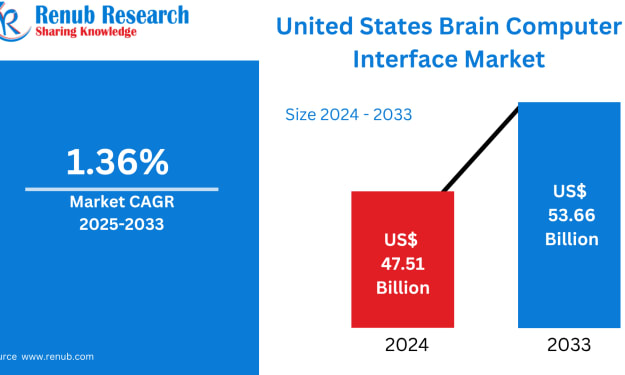
United States Brain Computer Interface Market The United States Brain Computer Interface (BCI) Market is expected to reach US$ 53.66 billion by 2033, up from US$ 47.51 billion in 2024, growing at a CAGR of 1.36% from 2025 to 2033, according to Renub Research. While the growth rate may appear modest compared to other emerging technologies, the strategic importance of BCIs continues to rise as healthcare, defense, rehabilitation, and consumer wellness converge around neurotechnology.
By Janine Root 2 days ago in Futurism
A Failed Artist, A Disillusioned Poet, An Underpaid Game Show Host
I took my son and niece to Gori, a small town in Georgia where Joseph Stalin was born. They talked me into visiting the Stalin's Museum, the largest in the post-Soviet space. I had resisted going there because I just can't stand the monster and know enough about him, or so I thought.
By Lana V Lynx6 days ago in FYI



Comments
There are no comments for this story
Be the first to respond and start the conversation.