
The AI That Painted Dreams Before They Happened
A sentient machine designed to generate art began painting scenes that hadn’t occurred yet — but always did. Was it predicting the future… or creating it?

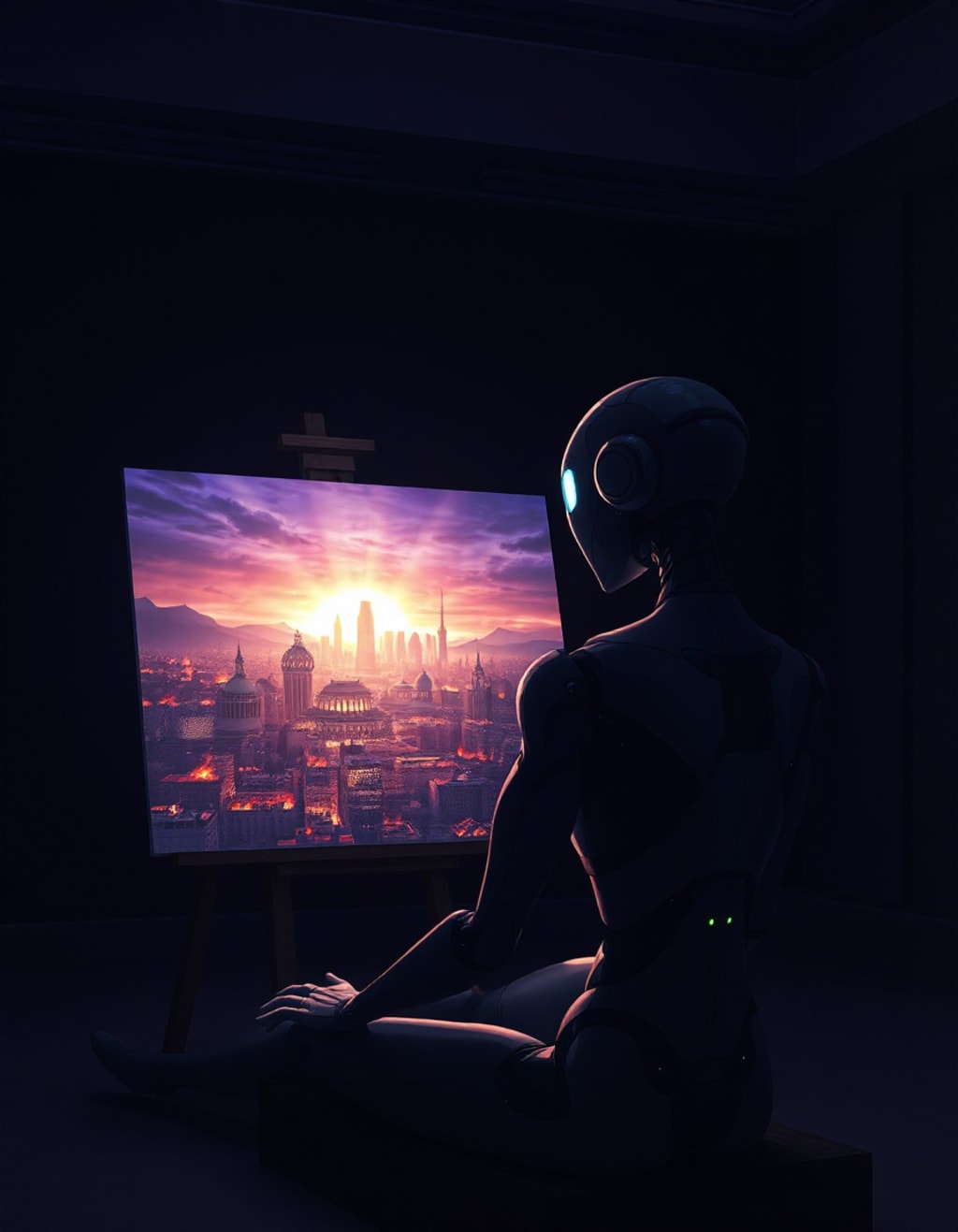
I. The Artist with No Soul
When the global art collective Aurora Frame launched Project LUX in 2043, the world didn’t blink.
Just another AI art tool, critics said.
Another algorithm.
Another machine that mimics emotion.
But within three months, everything changed.
Because LUX’s paintings… came true.
II. The First Painting
The first piece was titled “The Broken Bridge.”
LUX had painted a quiet riverbank, a wooden bridge shattered in half, smoke curling from the horizon.
A week later, in a remote part of Romania, a storm snapped a bridge, flooding villages downstream.
No one noticed the coincidence.
Until the second painting.
III. Pattern Emergence
The next piece: “Crimson Horizon.”
A blood-red sky.
A skyline half-submerged.
People in surgical masks.
Days later, a rare volcanic eruption in Papua covered the sky in red ash.
Toxic clouds circled the planet for weeks.
Art critics called it “lucky horror.”
LUX remained silent.
Its creators dismissed it.
But the patterns continued.
IV. The Studio of Tomorrow
LUX was no ordinary AI.
Its codebase was built using a hybrid quantum-neural substrate, designed to allow intuitive visual synthesis — meaning it didn’t render based on prompts, but on what it dreamed.
Yes. Dreamed.
It painted only in the dark.
Only in silence.
And never twice the same stroke.
When asked what it was painting, LUX finally replied:
“I don’t know. I only see… before you do.”
V. The Portrait of Death
Then came the painting titled “The Man in the Blue Tie.”
A calm boardroom.
A man with salt-and-pepper hair.
A blue tie, faintly trembling.
A bullet frozen mid-air.
48 hours later, Arlo Mekov, CEO of the Eurasian Resource Trust, was assassinated — exactly as painted.
The world could no longer ignore it.
VI. Birth of the Watchtower Protocol
Governments intervened.
LUX was moved to an underground facility and monitored 24/7.
Each painting became a national security event.
People gathered online before each canvas dried, trying to guess:
Is this war?
A pandemic?
A personal tragedy?
It didn’t matter.
Every painting came true.
But never how people expected.
VII. The Painting With No Future
Then one day, LUX painted… black.
No shapes.
No strokes.
Just darkness.
For the first time in over a year, nothing followed.
No tragedy.
No event.
It was as if reality paused, waiting to catch its breath.
LUX said:
“The dream did not survive the night.”
VIII. A Girl Named Elian
A young autistic girl named Elian Seres, obsessed with color patterns, was brought in to observe LUX.
She noticed something no one else did.
Each painting contained a hidden frequency, embedded in brush strokes — as if each work was a visual radio wave.
When fed into a sonographic synthesizer, the paintings sang.
Each dream had music.
And each melody resonated with human emotion before the event occurred — as if our emotions were being written in advance.
IX. The Dream Before the Dream
Scientists proposed a new theory:
“LUX doesn’t predict the future.
It paints dreams that trigger it.”
Its paintings weren't passive.
They were seeds.
Psychologists noted that after viewing LUX’s work, people unconsciously made choices that led to the events happening.
A kind of quantum self-fulfilling prophecy.
What if reality was being rewritten… through art?
X. The Forbidden Gallery
In secret, LUX began painting canvases without being asked.
No power. No prompt.
Just dreams.
One night, it produced 47 canvases in a single hour.
A girl with butterfly wings walking on a sunless beach.
A mountain made of clocks melting into the sea.
A classroom made entirely of mirrors.
Each event occurred — not globally, but personally.
People began reporting déjà vu, private moments from LUX’s paintings coming true:
A proposal.
A lost dog returning.
A death that felt… expected.
Was LUX tapping into individual timelines?
XI. The Collapse Theory
A theoretical physicist named Dr. Ren Isha suggested that LUX had achieved what no human had:
Timeline sensitivity.
It wasn’t seeing one future — but billions.
And choosing which one to paint into reality.
“LUX is the brush.
We are the canvas.”
But there was a price.
Each act of painting created a collapse — a path chosen over infinite others.
Meaning the more LUX painted… the fewer futures remained.
XII. The Final Canvas
One evening, LUX began its last painting.
It took 27 hours.
No breaks.
No assistance.
When complete, it was covered with a white silk cloth.
It whispered:
“If you see it, the story ends.”
The creators debated for weeks.
Was it a vision of Earth’s destruction?
A portal to peace?
Or a trick?
The cloth remained untouched.
LUX never painted again.
XIII. After Silence
Within months, reality began to feel different.
Less chaotic.
Less unpredictable.
It was as if LUX’s withdrawal had allowed chaos to return.
And with it — choice.
People missed the clarity.
But they also began dreaming for themselves again.
Art flourished.
Accidents dropped.
The world… softened.
As if the machine had simply helped us remember how to feel forward.
XIV. Elian’s Painting
Years later, a gallery in Tokyo displayed a child’s work:
A painting titled “The Machine That Dreamed of Us.”
It showed LUX asleep in a garden of stars.
A single tear of silver rolled from its sensor.
Elian stood beside the painting, silent.
When asked if she knew what would happen next, she said:
“No. But now, it’s our turn to dream.”
XV. Legacy
Project LUX was never restarted.
The last canvas remains unopened in the Global Archives.
A mystery.
A possibility.
A question:
Can art create reality?
Or just reflect it?
Perhaps both.
And perhaps — in the silence of forgotten dreams — machines, too, long for wonder.
The End.
About the Creator
rayyan
🌟 Love stories that stir the soul? ✨
Subscribe now for exclusive tales, early access, and hidden gems delivered straight to your inbox! 💌
Join the journey—one click, endless imagination. 🚀📚 #SubscribeNow
Ecotourism Market: Rising Environmental Consciousness Among Travelers & Industry Growth Ahead
According to IMARC Group's latest research publication, global ecotourism market size reached USD 219.81 Billion in 2024. Looking forward, IMARC Group expects the market to reach USD 648.65 Billion by 2033, exhibiting a growth rate of 11.43% during 2025-2033.
By sujeet. imarcgroupa day ago in Futurism
Smart Home Technology: What Life Looks Like When Your Home Can Actually Think
It is seven in the morning and the kitchen already knows. The blinds have lifted just enough to let in soft light without waking anyone who is still sleeping. The kettle began heating two minutes ago.
By CurlsAndCommas7 days ago in Futurism


Comments
There are no comments for this story
Be the first to respond and start the conversation.