
The AI Developer's Handbook: Pathways in an Emerging Field
The journey to becoming an AI developer can take several paths, each with its own advantages:

In today's digital revolution, the role of the artificial intelligence developer has transformed from a niche specialty into one of the most sought-after positions in technology. These pioneering professionals bridge the gap between theoretical computer science and practical applications, creating systems that can perceive, learn, and act with increasing autonomy. As AI continues to reshape industries from healthcare to finance, understanding the pathways available to aspiring and current AI developers has never been more crucial.
The Foundation: What Makes an AI Developer Different
Unlike traditional software engineers, AI developers require a unique skill set that combines programming expertise with data science, mathematical reasoning, and domain-specific knowledge. This multidisciplinary approach is essential because AI systems don't simply follow explicit instructions—they learn patterns from data and make decisions based on probability and statistics.
The most successful AI developers possess:
Strong programming abilities, particularly in languages like Python, R, or Julia
Solid understanding of linear algebra, calculus, and statistics
Familiarity with machine learning algorithms and their practical applications
Experience with frameworks like TensorFlow, PyTorch, or scikit-learn
The ability to preprocess and transform data for model training
Critical thinking skills to evaluate model performance and potential biases
Entry Points: Breaking Into AI Development
The journey to becoming an AI developer can take several paths, each with its own advantages:
The Academic Route
Many AI developers begin with formal education in computer science, mathematics, or related fields. Advanced degrees often provide:
Deep theoretical understanding of machine learning concepts
Research opportunities with experienced mentors
Access to computational resources and datasets
Networking with other AI professionals and researchers
However, the academic path requires significant time investment and doesn't always emphasize the practical implementation skills needed in industry roles.
The Industry Transition
Software developers and engineers increasingly transition to AI development through:
Specialized online courses and certifications
Internal company training programs
Self-directed learning and personal projects
Contributing to open-source AI initiatives
This approach often results in highly practical skills but may leave gaps in theoretical understanding that become important when troubleshooting complex models.
The Bootcamp Experience
Intensive AI and machine learning bootcamps offer:
Accelerated learning of essential concepts
Hands-on projects with real-world applications
Career services and industry connections
Peer learning opportunities
These programs work well for career-changers and those seeking to quickly develop practical skills, though they may not provide the depth of knowledge gained through longer educational paths.
Specialization: Finding Your Niche
As AI development has matured, various specializations have emerged, each requiring unique expertise:
Computer Vision Specialist
These developers create systems that can interpret and understand visual information from the world, working on:
Image classification and object detection
Facial recognition systems
Medical imaging analysis
Autonomous vehicle perception
Augmented reality applications
Natural Language Processing (NLP) Engineer
NLP specialists focus on enabling computers to understand, interpret, and generate human language:
Sentiment analysis and text classification
Machine translation systems
Conversational AI and chatbots
Document summarization
Information extraction from unstructured text
Reinforcement Learning Engineer
These developers build systems that learn optimal behavior through interaction with environments:
Game-playing AI
Robotics control systems
Resource optimization algorithms
Recommendation systems
Autonomous decision-making agents
AI Ethics and Responsible AI Engineer
This emerging specialization focuses on ensuring AI systems are fair, transparent, and beneficial:
Bias detection and mitigation
Privacy-preserving machine learning
Explainable AI development
Safety-critical AI systems
Regulatory compliance
The Growth Trajectory: Career Evolution
The career path for AI developers often progresses through several stages:
Junior AI Developer
Entry-level positions typically involve:
Implementing established algorithms
Feature engineering under supervision
Testing and validating models
Data preprocessing and cleaning
Mid-Level AI Developer
With experience, responsibilities expand to:
Designing new model architectures
Leading specific AI projects
Optimizing models for production
Mentoring junior team members
Senior AI Developer
Seasoned professionals take on:
Architecting complex AI systems
Making strategic technical decisions
Solving novel AI challenges
Collaborating across teams and disciplines
AI Leadership Roles
Career advancement may lead to positions such as:
AI Research Scientist
Machine Learning Engineering Manager
AI Product Manager
Chief AI Officer
Challenges and Opportunities on the Horizon
The field of AI development presents unique challenges that distinguish it from traditional software engineering:
Technical Challenges
Keeping pace with rapidly evolving research and techniques
Managing computational resources efficiently
Handling extremely large datasets
Developing models that generalize well beyond training data
Balancing model complexity with interpretability
Ethical Considerations
Addressing algorithmic bias and fairness
Ensuring privacy in data-hungry applications
Building transparent and explainable systems
Considering societal impacts of automation
Managing the responsible deployment of AI
Industry Trends Creating Opportunities
Several emerging trends are reshaping the landscape for AI developers:
Democratization of AI tools: Low-code and no-code platforms are making AI development more accessible, shifting focus toward domain expertise and problem formulation.
Edge AI: The push to run AI models on devices rather than in the cloud creates demand for optimization specialists who can make models smaller and more efficient.
MLOps maturity: As organizations formalize their AI development processes, skills in automation, monitoring, and governance become increasingly valuable.
Domain-specific AI: Industries from healthcare to finance are seeking AI developers with specialized domain knowledge, creating niches for those with combined expertise.
Multimodal AI: Systems that can process multiple types of data (text, images, audio) simultaneously represent the cutting edge of development, requiring interdisciplinary skills.
Building Your AI Development Toolkit
Beyond formal education, successful AI developers continually expand their capabilities through:
Practical Project Experience
Nothing replaces hands-on experience building real AI systems. Consider:
Contributing to open-source AI projects
Participating in competitions on platforms like Kaggle
Building portfolio projects that demonstrate your capabilities
Implementing research papers to understand cutting-edge techniques
Community Engagement
The AI field thrives on collaboration and knowledge sharing:
Attend AI conferences and meetups
Participate in online communities like Reddit's r/MachineLearning
Follow leading researchers and practitioners on social media
Join study groups focused on specific AI topics
Continuous Learning
The rapid evolution of AI requires ongoing education:
Follow research publications from organizations like OpenAI, DeepMind, and major universities
Take specialized courses in emerging techniques
Experiment with new frameworks and tools
Explore adjacent fields that complement AI development
Conclusion: The Path Forward
The journey of an artificial intelligence developer is simultaneously challenging and rewarding. It demands technical rigor, creative problem-solving, and ethical awareness. As AI continues to transform industries and societies, developers who can navigate both the technical complexities and the broader implications of their work will be positioned for success.
Whether you're just beginning to explore AI development or looking to advance an established career, remember that the field rewards those who remain curious, adaptable, and committed to responsible innovation. By continually expanding your skills, engaging with the community, and focusing on solving meaningful problems, you can help shape the future of this transformative technology.
The path of an AI developer may not always be straightforward, but it offers the rare opportunity to work at the frontier of human knowledge—creating systems that augment human capabilities and address some of our most pressing challenges.
About the Creator
Keep reading
More stories from Himshikha Chaudhary and writers in Futurism and other communities.
Understanding the Role of an Artificial Intelligence Developer
In the age of digital transformation, one title is becoming increasingly essential across industries: Artificial Intelligence Developer. These skilled professionals are the architects behind intelligent machines, building systems that can learn, adapt, and perform complex tasks once reserved for human cognition. As businesses seek innovative solutions to stay competitive, the demand for artificial intelligence developers continues to skyrocket.
By Himshikha Chaudhary11 months ago in Futurism
Australia Energy Storage Market: Renewable Integration, Battery Deployment & Grid Stability
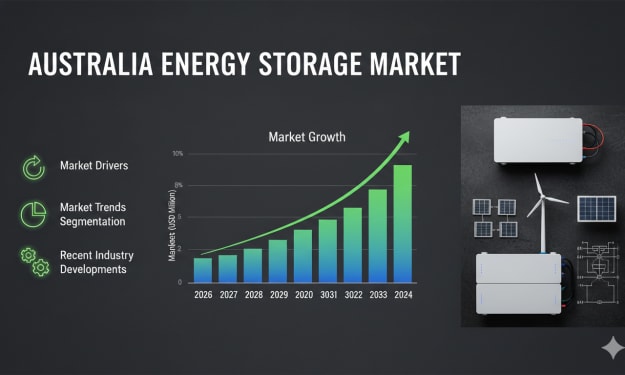
According to IMARC Group, the Australia energy storage market reached 4.72 GW in 2025 and is projected to expand significantly to 19.81 GW by 2034, exhibiting a compound annual growth rate (CAGR) of 17.28% during 2026–2034. The rapid growth of the sector reflects the country’s accelerating transition toward renewable energy and the increasing need for reliable electricity systems across Australia. As solar and wind power generation expands, energy storage technologies such as battery energy storage systems (BESS) are becoming essential for maintaining grid reliability and balancing electricity supply and demand. Government policies supporting clean energy adoption, declining battery costs, and investments in grid modernization are significantly strengthening Australia energy storage market share while enabling the integration of renewable power into the national electricity network.
By Shrestha Roy3 days ago in Futurism
Cooking Oil Market: AI-Driven Innovation Transforming Global Edible Oil Demand
AI Overview of the Cooking Oil Market The cooking oil market includes a wide range of edible oils derived from plant and seed sources such as soybean, palm, sunflower, olive, coconut, and canola. These oils are essential ingredients in households, restaurants, food processing industries, and the HoReCa (Hotel, Restaurant, and Catering) sector.
By James Smith5 days ago in Futurism
Guard Your Battery
Why are some people so attractive just by standing there? It’s not because they are "likable," but because they don’t need everyone to like them. I realized later that truly charismatic people allow themselves to be criticized, but they never criticize themselves. They never try to please the world; instead, the world stops to watch them.
By Emily Chan - Life and love sharing4 days ago in Poets



Comments
There are no comments for this story
Be the first to respond and start the conversation.