
The 5 Pillars of a Successful AI Strategy
Building the Foundation for Sustainable and Scalable AI Impact

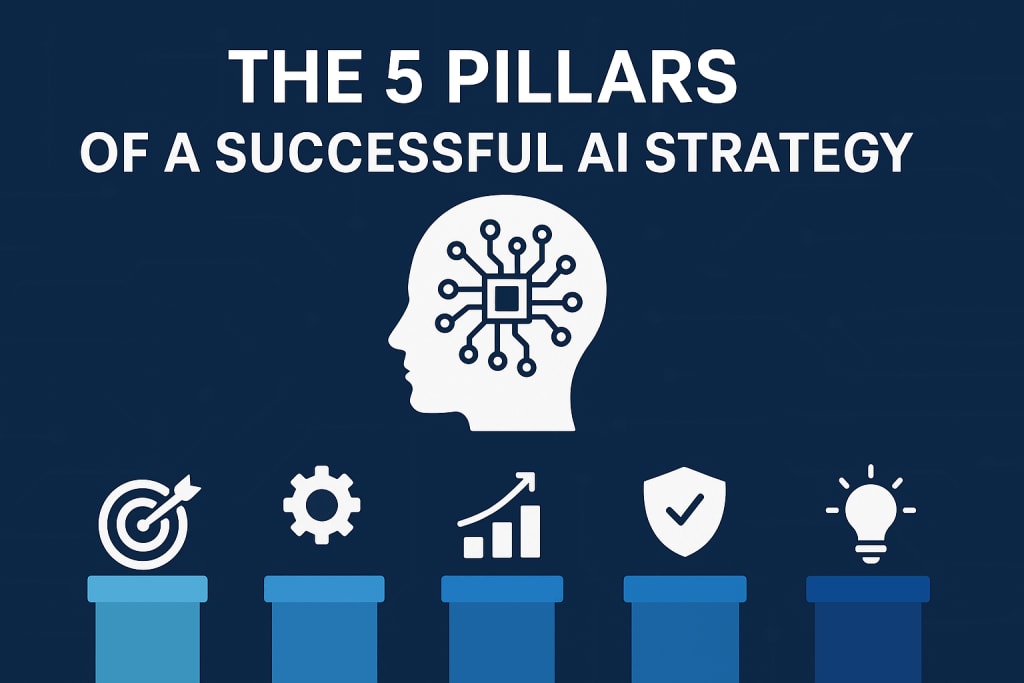
Artificial intelligence has evolved from a futuristic concept into a transformative force that is reshaping how businesses operate across industries. Companies of all sizes are leveraging AI to streamline operations, enhance customer experiences, and uncover new growth opportunities. From predictive analytics in finance to personalized recommendations in e-commerce, AI is no longer optional but essential for maintaining competitiveness.
Despite its potential, many businesses struggle to realize the full benefits of AI. One common mistake is focusing solely on technology adoption without a clear understanding of business objectives or strategic alignment. AI projects that lack proper planning often fail, leading to wasted resources, missed opportunities, and employee frustration. To truly harness the power of AI, businesses need a structured strategy that integrates five key pillars: business objectives, data management, technology and infrastructure, talent and skills development, and continuous evaluation with governance.
Working with experienced professionals can significantly enhance the success of AI initiatives. AI consultants provide valuable insights, industry best practices, and hands-on support for strategy development, model implementation, and process optimization. Collaborating with experts ensures that AI projects are aligned with business priorities and executed efficiently. For companies looking to begin or refine their AI journey, exploring trusted AI consultants can be a strategic first step.
A well-structured AI strategy delivers measurable outcomes by focusing on high-impact initiatives, leveraging the right data, adopting appropriate technologies, and cultivating skilled talent. It enables businesses to make informed, data-driven decisions, automate repetitive tasks, and offer highly personalized experiences that increase customer satisfaction and loyalty. In an era where digital transformation is a key differentiator, businesses that adopt AI strategically position themselves for long-term success.
Moreover, AI is not just about efficiency or cost reduction. It can drive innovation by uncovering new market opportunities, optimizing product development, and predicting trends before competitors. Businesses that integrate AI thoughtfully into their operations are better equipped to respond to market changes, improve operational resilience, and achieve sustainable growth. This makes understanding the five pillars of a successful AI strategy essential for any business looking to thrive in the modern digital economy.
Pillar 1: Clear Business Objectives
Defining Business Goals
The foundation of any successful AI strategy is establishing clear and measurable business objectives. Without defined goals, AI projects risk becoming technology experiments that do not create tangible value. Every AI initiative should have a purpose that aligns with the overall business strategy. Whether it is increasing revenue, reducing operational costs, improving customer experience, or streamlining internal processes, clearly articulated objectives ensure that AI projects are focused and effective.
For example, a retail company may implement AI to predict customer buying behavior, allowing for more effective inventory management and personalized marketing campaigns. In healthcare, AI can be used to analyze patient data to improve diagnostic accuracy and treatment recommendations. These examples show how objectives guide the choice of AI applications, ensuring that technology adoption directly supports business priorities.
Setting Priorities
Not all AI initiatives have the same level of impact. Businesses should prioritize projects based on potential business value, feasibility, and available resources. Conducting a cost-benefit analysis of each potential initiative helps determine which AI projects to pursue first. Starting with high-impact, achievable projects allows businesses to demonstrate early wins and build momentum for larger, more complex AI deployments.
Customer Experience: AI can enhance customer interactions through chatbots, personalized recommendations, and predictive analytics that anticipate customer needs.
Operational Efficiency: Automation of repetitive tasks such as invoice processing, supply chain monitoring, and resource allocation reduces costs and improves accuracy.
Revenue Growth: AI-driven insights can identify new market opportunities, optimize pricing strategies, and improve product development.
Measuring Success
Once objectives and priorities are defined, business organizations must establish metrics to evaluate the success of AI initiatives. Key performance indicators (KPIs) should be specific, measurable, attainable, relevant, and time-bound (SMART). For instance, a customer service AI project might measure response time reduction, customer satisfaction scores, and resolution rates. By continuously tracking KPIs, businesses can assess whether AI initiatives are delivering the expected outcomes and make adjustments as needed.
Defining business objectives is not a one-time activity. Businesses should periodically review and refine goals to reflect changing market conditions, emerging technologies, and evolving customer expectations. This ensures that AI initiatives remain relevant, aligned with business priorities, and capable of delivering maximum value.
Aligning AI with Strategic Vision
Aligning AI initiatives with the broader strategic vision of the business ensures that AI does not operate in isolation. AI should enhance decision-making, complement human expertise, and integrate seamlessly with existing business processes. When AI is strategically aligned, it contributes not only to short-term operational improvements but also to long-term business growth and competitive advantage.
Overall, the first pillar emphasizes the importance of clarity, focus, and alignment in AI adoption. By defining precise business objectives, prioritizing high-impact initiatives, establishing measurable KPIs, and aligning AI with organizational strategy, businesses set the stage for a successful and sustainable AI journey.
Pillar 2: Data Strategy and Management
The Importance of High-Quality Data
Data is the backbone of any AI initiative. Without accurate, comprehensive, and high-quality data, even the most advanced AI models will produce unreliable results. The second pillar of a creating successful AI strategy focuses on establishing a robust data strategy and management framework that ensures data is clean, structured, and actionable.
High-quality data enables AI systems to identify patterns, make accurate predictions, and provide meaningful insights. For instance, in the healthcare industry, AI models that analyze patient records can help predict disease outbreaks or improve treatment plans, but only if the data is complete and accurate. Similarly, in e-commerce, AI relies on precise customer behavior data to provide personalized product recommendations and enhance shopping experiences.
Data Governance and Compliance
Effective data governance is essential for ensuring that AI systems are reliable, ethical, and compliant with regulations. A data governance framework should address:
Data Collection: Define the sources of data, methods of collection, and ensure the data is representative of real-world scenarios.
Data Security: Protect sensitive information against unauthorized access, breaches, and cyber threats.
Regulatory Compliance: Adhere to laws such as GDPR, CCPA, or HIPAA to avoid legal penalties and maintain customer trust.
Data governance ensures that AI models operate within ethical and legal boundaries, reducing the risk of bias, discrimination, or privacy violations. Businesses that prioritize governance are more likely to gain trust from customers and stakeholders while mitigating potential risks associated with AI deployment.
Data Integration and Management
AI models perform best when they have access to comprehensive and integrated datasets. Businesses often collect data across multiple systems, departments, or platforms, which can result in fragmented and inconsistent datasets. A robust data strategy involves integrating these datasets to provide a holistic view of the business.
Key aspects of data management include:
Data Cleaning: Remove duplicates, correct errors, and standardize formats to ensure consistency and accuracy.
Data Labeling: Organize and categorize data to make it suitable for training AI models, especially in supervised learning scenarios.
Data Enrichment: Enhance existing data with additional context or external sources to improve AI insights and predictive capabilities.
Implementing data management platforms or AI-ready data lakes can simplify the process of storing, accessing, and analyzing large volumes of structured and unstructured data. This ensures that AI initiatives are built on a solid foundation, leading to better model performance and actionable insights.
Continuous Data Evaluation
Data strategy is not a one-time effort. Organizations must continuously monitor and evaluate data quality to ensure that AI systems remain accurate and relevant. This involves regularly updating datasets, removing outdated information, and addressing any inconsistencies that arise over time.
For example, in predictive maintenance applications in manufacturing, sensor data must be continuously collected, validated, and updated to ensure accurate predictions. Similarly, in financial services, market data and customer transaction information need to be constantly refreshed to maintain model reliability.
By prioritizing data quality, governance, integration, and continuous evaluation, businesses can create a solid foundation for all AI initiatives. A robust data strategy ensures that AI systems are not only accurate and reliable but also scalable and adaptable to future business needs.
Pillar 3: Technology and Infrastructure
Selecting the Right AI Tools and Platforms
The third pillar of creating a successful AI strategy focuses on technology and infrastructure. Choosing the right tools and platforms is critical because they directly impact the scalability, efficiency, and performance of AI initiatives. Businesses must evaluate AI frameworks, machine learning libraries, cloud-based platforms, and data processing tools based on their compatibility with existing systems, business requirements, and long-term scalability.
For example, cloud-based AI platforms such as AWS, Microsoft Azure, or Google Cloud provide scalable infrastructure, pre-built machine learning models, and integration options with enterprise software. On the other hand, open-source frameworks like TensorFlow, PyTorch, or scikit-learn offer flexibility and customization but require in-house expertise to manage. Selecting the right combination depends on your business organization’s goals, technical resources, and budget.
Planning Infrastructure for Scalability and Reliability
AI workloads, especially in machine learning and deep learning, are often resource-intensive, requiring high-performance computing, large memory, and fast storage solutions. Without adequate infrastructure planning, AI systems can face bottlenecks that affect performance, scalability, and overall ROI.
High-Performance Computing: Ensure that servers, GPUs, and other processing units can handle large-scale AI computations efficiently.
Storage Solutions: Implement robust storage systems capable of handling massive datasets while providing fast retrieval for real-time analysis.
Scalability: Choose infrastructure that can expand as AI initiatives grow, avoiding frequent costly upgrades.
Infrastructure planning also involves integrating AI systems with existing IT ecosystems. Seamless integration ensures that AI outputs can be easily accessed by business users and decision-makers without requiring significant changes to current workflows. For instance, integrating predictive analytics models into enterprise resource planning (ERP) or customer relationship management (CRM) systems enables teams to make data-driven decisions directly within familiar tools.
Ensuring Reliability and Security
AI systems process sensitive information such as customer data, financial records, or proprietary business insights. Ensuring the reliability and security of this infrastructure is paramount. Firms must implement robust cybersecurity measures, regular system monitoring, and disaster recovery plans to prevent downtime, breaches, or data loss.
Cybersecurity: Encrypt data at rest and in transit, implement access controls, and conduct regular security audits.
System Monitoring: Continuously track AI system performance to detect anomalies, performance degradation, or failures.
Disaster Recovery: Maintain backup systems and recovery protocols to minimize downtime in case of hardware or software failures.
Leveraging Emerging Technologies
To remain competitive, businesses should also consider emerging technologies that complement AI. Edge computing, for instance, allows AI models to process data closer to the source, reducing latency and improving real-time decision-making. Similarly, containerization and microservices architectures make AI deployments more flexible and portable across different environments.
By carefully selecting tools, planning scalable and reliable infrastructure, and integrating emerging technologies, agencies ensure that AI initiatives can deliver consistent, high-quality results. This pillar emphasizes that technology is not just a support function but a strategic enabler for AI success.
Pillar 4: Talent and Skills Development
Building an AI-Ready Workforce
No AI strategy can succeed without the right talent. The fourth pillar emphasizes developing a workforce capable of understanding, building, and managing AI solutions. Firms need professionals such as data scientists, machine learning engineers, AI architects, and business analysts who can translate data insights into actionable business decisions.
However, building an AI-ready workforce is not only about hiring new talent. It also involves training existing employees to understand AI concepts and use AI tools effectively. By fostering a culture where employees are encouraged to learn and experiment with AI technologies, companies can maximize adoption and innovation.
Hiring vs. Upskilling
When building AI capabilities, businesses face the choice between hiring new experts and upskilling existing employees. Both approaches have advantages:
Hiring Specialists: Brings in fresh expertise and specialized skills for complex AI projects, such as deep learning, natural language processing, or computer vision.
Upskilling Employees: Strengthens internal knowledge, promotes employee engagement, and ensures continuity of business processes. Training programs, workshops, and online courses can empower staff to contribute to AI initiatives.
A balanced approach often works best. By combining hiring for specialized roles with upskilling programs for existing employees, organizations create a workforce that is both technically capable and deeply familiar with the business context.
Collaboration with External Experts
Partnering with AI consultants or development firms can accelerate learning and implementation. External experts bring experience, industry insights, and best practices that reduce the risk of errors and help businesses achieve faster results. Consultants can assist with strategy development, model design, and deployment, ensuring projects stay on track and aligned with business objectives.
Businesses can explore reputable AI consultants to gain access to specialized knowledge that may not exist internally. Collaborating with experts also provides opportunities for internal teams to learn from hands-on experience, further enhancing the business' AI capabilities over time.
Creating a Culture of Continuous Learning
AI is a rapidly evolving field. New algorithms, tools, and best practices emerge frequently, which makes continuous learning essential. Businesses should encourage experimentation, innovation, and skill development as part of their AI culture. Employees should feel empowered to explore new techniques, share knowledge, and apply AI creatively to business challenges.
Investing in continuous learning initiatives such as mentorship programs, hackathons, and internal AI communities helps sustain innovation and keeps the workforce up to date with the latest developments. By prioritizing talent development, companies not only enhance their current AI initiatives but also build resilience and adaptability for future projects.
Overall, talent and skills development ensures that an business has the human resources necessary to implement AI effectively. A skilled, knowledgeable, and engaged workforce forms the backbone of sustainable AI success.
Pillar 5: Continuous Evaluation and Governance
Monitoring AI Performance
The fifth pillar of a successful AI strategy is continuous evaluation and governance. AI is not a one-time project; it is an ongoing process that requires constant monitoring, refinement, and optimization. Regular evaluation ensures that AI models continue to perform accurately, remain aligned with business objectives, and adapt to changing data or market conditions.
For example, in predictive analytics for sales forecasting, monitoring model accuracy over time ensures that predictions remain reliable. If the model starts producing errors due to changing market trends or data patterns, timely adjustments can prevent costly mistakes and maintain business confidence in AI outputs.
Establishing AI Governance Frameworks
Governance frameworks are essential for mitigating risks associated with AI deployment. They define policies, roles, and responsibilities to ensure ethical, transparent, and compliant AI usage. Key elements of AI governance include:
Ethical AI: Ensure fairness, prevent bias, and maintain transparency in AI decision-making processes.
Accountability: Assign clear ownership for AI models, data management, and outcomes.
Compliance: Follow legal and regulatory standards such as GDPR, HIPAA, or industry-specific guidelines.
By implementing governance frameworks, organizations reduce the risks of reputational damage, legal violations, and biased decision-making, while fostering trust among customers, employees, and stakeholders.
Iterative Improvement
Continuous evaluation encourages iterative improvement of AI systems. AI models should be retrained periodically with new data to maintain accuracy and relevance. Organizations should also analyze performance metrics, collect feedback from end users, and refine models to meet evolving business needs.
For instance, in a customer service chatbot, analyzing conversation logs can reveal gaps in understanding or response accuracy. Updating the AI model based on these insights ensures better customer interactions and satisfaction over time. Similarly, in manufacturing, continuously evaluating sensor data allows predictive maintenance models to improve and prevent equipment failures.
Balancing Automation and Human Oversight
Even the most advanced AI systems require human oversight to ensure ethical and effective outcomes. Humans should validate AI recommendations, investigate anomalies, and provide context that machines cannot interpret. Combining AI automation with human judgment ensures both efficiency and reliability in decision-making.
In conclusion, continuous evaluation and governance are essential to maintaining AI effectiveness, ethical standards, and business alignment. This pillar ensures that AI remains a strategic asset rather than a risk, supporting long-term organizational success.
Integrating the Five Pillars into a Cohesive Strategy
While each pillar is critical on its own, the true power of an AI strategy comes from integrating all five pillars into a unified approach. Businesses must ensure that business objectives, data management, technology infrastructure, talent development, and continuous governance work together seamlessly to deliver measurable results and long-term value.
Creating a Unified Roadmap
Integration begins with developing a comprehensive AI roadmap that aligns initiatives with business priorities. This roadmap should outline:
Strategic Objectives: Clearly defined goals that AI initiatives aim to achieve.
Data Requirements: Specifications for the data needed, including sources, quality standards, and governance rules.
Technology Stack: Tools, platforms, and infrastructure required to support AI projects.
Talent Allocation: Roles and responsibilities, including internal staff, external experts, and upskilling programs.
Evaluation Metrics: KPIs and performance indicators to measure success and guide iterative improvement.
By mapping out these components, businesses can ensure that all AI initiatives are aligned, coordinated, and focused on delivering value. A well-structured roadmap also facilitates communication between departments, reduces duplication of effort, and enables faster decision-making.
Encouraging Collaboration Across Teams
Successful AI implementation requires collaboration between business leaders, IT teams, data scientists, and operational staff. Cross-functional collaboration ensures that AI solutions are practical, scalable, and directly tied to business needs. For example, finance teams working with data engineers can create predictive models for revenue forecasting, while marketing teams can use AI insights for personalized campaigns.
Leveraging Resources and Guidance
Developing an integrated AI strategy can be complex, especially for businesses new to AI. Leveraging expert guidance, frameworks, and actionable resources can accelerate strategy creation and improve outcomes.
Conclusion: Partnering for AI Success
Artificial Intelligence (AI) has the potential to revolutionize business operations, customer experiences, and innovation. However, successful adoption requires more than just deploying technology—it demands a strategic approach built on five key pillars: clear business objectives, robust data strategy, technology infrastructure, skilled talent, and continuous evaluation with governance.
By focusing on these pillars and integrating them into a cohesive strategy, businesses can ensure that AI initiatives are aligned with business goals, scalable, reliable, and capable of delivering sustainable value. Businesses that prioritize strategic planning, data management, skilled workforce development, and ethical governance position themselves for long-term success in a competitive digital landscape.
For companies looking to accelerate AI adoption and ensure successful implementation, partnering with experienced AI development teams is a smart approach. AI development companies provide technical expertise, industry knowledge, and hands-on experience in delivering scalable solutions. Collaborating with trusted partners ensures that AI initiatives are executed efficiently and effectively, maximizing return on investment. Businesses can explore leading AI development companies to find the right partner for their AI journey.
Ultimately, AI is a journey, not a one-time project. Every business needs an AI Strategy that combines a strong roadmap, skilled talent, ethical governance, and robust technology. By adopting this approach, businesses can harness the full potential of AI to improve decision-making, enhance customer experiences, and achieve sustainable growth.
About the Creator
Avantika Shergil
An enthusiastic Operations Manager at TopDevelopers.co, coordinating and managing the technical and functional areas. She is an adventure lover, passionate traveller,and an admirer of nature.
Keep reading
More stories from Avantika Shergil and writers in Futurism and other communities.
Shopify Vs. Squarespace: Strength and Weakness of Ecommerce Builders
With steady growth in online shopping, total Ecommerce sales are expected to exceed $7 trillion by 2025. Increasing ROI makes Ecommerce businesses sell their offerings globally by creating an online store. However, the exciting opportunity is accompanied by the challenge of Ecommerce platform selection.
By Avantika Shergil4 months ago in Geeks
About Binding Prometheus
I want to start actively advocating on behalf of my own work, and the most valuable part of my canon is, without a doubt, Binding Prometheus, the play I have been working on since 2019 and only finished in 2023 as part of my MA. The play itself is an amalgamation of a million different inspirations. On one end, it evokes the Ancient Greek myth-play, deriving its own title from the earliest extant work of Western drama we have, Aeschylus’s Prometheus Bound. On the other end, it borrows significantly from the sci-fi bulwarks from over the years, namely Mary Shelley’s Frankenstein and Karel Capek’s Rossum’s Universal Robots. The play could be an episode of Black Mirror, I fear. I don’t know. I’ve only ever seen one episode of Black Mirror.
By Steven Christopher McKnight15 days ago in Futurism
Biodegradable Cutlery Market: Eco-Friendly Utensils, Sustainable Materials & Zero-Waste Trends
According to IMARC Group's latest research publication, global biodegradable cutlery market size reached USD 46.9 Million in 2024. Looking forward, IMARC Group expects the market to reach USD 69.3 Million by 2033, exhibiting a growth rate (CAGR) of 3.98% during 2025-2033.
By sujeet. imarcgroup7 days ago in Futurism




Comments
There are no comments for this story
Be the first to respond and start the conversation.