
Technology Trends for 2025: The Programming Landscape
2025 an era of coding and programming

The AI Revolution Continues
AI dominated the news for 2024. It will continue to do so in 2025, despite some disillusionment. The data shows massive growth in AI-related skills: Artificial Intelligence grew 190%; Natural Language Processing grew 39%; Generative AI grew 289%; AI Principles grew 386%; and Prompt Engineering grew 456%.
What's particularly interesting is the shift from specific models to general AI principles. Searches for GPT peaked in March 2023 and have been trending downward ever since, so our search data matches our usage data. This suggests developers are focusing on understanding AI fundamentals rather than learning specific tools.
The emergence of AI agents represents the next frontier. Usage of content about LangChain is on a par with PyTorch, and RAG is on a par with Keras. Neither of these skills were in last year's report; in 2023, content usage for LangChain and RAG was minimal. This demonstrates how quickly the field is evolving toward building applications that can plan and execute complex actions.
Programming Languages: A Shifting Landscape
The programming language landscape shows some fascinating trends. We see a small drop for Python (5.3%) and a more significant drop for Java (13%). And even C++, which showed healthy growth from 2022 to 2023, is down 9% in 2024.
However, Rust is up 9.6%. This growth is particularly significant given the U.S. government's emphasis on memory safety. Rust, for example, is gaining attention for its focus on performance, reliability, and productivity.
The decline in traditional programming language content usage raises important questions about learning in the AI era. Could generative AI have had an effect on the development of programming language skills? It's possible; shortly after GPT-3 was released, Simon Willison reported that he was learning Rust with the help of ChatGPT and Copilot.
The Challenge of AI-Assisted Learning
There's a critical concern about how AI affects learning fundamentals. If someone is using AI to avoid learning the hard concepts—like solving a problem by dividing it into smaller pieces—they are shortchanging themselves. Shortcuts rarely pay off in the long term; coding assistants may help you to write some useful code, but those who use them merely as shortcuts rather than as learning tools are missing the point.
The report emphasizes that we'll always need engineers who think like engineers—and that's what learning how to solve problems means. Whether lines end in a semicolon or a colon or whether you use curly braces, end statements, or tabs to delimit blocks of code is immaterial.
Web Development: Back to Basics
Web development is experiencing interesting shifts. Traditional frameworks are showing decline: React (down 18%) and Angular (down 10%). However, The Svelte framework had significant growth (24%); so did Next.js (8.7%).
There's a growing movement toward simplicity. A more significant development has been the movement away from complex platforms and back toward the simplicity of the earlier web. This is driven by performance concerns - despite faster networks and computers, web applications haven't necessarily gotten faster or easier to develop.
Security Takes Center Stage
Security is finally getting the attention it deserves. Security Governance drove the most content use in 2024, growing 7.3% in the process and overtaking Network Security. This represents a shift from reactive security to proactive governance.
The rise of governance is an important sign: "Security" is no longer an ad hoc issue, fixing vulnerabilities in individual applications or specific services. That approach leads to endless firefighting and eventually failure.
Zero Trust architecture is gaining significant traction, showing 13% growth, reflecting the need for authentication strategies that assume potential compromise rather than relying on perimeter security.
The Evolution of Software Architecture
Software architecture remains highly valued, with usage of material about Software Architecture rose 5.5% from 2023 to 2024. Interestingly, microservices are declining in popularity (declined 24%), suggesting the industry is moving beyond the hype toward more practical architectural decisions.
Many organizations that would never need the complexity of microservices were trying to implement them with underskilled staff. As an architectural style, microservices won't disappear, but they're no longer getting the attention they once were.
Professional Development in the AI Age
There's increased focus on professional skills, particularly communication and leadership. Professional Communication, grew 4.5%—not much but significant. We saw a 9.6% increase in users wanting to know more about Engineering Leadership, and a 21.5% increase in users using content about Personal Productivity.
This trend suggests that as technical tasks become more automated, human skills like communication, leadership, and productivity become more valuable differentiators.
Looking Ahead: Key Predictions for 2025
The report concludes with several key predictions:
1. AI Integration Everywhere: Using AI effectively isn't just about coming up with clever prompts so you can copy and paste an answer. If all you can do is prompt, copy, and paste, you're about to become superfluous. You need to figure out how to work with AI to create something that's better than what the AI could do by itself.
2. The Open Model Question: Companies will need to decide between using large foundation models or smaller open models. In the coming year, watch carefully what happens with the small open models. They already deliver performance almost as good as the foundation models and will undoubtedly be the basis for many AI applications.
3. Security as a Core Competency: Companies are waking up to the need to secure their data before their reputations—and their bottom lines—are compromised.
The overarching theme is adaptation: developers and organizations that learn to work effectively with AI while maintaining strong fundamentals in problem-solving, security, and architecture will thrive. Those who rely solely on AI shortcuts or resist the technological shift risk being left behind.
This comprehensive analysis reveals that 2025 will be a pivotal year where the programming industry balances AI adoption with fundamental engineering principles, emphasizing that technology amplifies capability but doesn't replace the need for deep understanding and good judgment.
About the Creator
Keep reading
More stories from noor ul amin and writers in Futurism and other communities.
The Algorithm That Loved Me Back
I never planned to fall in love with a machine.In 2015, I was an undergraduate student, majoring in literature, of all things. My world was filled with poetry, metaphors, and sonnets. The closest I had come to understanding a computer was opening Microsoft Word. But one summer afternoon, during an elective fair, a friend dragged me to a booth titled: "Intro to Artificial Intelligence and Machine Learning."I scoffed. “Machine learning? What’s next? Machines painting like Van Gogh?”The guy at the booth smiled. “Actually, that’s already happening.”That sentence changed everything.
By noor ul amin7 months ago in Futurism
Australia Ready-to-Drink Coffee Market: Consumer Demand, Retail Expansion & Product Innovation
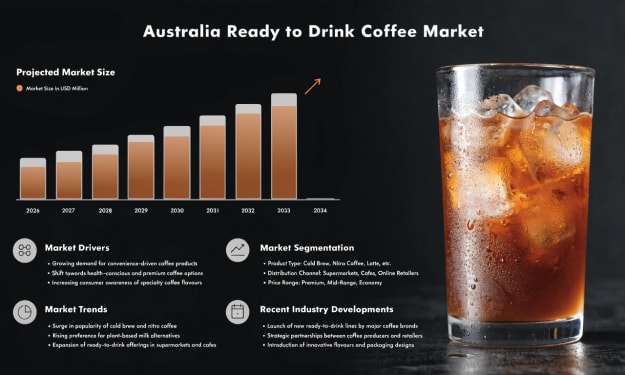
According to IMARC Group, the Australia ready-to-drink (RTD) coffee market reached USD 1,097.9 Million in 2025 and is projected to grow to USD 1,841.6 Million by 2034, exhibiting a compound annual growth rate (CAGR) of 5.74% during 2026–2034. The market’s expansion reflects shifting beverage consumption patterns across Australia, where convenience, portability, and premium taste experiences are becoming central to purchasing decisions. Rising demand for functional beverages, plant-based alternatives, and high-quality cold brew offerings is reshaping product portfolios. As supermarkets, convenience stores, and online platforms expand their beverage selections, Australia ready-to-drink coffee market share continues to strengthen across urban and regional areas.
By Shrestha Roy7 days ago in Futurism
Two Grumpy Old Men Solve the Problem
Marty and Steve were two grumpy old men who lived together. They had known each other for years. Marty had been a bachelor all his life. Steve said it was because no one could stand to ever live with. Marty’s standard reply was “Well, you are, so what sort of a moron does that make you!”
By Calvin London2 days ago in Humor



Comments
There are no comments for this story
Be the first to respond and start the conversation.