
Tarot of The Holy Mountain (Part 1)
A Tarot Reading for Alejandro Jodorowsky's Classic 1973 film.


All pathways lead to the gate of initiation, at the foot of the Holy Mountain, the great, towering pinnacle of our hopes, dreams, and fears.
The Holy Mountain by Alejandro Jodorowsky (not to be confused with the equally brilliant 1926 film by Leni Riefenstahl) is a work of such startling imagery and transcendent brilliance that it rises beyond the level of mere cinema, becoming almost a ritualistic, initiatory act. It marks the viewer on the deepest level, demanding intense scrutiny and concentration not usually afforded the average film. Jodorowsky has claimed, with characteristic understatement, that he wanted to "change the way people thought." That’s as if he said he threw a psychic hand grenade into the middle of a crowded audience just to "hear it go pop." His gift for understatement is incredible (by the way, his audio commentary for the film is the most fascinating I’ve ever listened to).
I could belabor the greatness of this film endlessly, but that would defeat the purpose of examining a film whose visceral and even mystical impact is unsurpassed. The key to the film is TAROT. I am a professional tarot reader and have been for many years.
I won’t pretend to be an expert on the subject of the "Tarot of The Holy Mountain" (how’s that for a potential name for a deck?). I can only share what I see and intuit, based on the unveiling of the film’s mysteries. It may come off as shorthand, or I may miss what some feel are salient points. Be that as it may, "He must needs go whom the Devil drives."
The Fool, The Hanged Man, and The Lord of the Flies
In the beginning of the film, we encounter The Magician, Jodorowsky himself, the card embodying the initiatory phase of a new endeavor—numbered as ONE among the twenty-two Major Arcana. Jodorowsky, wearing a black, wide-brimmed, conical hat, pours a Japanese tea service before stripping down two female acolytes. (The "Two Towers," in Tolkien mythology—Minas Tirith and Cirith Ungol—also refer to the legendary twins Castor and Pollux, represented on The Moon card, as well as Two of Cups—the perfect sacred union of opposites, Yin and Yang. In another sense, eleven is the mystical number of two opposites.)

He shaves their heads, perhaps having dipped his razor in the sacred underground waters of Zam-Zam. The deep, resonant cosmic hum of universal consciousness resonates as the opening sequence unfolds. A body astrally projects, its "spirit cord" visible. The small soul is depicted as a vermin or mouse.
Next, The Fool (credited as "The Thief," played by Horacio Salinas) is seen lying on his back in a puddle of his urine, covered in flies (corruption, Beelzebub, the "Lord of the Flies"—The Devil, a Trump card of the twenty-two). He is aroused by the monstrous side of himself: a limbless dwarf with a Tarot card (the Five of Pentacles, marked by two beggars—also "2,3," or twenty-three in a literal sense) tied to his back. He wears a sickle moon earring. This grotesque figure licks his face. They share a joint. The Thief/Fool looks the image of Christ ("The Cup," the Piscean Age of the Water-Bearer), and he is tied to a cross as The Hanged Man. This is the initiatory phase wherein he passes from devilry and indolence—filth—to a sense that he will "hang himself up" to discover the Holy Truth. Nude children swarm him, throwing stones. ("He who is without sin, cast the first stone," as it says in John 8:7.)
A Fragmented Deity
Progressing into the city, The Thief encounters the strange display of naked soldiers slaughtering students (their souls symbolically escaping their chests like birds), and a military parade of crucified dogs. The ruling class crawls on their knees, their arms outstretched, supplicating the military-industrial complex. Absurd tourists take pictures while dressed in traditional Mexican sombreros and garb, laughing and pleased as their wives are defiled. The Thief is invited to carry a cross. Later, he is made drunk by obese Roman centurions and a man dressed as the Blessed Virgin.

They make a plaster cast of this Christ-like figure. When he awakens from his drunken stupor, he is surrounded by a thousand plaster images of himself as Christ—phony representations of miraculous omnipotence. He screams in psychic agony before finding the single image that pleases him. He eats its face in an act of communion. He is the "Word made flesh," eating his body in symbolic communion with his selfhood and his phony deification. The commercialization of his skin and bone, as a stand-in messiah.
The Bourgeoisie on Their Knees
The Dance of the Bourgeoisie is depicted by men and women in evening dress on their knees, impaled above them by cruciform images of what appear to be skinned animals, perhaps dogs. Birds, as souls, are shot from the chests of student radicals executed in the streets by the Chilean army. A bishop lies in bed with a corpse. The defeat of the Mayan Pyramids is depicted by huge, grotesque toads that conquer, fight, and erupt in blood to a Nazi marching song. This display is presided over by a clown, a street entertainer, in a top hat with a swastika band.
A woman is defiled by a soldier while her husband, cuckolded and a tourist type, eagerly snaps photos. It is all surreal madness.
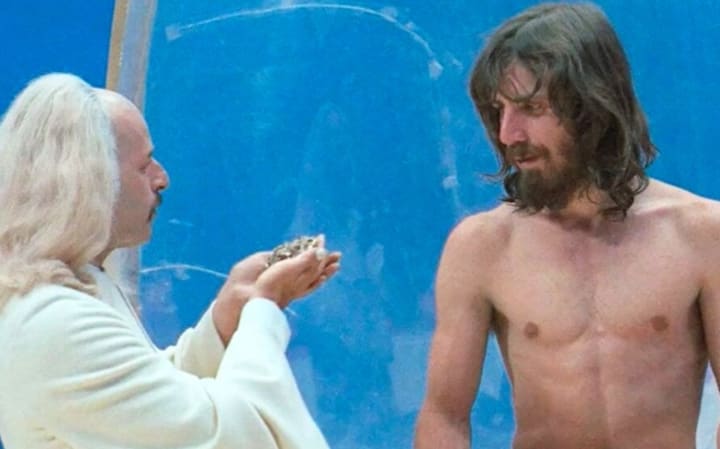
Our Christ figure, our Holy Fool, proceeds to The Tower (Trump number 16, six and one equaling seven, a high mystic number). Ascending to the apex of The Tower, he gains entrance and traverses the tunnels, until he meets a thin, gorgeous black woman with a shaved head and the mien of an Egyptian princess. She is covered in a tapestry of mystic symbols—her tattoos, the roadmap of alternating routes to the same mystic destination of the dawn. Around her throat, she wears a golden necklace. Her nails are long, sinister talons. This is The High Priestess, her skin tattooed with holy, arcane, and occult symbology. She holds within herself the secrets of these coded expressions, the keys unlocking the doors of higher perception—the alphabet of initiation. But is any of it valid and true?
The Holy Mountain | 1973
She cleanses him in an explicit scene. He is accorded all four symbols of the Tarot suits—Wands, Cups, Swords, and the Pentacle shield. Approaching him is The Magician, Jodorowsky himself, posed in a kung-fu stance, his absurdly large hat and high boots creating a strange countenance in black.
"Your excrement," he tells the Fool, who is about to become The Initiate, "is gold." And indeed, he is imprisoned inside a giant glass beaker or retort, wherein he defecates. Thus, we’ve transmuted filth into energy, wealth, power, and magnificence. But this is only one doorway out, and there are others along the path to the Holy Mountain.
End of Act 1
The Holy Mountain | Alejandro Jodorowsky (4K HD Trailer)
Author's website:
My book: Cult Films and Midnight Movies: From High Art to Low Trash Volume 1
Ebook
My book: Silent Scream! : Nosferatu. The Cabinet of Dr. Caligari, Metropolis, and Edison's Frankenstein--Four Novels. (Writing as C. Augustine)
Ebook
About the Creator
Tom Baker
Author of Haunted Indianapolis, Indiana Ghost Folklore, Midwest Maniacs, Midwest UFOs and Beyond, Scary Urban Legends, 50 Famous Fables and Folk Tales, and Notorious Crimes of the Upper Midwest.: http://tombakerbooks.weebly.com
Biogas Plants Market To Reach USD 9.4 Billion by 2034 at 7.6% CAGR
Overview The Biogas Plants Market is projected to experience steady growth over the coming decade, driven by increasing demand for renewable energy and sustainable waste management solutions. The market is expected to be worth around USD 9.4 billion by 2034, up from USD 4.5 billion in 2024, growing at a compound annual growth rate (CAGR) of 7.6% from 2025 to 2034. Biogas plants convert organic waste such as agricultural residues, food waste, and animal manure into renewable energy in the form of biogas, which can be used for electricity generation, heating, and transportation fuel.
By Hayden Kulas2 days ago in Futurism
Thermal Paper Market: POS Receipt Demand, Retail Digitization & Industry Growth Outlook
According to IMARC Group's latest research publication, The global thermal paper market size was valued at USD 4.7 Billion in 2025. Looking forward, IMARC Group estimates the market to reach USD 6.9 Billion by 2034, exhibiting a CAGR of 4.22% during 2026-2034.
By sujeet. imarcgroup3 days ago in Futurism



Comments
There are no comments for this story
Be the first to respond and start the conversation.