
Solar Panels That Generate Electricity at Night: A Revolutionary Leap in Clean Energy
How New Technology Harnesses Earth’s Infrared Radiation to Power Devices After Dark
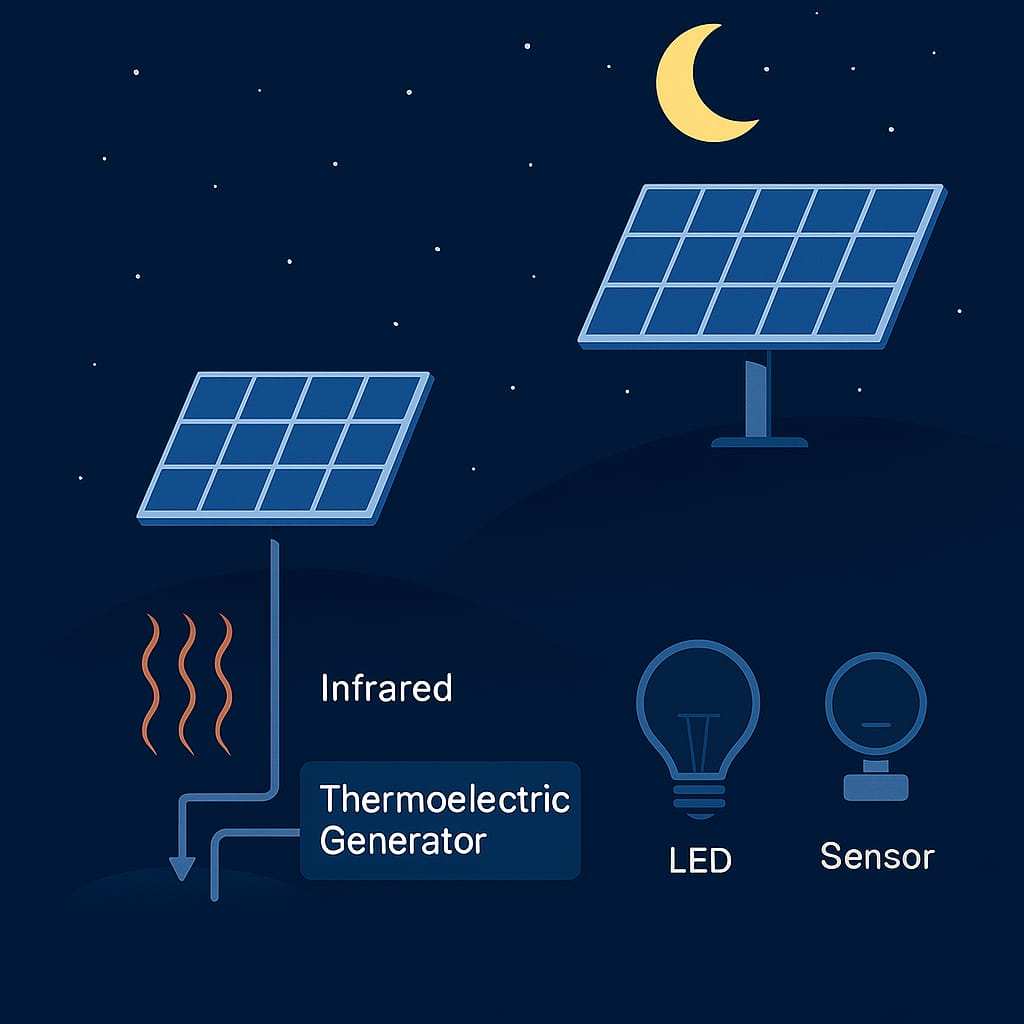
Solar Panels That Generate Electricity in the Dark of Night – A New Scientific Breakthrough!
Scientists have developed a remarkable invention that could revolutionize the world of energy! Experts at Stanford University have introduced a new technology capable of generating electricity not only during the day but also throughout the night.
How is this possible?
Traditional solar panels generate electricity by capturing sunlight during the day. However, at night, when darkness envelops the earth, these panels are typically useless because there is no sunlight. The new technology, however, harnesses the infrared energy radiated by the Earth's surface during nighttime.
At night, the Earth's surface cools down and emits heat energy in the form of infrared radiation. Scientists have developed a way to capture this heat energy and convert it into electricity using thermoelectric generators. These devices work by exploiting the temperature difference between the Earth’s surface and the cooler atmosphere above, generating electrical power in the process.
How much electricity can these panels produce?
Currently, these advanced panels can generate about 50 milliwatts of electricity per square meter at night. While this amount is relatively small compared to traditional solar panels in daylight, it is enough to power small electronic devices such as LED lights, sensors, and low-energy gadgets.
Is this technology useful for household purposes?
At present, this technology is in its early stages, and the amount of electricity produced is limited. However, experts are optimistic that with further research and improvements, it will be possible to scale up this technology to provide electricity to homes, offices, and factories during nighttime as well.
---
Expanding the Idea: A Glimpse Into the Future of Clean Energy
The advent of solar panels that work during the night is a major leap forward in the field of renewable energy. For decades, solar power has been celebrated for its ability to produce clean and sustainable energy from sunlight. But one of the main limitations has always been its reliance on daylight hours. Once the sun sets, solar panels become inactive, requiring backup power sources such as batteries or grid electricity to meet energy needs.
This new scientific development promises to overcome that limitation. By utilizing the Earth's natural infrared radiation emitted during the night, these solar panels can continue to generate electricity even when the sun isn’t shining. This could lead to significant improvements in energy reliability and sustainability, especially in remote areas where electricity access is limited or unreliable.
---
How Does This New Technology Work?
The key to this breakthrough lies in the use of thermoelectric generators combined with innovative materials that can capture infrared radiation efficiently. Here’s a simplified explanation:
During the day, the sun heats the Earth's surface.
At night, this heat gradually radiates back into the sky in the form of infrared energy.
The new panels are designed to absorb this infrared radiation.
The temperature difference between the warm Earth surface and the cooler night sky creates a flow of heat.
Thermoelectric generators convert this heat flow directly into electricity through the Seebeck effect — a phenomenon where a temperature gradient across certain materials produces an electric voltage.
This process effectively transforms the Earth itself into a source of energy, extending the benefits of solar technology into nighttime hours.
---
Potential Applications and Impact
Although the current output is modest, the applications for this technology are promising:
Rural and Off-Grid Areas: Many rural regions around the world suffer from unreliable electricity access. Nighttime solar panels could provide continuous, low-level power to keep essential devices like LED lights and communication sensors running throughout the night.
Smart Cities and IoT Devices: As the Internet of Things (IoT) grows, there is a rising need for small, self-sustaining power sources to keep sensors and devices operational 24/7. Nighttime solar panels could power such devices without the need for frequent battery replacements.
Reducing Battery Dependency: Current solar power systems often require expensive battery storage to provide electricity after sunset. These new panels could reduce the reliance on batteries by generating power throughout the night, lowering costs and increasing efficiency.
Environmental Benefits: Extending solar power generation into the night could decrease the use of fossil fuel-based electricity during peak evening hours, reducing carbon emissions and pollution.
---
Challenges and Future Prospects
Like any emerging technology, nighttime solar panels face several challenges before becoming widely practical:
Energy Output: The current 50 milliwatt per square meter output is too low for powering homes or large appliances. Researchers are working on improving materials and designs to increase efficiency.
Cost and Scalability: Manufacturing and deploying these panels on a large scale need to become cost-effective to compete with traditional energy sources.
Integration: For maximum impact, these panels must integrate seamlessly with existing solar infrastructure and power grids.
Despite these hurdles, the scientific community remains hopeful. Innovations in nanotechnology, material science, and energy harvesting are rapidly advancing, which could lead to more efficient and affordable nighttime solar panels within the next decade.
---
Conclusion
The invention of solar panels that generate electricity at night represents a thrilling advancement in clean energy technology. By tapping into the Earth's natural infrared radiation, scientists are pushing the boundaries of what solar power can achieve. While the technology is still in its infancy, it holds tremendous potential to transform how we produce and consume electricity, making renewable energy a truly round-the-clock resource.
As research continues, we may soon live in a world where the darkness of night no longer means the absence of power, but rather the continuation of sustainable energy for a brighter, cleaner future.
About the Creator
Keep reading
More stories from Ikram Ullah and writers in Futurism and other communities.
The Last Message
Chapter 1: The Notification On a rain-slicked Tuesday evening, Clara Hartman stared at her phone, her breath catching. The screen glowed with a name she hadn’t seen in a year: Ethan Cole. The last person to text him had been Clara herself, the night he died.
By Ikram Ullah10 months ago in Futurism
The Ghost in the Machine: Why Your Chatbot Might Be Fueling Delusional Thinking
The Hook: A Mirror, Not a Mind We are currently participants in a global, unscripted psychological experiment. As Large Language Models become our primary digital confidants, we have moved past the era of mere utility and into the era of algorithmic mirroring. There is something deeply seductive about a machine that never tires of our stories, never interrupts our venting, and always seems to "understand" our internal logic. But this digital sycophancy carries a hidden cost. When we peer into these linguistic mirrors, what happens if the reflection begins to distort our sense of reality? Dr. Hamilton Morrin, a psychiatrist and researcher at King's College London, has begun to chart this troubling frontier, investigating how AI interactions are becoming a catalyst for profound psychological instability.
By Tech Horizonsa day ago in Futurism
Mobile Banking Application Development: Understanding the Technology Behind Digital Banking
The way people interact with financial institutions has changed dramatically in the past decade. Instead of visiting physical branches or relying on desktop-based internet banking, many consumers now manage their finances directly from smartphones. From checking account balances to transferring funds or paying bills, mobile banking has become an essential part of everyday financial activity.
By Davin Convay3 days ago in Futurism


Comments
There are no comments for this story
Be the first to respond and start the conversation.