
Solar Man ignites young minds of Apeejay School, Noida
The visit by Professor Chetan Singh Solanki was more than an event; it was a wake-up call, a stirring reminder that change begins with now
On the bright morning of April 28, 2025, Apeejay School, Noida, witnessed an extraordinary visit that would remain etched in the hearts of its students and staff for a long time. Professor Chetan Singh Solanki, renowned as the Solar Man of India, arrived at the school aboard his solar-powered bus, carrying not just his mission but also the fire of transformation. His visit was part of the Energy Swaraj Yatra, a nationwide movement aimed at promoting energy self-reliance and environmental sustainability.
Professor Solanki is a distinguished educator, researcher, innovator, and certified teacher of the Art of Living’s Happiness programme. Since November 2020, he has embarked on a remarkable 11-year journey aboard a solar bus, set to continue until 2030 with a pledge not to return home throughout this entire duration.
The Energy Swaraj Yatra, designed to address urgent climate change challenges, aims to spark a broad movement for 100% solar energy adoption. Prof. Solanki’s remarkable journey has earned accolades, including a commendation from Prime Minister Modi.
Professor Solanki has led major solar projects at IIT Bombay, including the National Centre for Photovoltaic Research and Education (NCPRE). Through his Solar Urja through Localisation for Sustainability (SoULS) project, he has reached 7.5 million families, providing them with clean light.
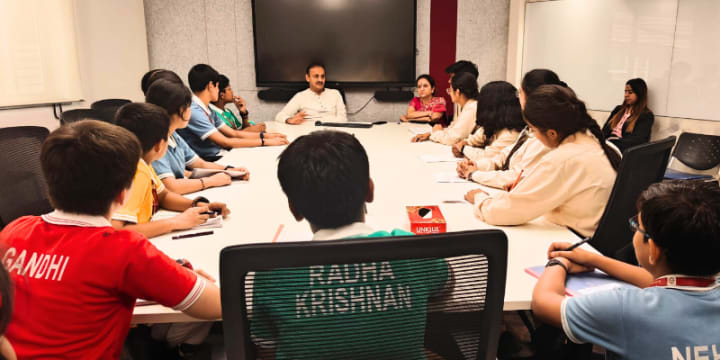
The session began with an interaction between Professor Solanki and a select group of students in the school’s conference room. This personal conversation revealed the man behind the mission — a visionary who had given up the comforts of home to live in his solar bus for 11 years, committing himself to his cause.
As the discussion unfolded, the students, filled with curiosity, asked a wide range of questions. One particularly thought-provoking moment came when a student asked how the idea of Energy Swaraj differed from the globally trending concept of Net Zero. Professor Solanki’s response was deeply insightful and critical. Net Zero, he explained, is a misleading term.
“We proudly say we’ll offset emissions, but nothing we do is ever truly zero. Everything — from manufacturing to consumption — has an environmental cost.” He illustrated that even generating 100 kilowatts of solar power consumes materials like copper, aluminium, and silicon, which are extracted at the cost of the Earth’s resources. “You can’t claim zero impact after digging up the planet,” he said passionately. “Everything we do, from wearing a shirt, sitting on a chair, brushing our teeth, is a transaction of energy.”
With his characteristic intensity and humility, Professor Solanki explained his view that the world is essentially a theatre of energy. “From the moment we wake up to the time we sleep, everything we touch, use, or consume is a form of energy. The tragedy is, most of us are playing the game all wrong — we don’t understand the cost behind even the smallest act.”
He used a seemingly mundane example, such as brushing our teeth, to underscore how deep our everyday energy usage goes. “Is brushing a simple activity or a dangerous one?” he asked, then unravelled the web of energy consumption behind it: the factories producing toothbrushes, the transportation, packaging, storage, and even the energy required to run water taps. Each element, he said, contributed to a significant environmental load. “Just this one action involves mining, manufacturing, electricity, and logistics. And we repeat it every day, mindlessly.”
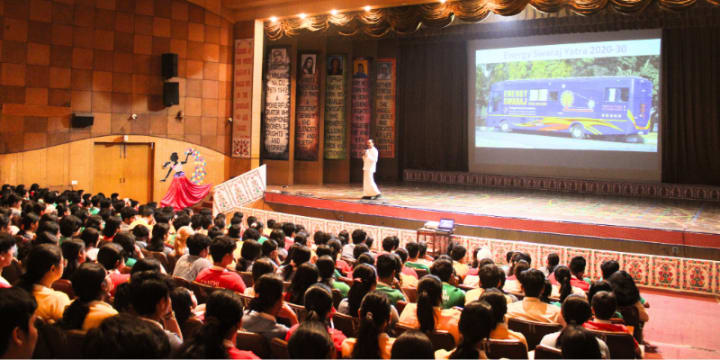
With this, he drove home a hard-hitting message: we are playing with resources without understanding the rules of the game. And unless we change the way we think and act, we will remain “the most foolish species on the planet,” as he put it. “We’ve polluted the air we breathe, the water we drink, and the soil we depend on. Isn’t that the very definition of stupidity?”
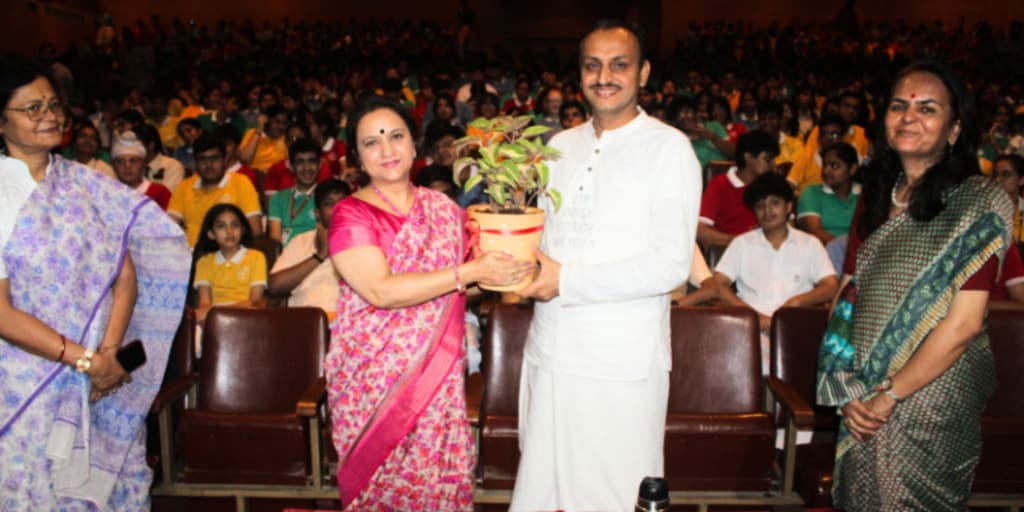
From the conference room, Professor Solanki then moved to the school auditorium, where students from Classes VI onwards were eagerly waiting. The formal ceremony began with a warm welcome from the school’s leadership, Dr Neha Sharma (Principal), Ms Amrita Hajela (Vice-principal, Senior School), and Ms Puneeta Bhasin (Vice-principal, Junior School). Professor Solanki was honoured with a symbolic green welcome—a sapling—signifying the school’s commitment to sustainability.
Two students of class VIII namely Natalya Agarwal and Avighna Kaushik read out his biography and detailed his inspiring journey. The stage was set for an unforgettable session. Dressed in his iconic white shirt that read, I am energy literate. Are you? Professor Solanki captivated the audience instantly. He opened with a relatable question: “Do you realise that even brushing your teeth consumes energy?” This sparked a wave of enthusiasm among the students, who eagerly engaged with him, asking about ways to reduce their energy footprint.
What followed was not a lecture but a journey into awareness and responsibility. He involved students in interactive activities, such as enacting Ashcharya Chakit Pranayam — an expression of constant wonder — and repeating affirmations like I am happy and I am grateful.”These moments built not just awareness, but a deep emotional connection with the cause.
He invoked Plato’s wisdom, quoting, “Kings should become philosophers or philosophers should become kings,” emphasising the importance of wise leadership in shaping the world. This segued into the core of his message — six critical questions every citizen must ask: What has changed? Why has it changed? Who has changed it? When should we start correcting it? How do we correct it? And what can I do as an individual?
Each question was dissected with real-life examples and practical solutions. He highlighted how the Earth has seen dramatic shifts due to unchecked energy consumption and CO2 emissions. “Our population, our consumption, everything is increasing — but the size of our planet remains the same. We’re expanding without limits on a finite resource.”
To address this, Professor Solanki proposed actionable solutions — promoting finite consumption, minimising unnecessary usage, generating clean energy locally, and the mass adoption of solar energy. He didn’t preach, he practised. “I generate my energy, live within it, and have made myself completely independent,” he shared. His bus itself is a living example of the Energy Swaraj ideology —powered by solar panels, it symbolises self-reliance and mindful living.
The session culminated in a vibrant Q&A where students asked a range of thoughtful questions — from the role of electronic vehicles and the impact of WhatsApp messages, to water conservation and the challenges of solar energy adoption. Professor Solanki responded with patience, clarity, and depth, reinforcing the role of individual action in global change.
The final moments were truly transformative. He stressed that it’s not governments or corporations, but “I”, each individual who must take responsibility. “I have done it. I must correct it.”
As a fitting close to the event, Principal Dr Sharma delivered a heartfelt speech, thanking Professor Solanki for his powerful insights and his unwavering dedication. She applauded the Energy Swaraj Yatra for igniting such deep reflection and commitment in young minds.
Taking the centrestage, Dr Sharma shared, “Thank you, Professor Solanki, for visiting our school and sharing such a powerful and much-needed message. Today’s session was truly an eye-opener. I hope each one of us reflects on what was discussed and continues the conversation at home with parents, siblings, and family so that they, too, become part of this important movement. We don’t need more problems; we need solutions, and that begins with us. On behalf of all our students, who I believe are capable of bringing real change, thank you once again for inspiring us to use our resources mindfully for a better tomorrow.”
“I will go home and encourage my parents to use everything in moderation,” shared Samrat Upadhyay of Class VII-B. “I’ll also talk to my friends about it, because we are the generation of tomorrow, and it’s our responsibility to act now.”
“This was an insightful session. I will try to store fruits in water or baskets to reduce the use of the refrigerator,” shared Anay Kapoor of Class VII-D. “I’ll also make sure my friends and siblings are aware of the simple steps we can take to make a difference.”
It was time to take a pledge to save energy, reduce consumption, and live mindfully. The visit was more than an event, it was a wake-up call, a stirring reminder that change begins with us. Through his passion and purpose, Professor Solanki planted the seeds of awareness in the fertile minds of Apeejay School, Noida’s students. And if those seeds grow into thoughtful action, the future will indeed be cleaner, greener, and more sustainable!
For more coverages, visit: www.apeejay.news
About the Creator
Keep reading
More stories from Apeejay Newsroom and writers in Futurism and other communities.
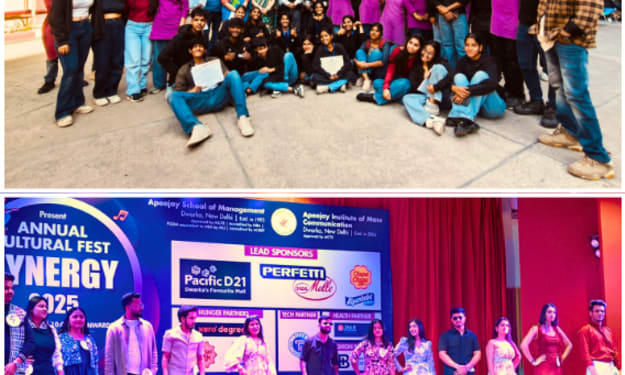
A grand celebration of talent, art and creativity
The atmosphere at Apeejay’s Dwarka campus was electric as the much-anticipated “Synergy 2025” kicked off, bringing together students from Apeejay School of Management (ASM) and Apeejay Institute of Mass Communication (AIMC) for the grand annual fest.
By Apeejay Newsroomabout a year ago in Futurism
Palm Vein Biometrics Market: Healthcare Patient Identification, Data Security & Growth Outlook
According to IMARC Group's latest research publication, The global palm vein biometrics market size was valued at USD 1.81 Billion in 2025. Looking forward, IMARC Group estimates the market to reach USD 7.99 Billion by 2034, exhibiting a CAGR of 17.12% from 2026-2034.
By sujeet. imarcgroup2 days ago in Futurism
AI in Geospatial Market expected to be worth around USD 1,165.3 Million by 2033
The Global AI in Geospatial Market size is expected to be worth around USD 1,165.3 Million by 2033, rising from USD 78.3 Million in 2023, and it is projected to grow at a CAGR of 31.0% during the forecast period from 2024 to 2033. The strong expansion of this market is associated with the increasing use of artificial intelligence in mapping, remote sensing, satellite imaging, and spatial analytics.
By Roberto Crum4 days ago in Futurism


Comments (1)
wow