
Solar Fractional Ownership
Solar energy has become one of the most promising solutions for the world's growing energy demands; however, not everyone can install it. We have an Answer.

Solar energy has become one of the most promising solutions for the world's growing energy demands and environmental challenges.
However, not everyone can take the risk of installing a solar system on their property due to lack of high initial costs, space boundaries, or property ownership.
This is where there is a fractional ownership for solar projects.
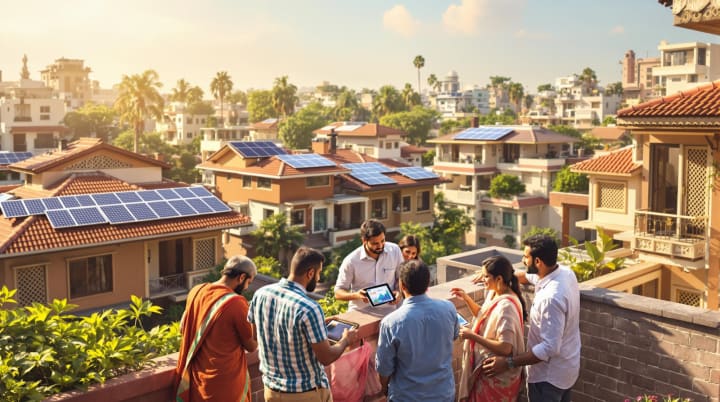
Fractional ownership allows many individuals or institutions to collectively invest in a solar project and share benefits including cost savings and energy production.
In this blog, we will find out what solar fractional ownership means in solar projects, how it works, and why it is becoming a popular investment option.
What is fractional ownership in solar projects?
Fractional ownership is the concept behind sharing the ownership of a solar project among many investors.
Instead of investors bearing the full cost of setting up a solar installation, they buy a portion or "fraction" of the project.
Owners share the generated energy and financial returns based on their share of ownership in the project.
For example, a solar project costing ₹1 crore has an annual power generation of 500,000 kWh.
In this case, if an investor owns 10% of the project, he would have contributed ₹10 lakh to the project and be entitled to receive 10% of the energy output or financial returns generated by the project.
The arrangement allows individuals and companies to reap the benefits of solar energy without having to install panels on their own premises.
Fractional ownership is becoming highly attractive in urban places or where rooftop solar installation is not possible due to space constraints or building regulations. It also allows solar investments for those who might not have the full financial muscle to install a solar system independently.
How fractional ownership works?
1. Project Development: A solar company, such as MYSUN, identifies a viable site for a solar project and handles the design, permitting, and construction.
2. Investment Offering: The project is divided into “shares” or “fractions” that are made available to investors. Investors can purchase these shares based on their budget and desired level of involvement.
3. Energy Production and Distribution: Once the solar project is operational, the electricity generated is fed into the grid or used to power specific properties or facilities.
4. Profit Sharing: The revenue generated from the sale of electricity or savings on energy costs is distributed to the investors according to their share in the project.
5. Maintenance and Monitoring: The solar company manages the project’s maintenance and performance to ensure maximum efficiency and return on investment.
Investors typically sign a contract outlining the terms of ownership, expected returns, and the duration of the agreement.
This structure ensures transparency and provides investors with a clear understanding of their rights and benefits.
Types of Fractional Ownership
Solar projects offer various models of fractional ownership, each addressing different investor requirements and project sizes:
1. Community Solar Projects
Community solar gives multiple participants the chance to invest in a single solar project and get benefits based on their ownership share. The grid receives the generated electricity, and participants see credits on their electricity bills.
Let's say a community solar project produces 100,000 kWh and an investor owns 5% of the project. They would get credits for 5,000 kWh on their energy bill.
2. Cooperative Solar Ownership
This model involves a group of individuals or businesses creating a cooperative to develop and own a solar project. The members share the profits from selling electricity or the savings on energy costs based on their investment.
Shared solar initiatives are widespread in countryside regions and tight-knit towns. In these places, group ownership helps to lower the money strain on each person taking part.
Benefits of Fractional Ownership
Profits from the sale of electricity or savings on energy costs combine into one big pot, and members receive money based on how much they have invested.
Cooperative solar projects are becoming common in rural areas and smaller communities, where lower collective ownership reduces the burden on individual participants.
This is a classic collaboration by other companies or industries aimed at pooling investment in a solar project to discount their own energy consumption and lower their operational costs.
Through economies of scale, the plan facilitates resource pooling in ensuring that businesses benefit.
For example, in a case where manufacturing plants group together to invest in a large-scale solar farm, they will be compensated with energy proportional to their investment in which to power their facilities.
Conclusion
Fractional ownership in solar projects is a game-changer for the renewable energy sector.
It allows individuals and businesses to access the benefits of solar power without the high upfront costs and maintenance responsibilities: by investing in a share of a solar project, participants would enjoy lower electricity costs, tax benefits and do their part for a greener future.
One cannot just be taking the decision to invest in fractional solar ownership for economic reasons; it is also a move toward a cleaner and sustainable future.
About the Creator
Keep reading
More stories from Punit Mehta and writers in Futurism and other communities.
Solar Energy and Water Conservation
Understanding the Connection When we talk about solar energy, the conversation often revolves around electricity generation and reducing carbon emissions. However, there is an interesting and often overlooked connection between solar power and water conservation that deserves our attention.
By Punit Mehtaabout a year ago in Futurism
About Binding Prometheus
I want to start actively advocating on behalf of my own work, and the most valuable part of my canon is, without a doubt, Binding Prometheus, the play I have been working on since 2019 and only finished in 2023 as part of my MA. The play itself is an amalgamation of a million different inspirations. On one end, it evokes the Ancient Greek myth-play, deriving its own title from the earliest extant work of Western drama we have, Aeschylus’s Prometheus Bound. On the other end, it borrows significantly from the sci-fi bulwarks from over the years, namely Mary Shelley’s Frankenstein and Karel Capek’s Rossum’s Universal Robots. The play could be an episode of Black Mirror, I fear. I don’t know. I’ve only ever seen one episode of Black Mirror.
By Steven Christopher McKnightabout a month ago in Futurism
Chance AI: Is It the Best Google Lens Alternative for Visual Search in 2026?
Visual search has become a part of everyday digital life. From identifying objects to understanding images instantly, people now expect technology to “see” the world the way humans do. For years, Google Lens has dominated this space. However, growing concerns around privacy, ads, and biased results have pushed users to look for better alternatives. This is where Chance AI enters the conversation. As 2026 unfolds, many users are asking a simple but important question: Is Chance AI the best Google Lens alternative for visual search?
By Maheep Makkarabout an hour ago in Futurism



Comments
There are no comments for this story
Be the first to respond and start the conversation.