
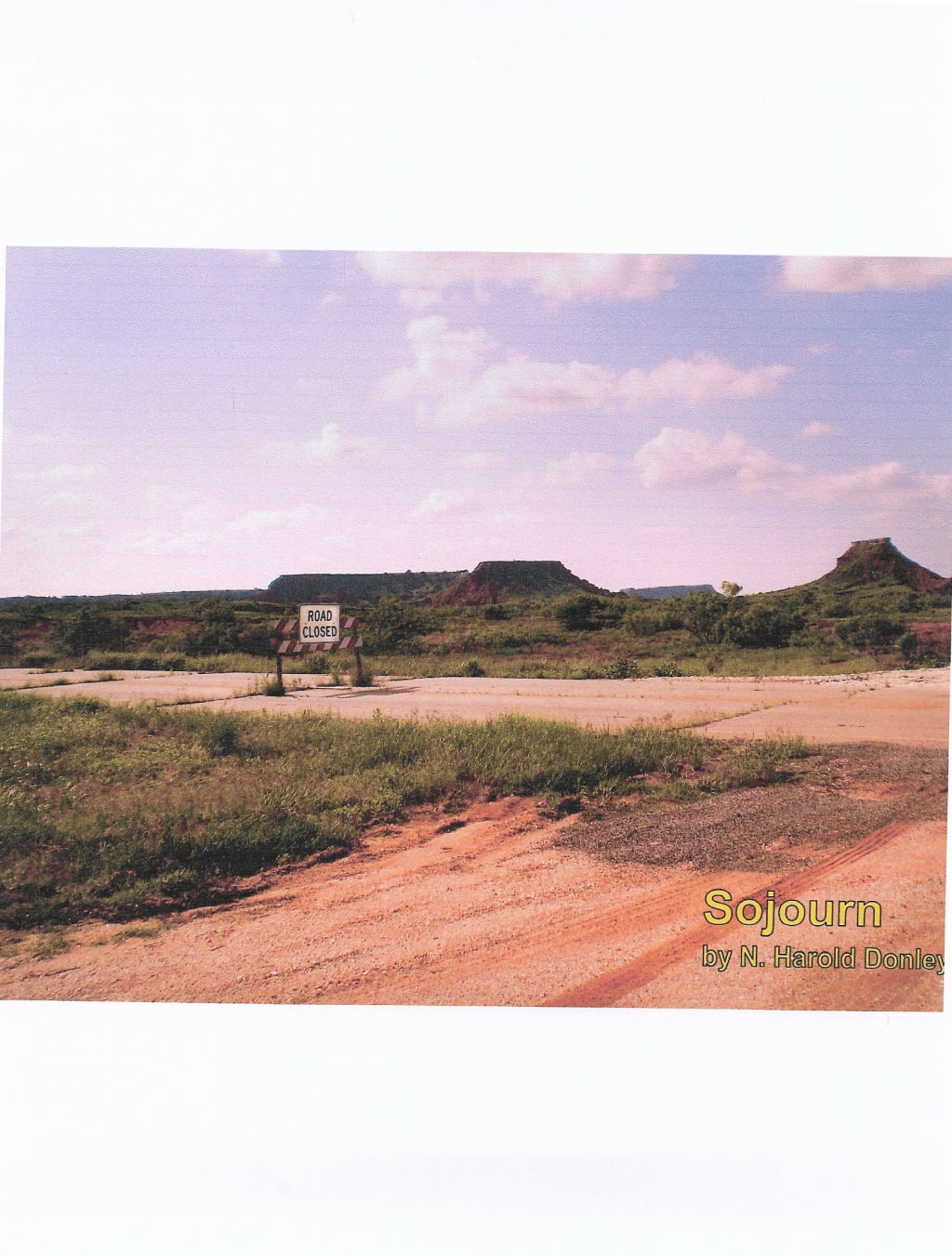
Sojourn by N. Harold Donley
A Journey in the New Territories
The red dust streaked the windshield as the wipers swept across.
The sun was low now; its intensity piercing even the mirror sunglasses the driver wore. He adjusted the interior visor but knew, in 20 minutes, 30 tops, it would be glaring into his eyes again.
Time to make camp, he thought as he glanced over to his gauges, 120 degrees Fahrenheit, power down to one quarter and trending low fast.
He brought the bus to a stop at the crest of a small hill to scan the horizon. The cloud of red dust trailing his van caught up and enveloped him. He pulled the bandana around his neck up to cover his mouth and nose.
The dust still penetrated, causing him to cough.
"Damn!" He said aloud, to no one but himself.
As the dust settled he could make out the land. The same as this morning, the same as this afternoon; low rolling hills of tall, brown grass, broken by red patches of cracked but hard earth. Scattered about were the skeletons of dead trees, their leafless branches broken and gnarled against a purplish horizon.
Then he saw it. At the base of one of the hills … a living tree!
Not just any tree, a towering cottonwood that he had missed at first glance because he thought it to be a smaller hill.
"That's it!" He proclaimed as he spun the steering wheel toward the tree and left the relative flatness of the old concrete road. The van pitched from side to side over the uneven ground. He hung out the driver’s window watching for rocks and other obstruction that could break an axis, with glances to the power gauge.
The batteries were almost out.
The indicator was blinking red.
Finally, he was there. The massive Cottonwood had certainly seen better days, it's leaves brown around the edges but its roots obviously ran very deep, or it would be dead like so many of it's surrounding fellows.
Not much time, he thought as he pulled up to the drooping canopy of the tree. He backed the van up so its tail was facing south, or at least what he hoped was south.
Looking around one last time, he turned the van off, the quiet hum of the electric engine immediately ceased, and he thought, For better or worse, this is it for at least a day.
Swinging out of the driver’s seat into the van interior he crouched as he unlatched the roof. It popped loose and, with help of the grab bar, he pushed it to its full height. As he did a new faint hum began, the sound of the photovoltaic cells on the roof absorbing the setting sunlight.
Sliding open the side door he stepped out of the camper van and under the cottonwood canopy, brushing aside low hanging branches as he entered.
It must be 20 degrees cooler, he thought, Thank God.
He took off his bandana and wiped the sweat and red grim from his face. Pulling himself up into the tree he found a place where two branches fanned out from the trunk, wide enough to cradle him.
His last thought, as he drifted off to sleep, No scorpions, no snakes...good...another day.
***
He awoke in a sweat…
… of course, he always woke up in a sweat.
Climbing down from the low branches where he had made his bed, he walked over to the van.
It was night now but the heavy heat lingered, held in the earth, radiated into the air.
Sliding open the van side door, he sat in the doorway looking back under the tree canopy. Pulling out a container he munched on wheat and rye sprouts, then took a sip of precious water from a nearby jug. "You're all that remains,” he said to himself as he popped more of the sprouts into his mouth.
***
It was a modest farm, in the wheat country near Woodward, OK. His family had farmed the land since the early 1900s. It had survived the Great Depression, two world wars, the Woodward tornado of 1947, blizzards, droughts, and bad political decisions.
But, it would not survived "The Change".
It had begun long before he was born. Warnings about climate change had been made since the late Twentieth century. But with the start of the Twenty-First Century the summers became more intense, and ever longer, winters milder with occasional freakishly heavy blizzards followed by incredibly intense "storm” seasons in the spring.
Scientists were unified, speaking clearly in paper after paper, conference after conference, treaty after treaty. But, the world went about its way, burning more of the very fossil fuels everyone knew was causing the problem.
"National leaders" in the Senate, Congress and even the Presidency denounced climate change theory, calling it "the greatest hoax".
The clock ticked.
For him, away at the University, messages from The Farm had become more dire. The wells had dried up, the wheat would not grow, the cattle began to die...there was no water to be had, except what the occasional rains brought. The deep aquifer the farmers had always relied upon had ceased to yield, some people said the underground aquifer caverns had collapsed from being drained so completely.
When the messages stopped, he left the University for home.
Too late.
He found them in their bedroom, lying together. His Father was cradling his Mother's hand. Next to him, on the nightstand, was a note.
Son,
If you are reading this then you can see what happened,
Your Momma came in this morning and said, between coughs, “The last hog is dead.”
After the wheat, the cattle, you Momma's garden, and everything else, that hog was just the last straw. Your Great Grandpa used to say, “As long as you got a sow, you can make it.” That was what got the family through the Dust Bowl days, but now we didn’t even have that hog!
Your Momma wandered out the back door. I thought she was checking on her garden.
That’s where I found her. The heat, lack of water and dust pneumonia was finally just too much for her good heart.
I laid her out here on the bed.
I must have sat in that kitchen, staring out the window, for a day and a night.
That was when I heard the "Announcement" on the radio. We are not Americans, not people, anymore. Someone, somewhere had declared us expendable… just empty land. Oh, they said it more nicely than that but that is what they meant.
Well, Son, that was just it for me.
Your Momma is with the Lord, in the Bosom of Abraham.
Our way of life is gone.
I suppose it's time for me to go too.
As your Momma used to say, "You must find your place in the circle.”
We love you, Son.
God Bless and keep you.
Dad.
He buried them in the garden, between the rows his Mother had tended for decades. As he muttered a prayer the last words seemed particularly poignant, “ …dust to dust…,” as he sprinkled red dust over their graves.
After attending to his parents, he wandered about the farm, eventually finding himself in the barn.
What now? He thought.
He sat on the dirt floor in the stifling heat of the barn, thinking of his parents, this farm, and everything lost. The world was spinning beyond his control, beyond humankind’s control...beyond comprehension. Events set in motion by humanity's inability to live within its own means...its own world …had now come down to him on this dirt floor in the barn of a failed farm.
Looking up, his eyes fell on the family's old VW electric camper van. Inside, he saw the small dream catcher hanging behind the front seats. His mother was descended from an Arapaho family near Seiling. Her Grandmother had brought the dream catcher to their family, when she was active in what was then known as the Pan-Indian movement in the 1970s. Originally from Ojibwa Nation, dream catchers were one of several items spread throughout other Nations by movement participants.
His Mother had placed the dream catcher in the van for their family trips...and to remind him of his place in the circle.
Rising, he walked to the van, opened the side door and cradled the dream catcher in his hand. Outside the van he saw two large sacks of seed, wheat and rye, and heard the hum of the solar panels on the roof.
And, in that moment, he knew…
"Thank you, Momma,” he said quietly, almost reverently, as he leaned against the door frame.
Like the First People of the Plains, who knew the land, he would be become a wanderer, a nomad ... a sojourner.
He could fit some of the solar panels from the barn to the van roof, making it into a portable charging station. He could not travel more than a few hundred miles on a charge, but he could traverse the land, finding water and sustenance where he could.
No “Okie” refugee status for him, no relocation camp, teaming with others with no place to go.
He would make his own way.
***
All those memories from a handful of sprouts... he thought as he finished off his dry meal.
A little later, with the sun almost down, he found himself lying in the tall grass on the crest of one of the hills surrounding the hollow, he could see down into the valley on the other side. A bright rectangle of light illuminated the dark prairie. The Pump jack in the center bobbed up and down in a ceaseless rhythm. The distant shouts of men could be heard as they moved about the site.
"Oilies!" He hissed to himself.
The Oilies were the only people the Marshals, the only law enforcement allowed on the prairies…or, the “Territories," as they called it.
All of what was once known as the “Plains States” of the 50 states which comprised the United States, except Texas to the South, lost their status as sovereign states and were reconfigured as territories, as they had once been in the 19th Century. From small farming / ranch communities to major cities, the populace was “evacuated” to the Border States, or Borderlands, where large refugees camps were established.
Oklahomans were uniquely familiar, historically, with these regressive policy decisions. Once know as the “Indian Nations," or, simply, the “Nations," in the 19th century, Oklahoma was a territory of the United States populated by nearly 40 sovereign tribal nations well into the 20th century before becoming one of the last states to be admitted to the union. In the 1930s, in the midst of The Great Depression, the “Dust Bowl," the first ecological disaster, sent thousands of Oklahomans, “Okies” as they became known, to camps in California and other states, where they worked as underpaid migrant workers in their own country.
Just a few years earlier, when the country was faced with public utilities collapsing from the strain of warming temperature and a corresponding decrease in available fresh water, the Congress determined that the lesser populated interior states of the Great Plains were expendable … except for their oil and gas resources.
So, once again, Oklahoma became a territory, along with four other states, with the majority of its people moved to the Borderland camps for relocation to the remaining 45 states in the union.
Now, only “renegades” lived in the Territories. Most, like him, were nomads who wandered across the great expanse of grass to eke out an existence on the land they refused to leave…remnants of a state whose state song once proudly proclaimed, “We know we belong to the land…”
The oil field workers, “Oilies," maintained the oil and gas operations and transported the oil back to refineries in the Borderlands. There, between "the Territories" and the ever-expanding Mississippi Sea, the oil was refined and sent on to power what remained of the coastal cities on the fringe of the continent.
Parasites! He thought, It's not enough that you altered the planet...now you're the only game in town...and you just keep making it worse.
***
He snapped away another sand plum and dropped it into his bag.
He felt quite fortunate to find a cluster of trees this morning that were still bearing fruit, albeit smaller and more shrunken in the heat. He had come across some blackberry canes as well
He would save a small amount of both fruits to eat over the next day or so; the rest would go into the dehydrators to be made storable.
As he walked back through the tall grasses he reflected on his life now. A sojourner, moving from spot to spot, spending a few days recharging the van batteries and gathering food and water then off to a new place. Always moving, just like the people of the plains in ancient times, moving with the season from spot to spot to gather what nourishment there was to be had. How interesting that the few, such as him, who had remained had reverted, albeit with contemporary devices, to the ancient ways, the proven ways of the land and its people.
In the van, he carried an array of collapsible items, dehydrators, solar water still, and even a solar oven to process and cook his meals. Combustion, fire, was out of the question. Not only was there little fuel for a sustained fire, but, the fire itself was extremely dangerous in these arid grasslands.
Pulling his sweat-stained straw cowboy hat lower against the morning sun; he could feel the oppressive heat of the day rising. It was probably in the 90s already and he knew it would be 120 by mid-day.
Hopefully, by that time, he would be relaxing in the shade of the cottonwood.
Breaking out of the high grass into his campsite, he walked over to the van and opened the side door. Pouring a half-cup of water from the gravity fed jug on top of the cabinet, he was taking his first sip when he heard it...
... a rattle!
He froze.
The rattlesnake was coiled by the back tire, curling tighter and tighter.
A strike was imminent.
He had walked right up on the snake without seeing it. The best he could hope for was the strike would hit where his pants covered his boots, perhaps too thick for the fangs to penetrate. His crossbow was out of reach in the van, without a bolt, and any movement toward the knife on his belt would simply make the snake strike sooner than later. All he could do was stand as still as possible and hope, just hope, the rattler choose to slither on rather than strike.
At just that moment…an arrow impaled the rattler’s head.
It struck from behind, severing the spine and going on to dissect the brain. The snake, with the arrow now protruding, dropped its head into its coils and withered.
Startled, he looked about for an instance at the withering snake and then lunged toward the cabin.
“DON’T!” came a voice.
She stepped out from under the cottonwood branches with another arrow already fully drawn in her long bow. The arrow was aimed, center-shot, at him.
“NOT!” was all he shouted as he threw his hands up and bowed his head.
She walked forward, her eyes watching him, the bow still drawn, coming up next to the dead snake. She watched him for a long time, and then motioned him away from the van. Glancing inside she ran her eyes over the bed, the small kitchen, the storage cabinet with water jug and even the crossbow, hanging on the far van wall.
It was then she saw the dream catcher hanging behind the seat.
“Cheyenne?” was all she asked.
“Arapaho” he answered, “From my Mom.”
She smiled and lowered the bow, ”Comanche.” She continued looking around the cabin as she spoke, ”You look more Anglo. And a sun burnt Anglo at that.”
“Irish and German from my Dad…Scots and Arapaho from my Mom.”
“Irish and Scots, myself," she smiled again, “those Celts got around. Driven out by the same invaders who came to this land…once upon a time.”
“Water?” he gestured toward the jug on the kitchen counter.
Her smile broadened, “Yes, please,” she sat down in the doorframe, ”I’ve never seen a rig quite like this.”
He handed her a half-cup of water, ”My Dad bought it new in 2025, one of the first all electric models with a 300 miles range. He kept up with battery replacements and such over the years. I cannibalized solar panels from our old farm for the top.”
Staring down at the water cup, she said, “Sorry about before, I thought you might have been a surveyor from the station in the valley,” she said gesturing toward the hilltop and beyond. “A women must look out for herself.”
She stood and walked over to the dead rattler. Producing a long bladed knife, she put her boot on the snake’s head and detached it from its body. “Sorry, little brother…” She said quietly, closing her eyes for just a few seconds, as if in prayer.
Then using the arrow shaft as leverage she flung the rattlesnake head off into the tall grass on the opposite side of the van. “So, Rattlesnake?”
***
She was sleeping in the van.
The idea of sleeping on an actual bed, even in a stifling cabin, was just too tempting and he thought allowing it was the least he could do for someone who had saved him from a painful death by snakebite. He went about his chores of setting out the dehydrators to dry the fruits he had gathered. They had cooked some of the rattlesnake meat in the solar oven, set the rest out to dry into jerky in one of the dehydrators and stretched the skin for later utility.
He could feel himself getting dizzy, his breath becoming heavier. He glanced at the thermometer on the outside of the van, 110 and climbing. The sun had crossed over the cottonwood and continued in westward journey putting more of this side of the tree in welcome shadow.
It was time for a siesta, a nap.
Taking a rolled up hammock from the cabin he fashioned a nice spot between two of the low branches of the cottonwood. He drifted off to sleep in just a few seconds in the shade of its canopy.
***
His nostril twitched.
Something acrid ...
He started awake, just as she came running under the canopy from the van cabin, “Do you smell it?”
“Yeah!” he shouted as he untied the hammock and rolled it quickly.
They both knew that smell...
Wildfire!
Off to the East, they saw black smoke rising across the entire horizon.
“It’s a big one.” He said, throwing the hammock into the van, “Help me get these into the van!”
“There’s no time,” she said, grabbing up her bow and quiver, ”the wind is blowing out of the East. It will be here in minutes!”
He grabbed her by the shoulders, “You see the size of that thing? Do you think it’s going to leave anything to eat behind?”
As she nodded agreement, the orange tipped flames broke over the far hill and began streaking down into the valley just beyond their hollow.
“Hurry!” he said, grabbing a dehydrator. ”Just throw them inside.”
She began pitching equipment into the van cabin as he lowered the roof. Partially dehydrated fruit spilled across the floor. Some of the partially dehydrated fruit squished under his feet as he stepped across the van floor to the door.
Done.
The hill across the valley from them was now black. They could not see the flames, but the black smoke was everywhere.
Just then a huge fireball erupted sending a mushroom plume of orange-red flame high into the sky.
“The pumping station!” he exclaimed. “I hope those Oilies got out.”
“Yeah, I hope so too,” she said as she scrambled into the passenger seat.
As he pulled himself behind the steering wheel he hit the “start” button and felt the satisfaction of the slight vibration from the electric engine. Glancing at the indicator he could see it was half charged.
Checking all sides quickly, he wheeled the van back up the hill toward the road, away from the flames.
Finding the road, he floored the accelerator.
She turned to look behind them, ”Oh, no, its on the camp!”
The cottonwood tree…exploded into a tower of flame.
All he could see in the mirrors now was flame!
There was silence as they raced along, cresting another hill and heading down, the flames temporarily obscured.
“The Salt Flats!” she exclaimed, grabbing his shoulder, “Make for the Salt Plains!”
“Yes, yes...the flats.” He yelled, pushing the van for more speed, ”Salt crystals and sand but no grass or trees.” They rounded another hill, heading into a low valley as the flames crested that same hill. The salt flats had once been a state park, back when Oklahoma was still a state.
“Can we make it?” she asked, anxiety in her voice as she stared into the side mirror.
“ I don’t know... it will be close, the road is winding ... we don't dare go ‘off road’... it will slow us to a crawl.”
They did not say any more, just stared ahead as the flames raced down the hill toward them.
At the valley entrance the flames caught up to them. He swerved the van to the middle of the narrow, ancient highway, to put as much distance as possible, on either side, between the flames fanning out rapidly in all directions behind them. They were in a bottleneck of fire with the surrounding hills trapping the heat and flame.
The thick, black smoke enveloped them, but they could not slow down. Both, instinctively, pulled their bandanas up on their faces, to block at least some of the smoke.
The coughing began, becoming more ragged with every breath.
“Faster! You have to go faster!” she exclaimed between coughing fits.
He flattened the accelerator to the floor, praying the road immediately ahead was straight and not curved as he could make out very little through the windshield.
Then, as if someone opened a door, they exited the valley, driving out of the smoke.
“There!” she shouted, pointing to a small bridge spanning a dry creek bed ahead, “The flats are on the other side.”
Just then they felt a lurch. He glanced over to the monitors, the power indicator was going to yellow...warning.
“We’re losing power. She was not designed to be topped out like this, we’ve burned through a half day of energy in just a half hour!”
The flames erupted from the valley, fanning out across the grasslands toward the road, the bridge and the van.
In seconds, the flames, fanned by the winds, caught up to them, rolling over the van exterior and even, for a moment, seeming to get ahead of them. It engulfed them, with only their forward motion carrying them through the conflagration. Smoke spewed from the vents, filling the cabin. They both gasped, coughing so hard it was almost impossible to sit erect and for him to hold the wheel straight.
The flames were swallowing them whole.
It was at that moment they crossed the bridge.
The flames hit the rock and gravel of the dry creek bed and, with no fuel, began to abate. It was a natural firebreak followed by miles of salt flats.
They rolled off the road onto the hard Salt Flats, hearing the crunch of the sand and salt crystals under their tires.
Stopping the van, he fell forward onto the steering wheel. With what was left of the van’s power, and his own strength, he held down the switch that opened all the windows, allowing the smoke in the cabin to escape.
The fresh, hot air of mid-day flooded into the cabin.
She fell back into her seat, closed her eyes and just exhaled.
Moments of silence passed before he opened the door.
Half falling and stumbling, he stepped out of the cab onto the salt flats. Walking a few steps, he turned and looked back at the van. The exterior paint was singed, but, miraculously, the tires looked okay and the solar panels seemed undamaged.
He pitched forward, falling to his knees on the sand and salt crystals. His head fell forward, his eyes closed and he fell silent; just listening to his own slow but deep breaths and the pounding of his heart.
Alive!
He did not know how much time passed.
He was lost in the silence of his mind, grateful to have survived Hell itself.
He felt an arm drap over his shoulders, felt a body close to his, words and breath being whispered into his ear, “We’re alive. Thank the Creator, we are alive!” was all she said. She lowered her head next to his, he raised his arm to embrace her and they simply held one another.
“Neither of us would have survived that alone,” he said quietly, some time later. “Thank you…thank you…”
She smiled, a familiar feeling smile, “I know we have not known each other long, but, perhaps we ought to stay together, at least for a while.”
She formed her hand into a fist and held it out. He did the same and bumped hers, to which she said, “Renegades.”
“Sojourners.” He replied with a smile.
Yes, this was their world now. Scorching heat, savage winds, little water, and only the food they could scrounge from dying plants. The plains had always been a tough land, made more so by these new extremes. A meager life here or a life of little hope in a camp, where they were the new “illegals” in their own land.
Yes, together. In his mind he knew, together they might not only survive this changing environment, they might, actually, be able to create a new community, with other renegades, in this changing world.
Looking back into the van, now fully silhouetted in the afternoon sun, his eyes found his mother’s dream catcher…
…I found my place in the circle, Momma.
Sojourn Copyright © 2021 by N. Harold Donley and Lughnasa Press, All Rights Reserved.
Note from N. Harold: I hope you enjoyed "Sojourn". This may be the beginning of a new series of short stories I will post on VOCAL. If you are so inclined, I hope you will consider leaving a tip for me. Tips go directly to my account, within a day or so, and are a direct means of supporting my work as an author.
Also, feel free to check out my original climate-fiction work, OUTWORLD, available whereever ebooks are sold as well as at the BookBaby Store, https://store.bookbaby.com/book/outworld1. You can purchase an ebook, print-on-demand copy or both.
About the Creator
N. Harold Donley
N. Harold Donley is a free lance writer based in Norman, OK. Author of OUTWORLD, a novella set in a climate altered future, N. Harold has also written a number of short stories. He is currently working on a sequel to OUTWORLD.
Keep reading
More stories from N. Harold Donley and writers in Futurism and other communities.
The Black Notebook
The Black Notebook By N. Harold Donley “ NO! WAIT! THAT’S MY CAR!” Running out of the corner cafe into the cold rain, I watched my little red station wagon disappear around the corner on the tow truck. I stood there for a moment, in the middle of the street, cars skirting around me.
By N. Harold Donley5 years ago in Humans
About Binding Prometheus
I want to start actively advocating on behalf of my own work, and the most valuable part of my canon is, without a doubt, Binding Prometheus, the play I have been working on since 2019 and only finished in 2023 as part of my MA. The play itself is an amalgamation of a million different inspirations. On one end, it evokes the Ancient Greek myth-play, deriving its own title from the earliest extant work of Western drama we have, Aeschylus’s Prometheus Bound. On the other end, it borrows significantly from the sci-fi bulwarks from over the years, namely Mary Shelley’s Frankenstein and Karel Capek’s Rossum’s Universal Robots. The play could be an episode of Black Mirror, I fear. I don’t know. I’ve only ever seen one episode of Black Mirror.
By Steven Christopher McKnight18 days ago in Futurism
Australia Iron Ore Market: Global Supply Leadership, Steel Demand & Resource Security
In 2024, Australia iron ore market reached USD 8.34 Billion. Looking ahead, the market is projected to expand to USD 12.23 Billion by 2033, exhibiting a compound annual growth rate (CAGR) of 3.90% during 2025–2033.
By Kevin Cooper6 days ago in Futurism
The Devil's Cut
“Comrade, finally you’re awake.” The voice was smooth, sensual. A flickering incandescent bar was all that lit the white, sterile room. All Vladimir remembered was everything going black. He tried to move his arms and found them strapped to the gurney.
By Matthew J. Fromm4 days ago in Fiction


Comments
There are no comments for this story
Be the first to respond and start the conversation.