
Single-Wheel Passenger Vehicle (SWPV)
Balance the future — one wheel, endless possibilities.
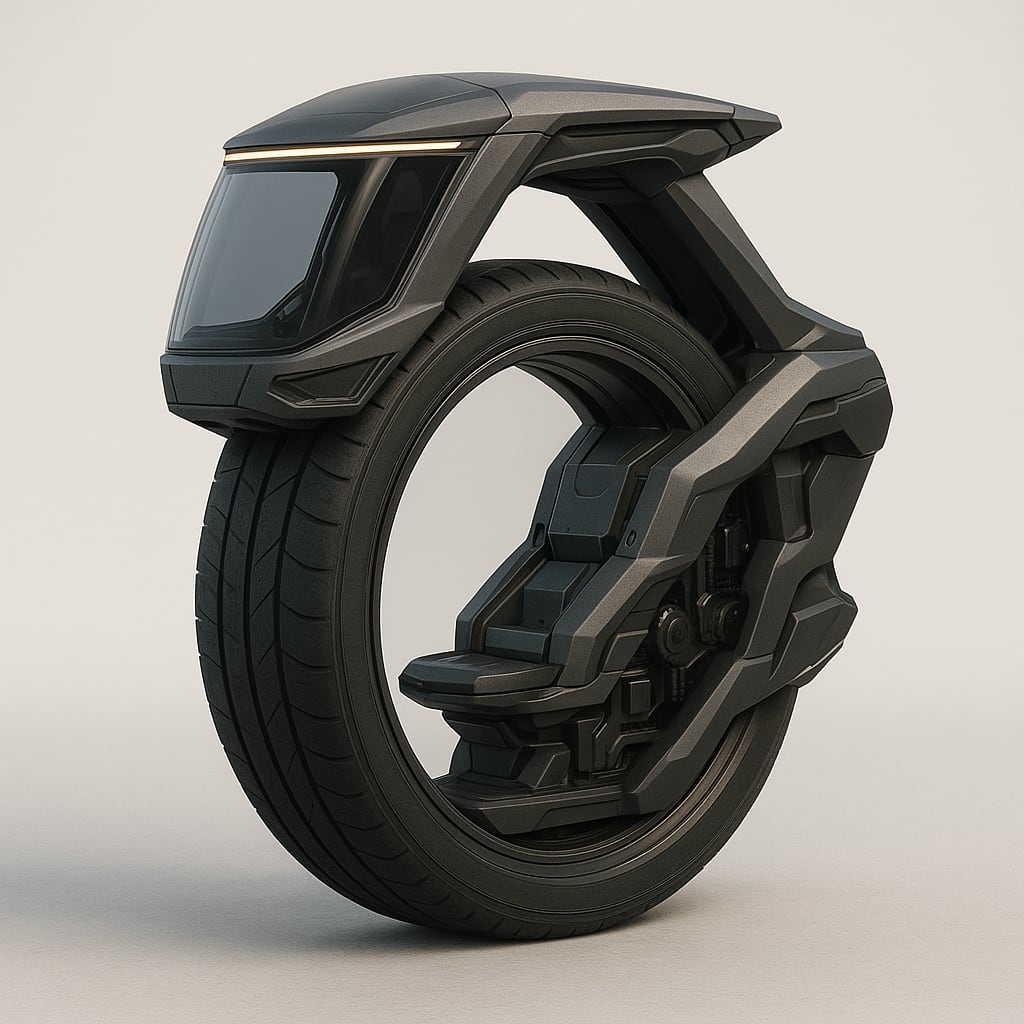
🚘 Concept: Single-Wheel Passenger Vehicle (SWPV)
🔧 How It Works
1. Structural Overview:
• A massive central wheel forms the base.
• The passenger module is mounted either within or above the wheel, stabilized dynamically.
• All movement and balance are achieved through precise motor control and AI-assisted sensors.
2. Core Components:
• Drive Unit: Electric motors that spin the wheel and enable directional control.
• Stabilization System:
• Gyroscopes + Inertial Measurement Units (IMUs): For real-time orientation sensing.
• Flywheels or Reaction Wheels: Used to counteract instability.
• Suspension Module: Dampens vibration and adjusts center of mass dynamically.
• Power Source: High-density lithium batteries or future alternatives like solid-state or hydrogen fuel cells.
• Frame: Carbon fiber or magnesium alloy for a lightweight yet durable chassis.
3. Locomotion & Control:
• Forward/backward: Controlled by varying the torque on the wheel.
• Turning: Achieved by leaning the module or via internal directional motors.
• Braking: Regenerative, combined with torque reversal.
⸻
💰 Estimated Cost Breakdown (Prototype Stage)
Component Estimated Cost
High-Torque Motor System $3,000–$5,000
Custom Wheel Fabrication $2,000–$4,000
IMUs + Gyroscopes $500–$1,000
Battery System $3,000–$6,000
AI Control Hardware (e.g., Jetson Orin) $500–$1,000
Frame and Shell (CF/Alloy) $2,000–$4,000
Software R&D $10,000+
Total (Prototype) $20,000–$35,000
Mass Production Target: ~$5,000–$10,000 per unit
⸻
✅ Pros
• Minimal Footprint: Ideal for crowded cities; occupies very little road space.
• Ultra-Agile: Can turn in place, operate in tight spots.
• Eco-Friendly: Zero emissions.
• Futuristic Appeal: Could redefine personal mobility.
• Advanced Safety Potential: With AI, can predict and prevent accidents.
• Battery Efficiency: One wheel = less rolling resistance.
⸻
❌ Cons
• Stability Complexity: Extremely hard to balance, especially on uneven terrain.
• Risk of Toppling: Sudden movements or wind gusts may destabilize it.
• Passenger Comfort: Constant stabilization might cause motion sickness.
• High Initial R&D Costs.
• Not Suitable for Rough Terrain.
⸻
🤖 Role of AI in SWPV
AI would be the central nervous system of the vehicle:
1. Balance & Motion Control
• Real-time adjustments using AI-assisted PID controllers.
• Predictive modeling to respond faster than traditional controls.
2. Navigation & Obstacle Avoidance
• Vision + LiDAR + Ultrasonic sensors for detecting objects.
• AI-driven path planning and traffic understanding.
3. User Personalization
• Adapts riding style (aggressive/smooth).
• Learns preferred destinations, behaviors, music, etc.
4. Maintenance & Self-Diagnostics
• AI can detect wear in real time and predict failures before they happen.
⸻
🔮 Future Scope
1. Urban Commuting Pods
• Autonomous or semi-autonomous pods for last-mile delivery and people transport.
2. Swarm Transport Systems
• Networked SWPVs could operate as a fleet, optimizing traffic flow.
3. Military & Rescue
• Single-wheel form can traverse narrow paths or rubble zones.
4. Entertainment & Tourism
• Used in theme parks or futuristic cities to offer a new experience.
5. Transformable Vehicles
• Modular passenger cabins that can attach to different wheel platforms (single-wheel for urban, 4-wheel for off-road, etc.).
⸻
🧪 Innovations You Could Explore
• Magnetically Levitated Module inside the wheel (for ultra-smooth ride).
• Wireless Charging Pads integrated into roads.
• AR HUD for riders (navigation, info overlays).
• Biometric Access and gesture-based controls.
• Self-healing tires or airless composite wheels.
• Swappable AI Brains for upgrading software like a PC.
⸻
📈 Investment & Go-to-Market Strategy
• Start with small-scale prototypes.
• Partner with urban mobility labs or smart city pilots.
• Pitch to venture firms interested in green mobility + AI.
• Eventually, enter markets like:
• Personal mobility (India, China, EU)
• Last-mile delivery bots (Amazon, Flipkart)
• Smart campuses
⸻
🧠 Summary
A single-wheel vehicle is viable, futuristic, and full of potential, but extremely hard to implement safely without top-tier AI and mechanical control systems. The idea blends robotics, vehicle dynamics, AI, and UX design — a dream project if you’re into deep tech or want to push the limits of transportation design.
About the Creator
Keep reading
More stories from Ojas Srivastava and writers in Futurism and other communities.
Ball Bearing Market: Aftermarket Replacement Demand, Maintenance Solutions & Industry Growth Ahead
According to IMARC Group's latest research publication, the global ball bearing market size reached USD 45.46 Billion in 2024. Looking forward, IMARC Group expects the market to reach USD 65.05 Billion by 2033, exhibiting a growth rate of 3.65% during 2025-2033.
By sujeet. imarcgroup6 days ago in Futurism
Australia Digital OOH Advertising Market: Technology Adoption, Audience Targeting & Programmatic Growth
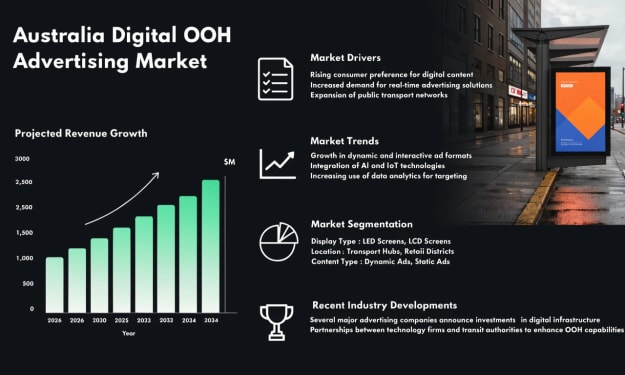
According to IMARC Group, the Australia digital out-of-home (OOH) advertising market reached USD 474.2 Million in 2025 and is projected to grow to USD 1,096.9 Million by 2034, exhibiting a compound annual growth rate (CAGR) of 9.47% during 2026–2034. The market’s expansion reflects the rapid digital transformation of outdoor advertising infrastructure across Australia. Increasing smartphone penetration, advancements in display technologies and the growing shift from traditional static billboards to data-driven digital platforms are redefining how brands connect with audiences. Government-backed smart city initiatives and the rising integration of programmatic buying are further strengthening market momentum.
By Kevin Cooper6 days ago in Futurism
Cassie and Johnny
I’m the kind of dame you notice. I’m no femme fatale, but you can’t ignore me, at least not until I warn you about what’s coming, then everybody ignores me. Hell, they usually blame me afterwards and give Johnny all the credit for saving the day, but my Johnny couldn’t save a seat at the movies without my help. Sure, he’s brawny, but brainy? Not so much. Like that time I asked him to spot me five bucks, and he said he didn’t see it anywhere on me, and believe you me, he looked but good.
By Harper Lewis6 days ago in Critique



Comments
There are no comments for this story
Be the first to respond and start the conversation.