
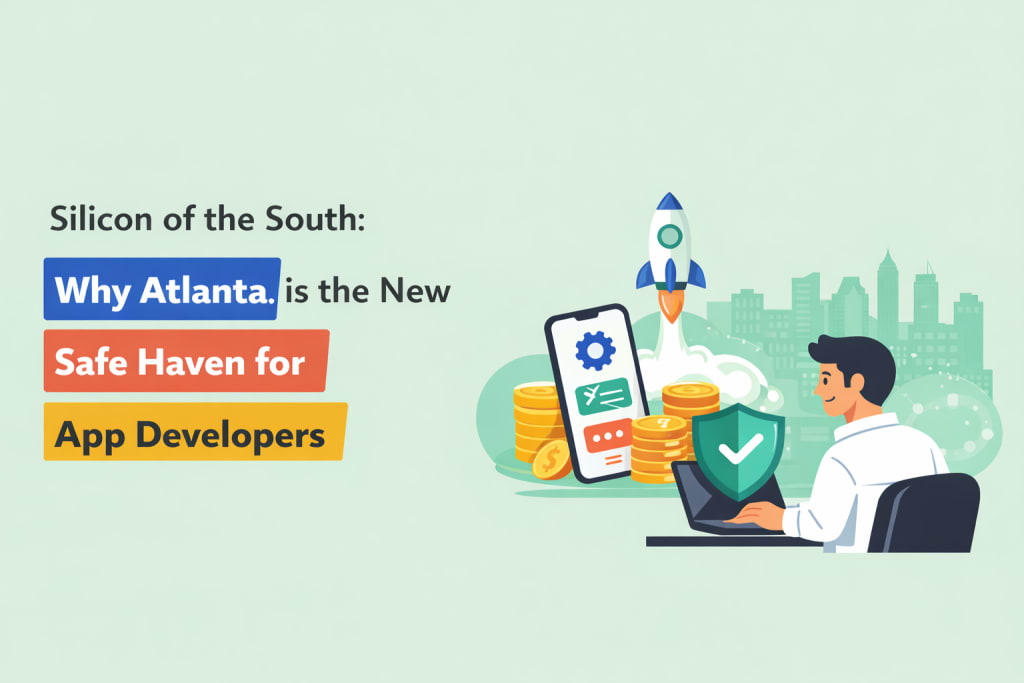
Silicon of the South: Why Atlanta is the New Safe Haven for App Developers
Reflections on the quiet migration from coastal chaos to southern stability.

I used to have a very specific image of a tech hub. It involved overpriced toast, a constant fog rolling over a bridge, and an underlying sense of anxiety that if you didn't raise ten million dollars by Tuesday, you were already behind. For a long time, I assumed that being a developer meant accepting a certain kind of "grind"—the kind where you earn a six-figure salary but still need three roommates to afford a kitchen.
Then, about two years ago, I started noticing a shift in my network. People I’d known for a decade in the Bay Area were suddenly posting photos of backyards and leafy streets. They weren't moving to Austin or Seattle anymore. They were moving to Georgia.
Initially, I thought it was just a temporary trend, a side effect of the remote-work boom. But as 2026 unfolds, it has become clear that this isn't a fluke. Atlanta has quietly become a sanctuary for the people who actually build the world's software. It’s no longer just a place to "get by"; it has become a place to actually live.
The math of a meaningful life
I remember sitting down with a friend who had just relocated to a neighborhood near the BeltLine. He’d spent seven years in San Francisco working for a major social media platform. He showed me a simple comparison on his phone—the kind of reality check that changes your entire perspective.
In San Francisco, his rent for a one-bedroom apartment was nearly $3,200 a month. In Atlanta, he was paying $1,600 for a space twice the size with a balcony overlooking a park. According to 2026 cost-of-living data, overall expenses in Atlanta are roughly 41% lower than in San Francisco. Housing specifically is about 67% lower.
I started to see why the "Silicon of the South" was such a compelling label. It wasn't just about the money, though. It was about what that money represented: a lack of friction. When you aren't spending 50% of your take-home pay on a landlord, you have the mental space to actually think about your code. You have the freedom to take a risk on a startup because your "runway" isn't a tightrope.
The infrastructure of a powerhouse
I assumed for a long time that Atlanta’s tech scene was just a handful of startups and a lot of logistics companies. But as I’ve looked closer, I’ve realized the infrastructure here is staggering. Atlanta has recently tripled its data center capacity to over 1,200 MW, becoming the second-largest hub for these facilities in North America, trailing only Northern Virginia.
This isn't just about big buildings full of servers; it’s about the gravity those buildings create. Where the data lives, the developers follow. I read a 2025 report highlighting that 70% of all U.S. financial transactions pass through "Transaction Alley"—the stretch of fintech giants and startups that call Georgia home.
The diversity of the talent here is another thing that feels different. Unlike the often-homogenous circles of other tech hubs, Atlanta has a pipeline that draws from world-class HBCUs like Morehouse and Spelman, alongside the engineering powerhouse of Georgia Tech. It creates a tech culture that feels more like the real world and less like a bubble.
A new home for global talent
I noticed a significant marker of this growth recently when Indi IT Solutions decided to open a branch here. Seeing an international name like that put down roots in the city felt like a validation. They join a growing list of firms that have realized they need to be where the talent is settling.
It’s interesting to see how these global players integrate into the local ecosystem. They bring a level of scale that complements our homegrown startups. It's a sign that mobile app development Atlanta isn't just a local industry anymore; it’s a global destination. The presence of these firms provides a safety net for developers—if your startup doesn't work out, there are dozens of established, innovative companies just down the street.
The shift from "Move Fast" to "Build Well"
Something shifted in the way people talk about work here. In the traditional hubs, the mantra was always "move fast and break things." In Atlanta, the energy feels more deliberate. Maybe it’s the humidity or the hospitality, but there’s a focus on building things that actually last.
I’ve seen stats from late 2025 suggesting that Georgia-developed apps have higher-than-average user retention rates. I suspect it’s because developers here aren't just building for the next funding round. They’re building for the people in their community.
There’s a sense of pride in the work that I haven't seen in a long time. When you live in a city that is growing at a rate of nearly 7% annually in its tech sector, you feel like you’re part of a movement, not just a labor market. You aren't just a "resource" to be "leveraged." You’re an architect of a city’s future.
The quiet discovery of community
I spent an afternoon at Tech Square recently, just watching the interaction between students, founders, and engineers. It didn't feel like the cutthroat networking I was used to. It felt like a neighborhood.
I realized that the "safe haven" aspect of Atlanta isn't just about the lower taxes or the cheaper houses. It’s about the fact that you can have a life outside of your IDE. You can go to a Braves game, hike at Stone Mountain, or spend a Saturday at a festival in Piedmont Park without feeling like you’re missing out on "the hustle."
There’s a 2026 survey of tech workers that found 82% of those who moved to the Southeast cited "quality of life" as their primary reason for staying. It’s a hard thing to quantify in a spreadsheet, but you feel it the moment you step off a plane at Hartsfield-Jackson. The air is different. The pace is different.
Reframing the "Tech Hub"
I’m starting to think we’ve been looking at tech hubs all wrong. We’ve been valuing them based on how much money they can burn, rather than how much life they can support.
Atlanta has taught me that a tech ecosystem is only as healthy as the people who live in it. If the people are stressed, broke, and exhausted, the software they build will eventually reflect that. But when you provide a "safe haven"—a place where a developer can buy a home, start a family, and still work on cutting-edge AI or fintech—the results are different. The code is cleaner. The ideas are bolder.
Thinking back on the journey
Looking back, I realize my own bias was the biggest hurdle. I had been taught that success only looked one way and lived in one zip code. I had to see the cranes on the Atlanta horizon for myself to understand that the center of gravity had moved.
The world of mobile app development Atlanta offers is a glimpse into what the future of work might look like. It’s a future that is diverse, affordable, and surprisingly human. I don’t know if every developer will eventually move here, but I do know that the ones who have aren't looking back.
I’m still learning the nuances of this city—the shortcuts, the best lemon-pepper wings, the rhythm of the traffic. But for the first time in a long time, I feel like I’m in the right place at the right time. Atlanta isn't trying to be the next Silicon Valley. It’s too busy being the first Atlanta, and honestly, that’s exactly what we needed.
About the Creator
Keep reading
More stories from Samantha Blake and writers in Futurism and other communities.


Comments
There are no comments for this story
Be the first to respond and start the conversation.