
She Never Said That" — AI Deepfake of Global Celebrity Sparks Outrage Online
When technology speaks in your voice, how do you defend your truth?

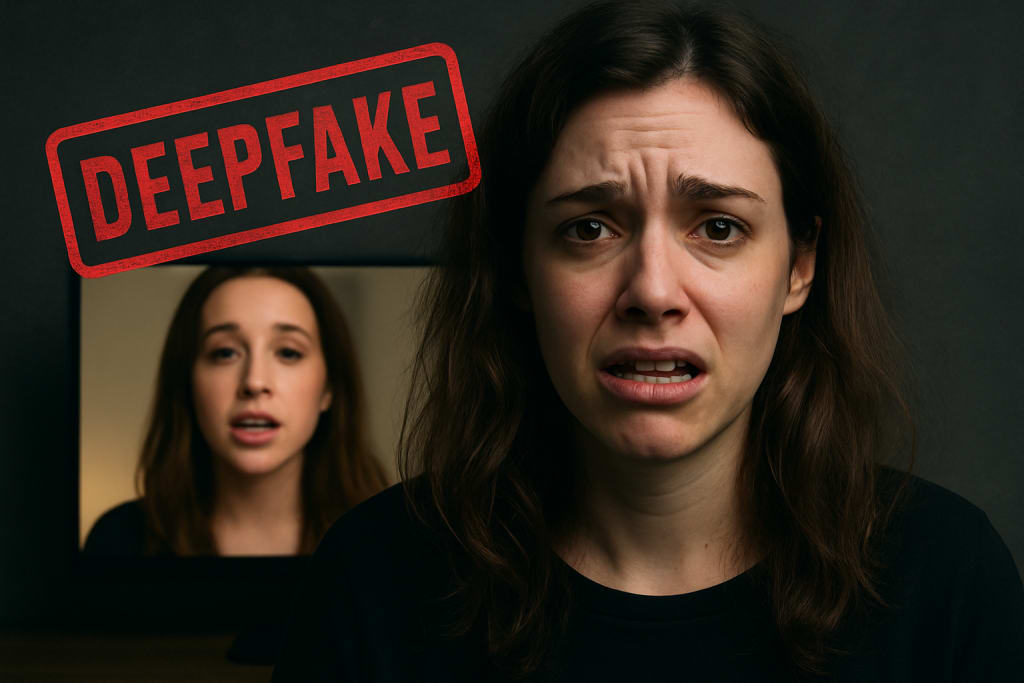
Last night, the internet broke again. And not because of a viral dance or a shocking breakup — but because of a fake video that looked more real than reality itself.
At exactly 8:46 PM GMT, a video began circulating on TikTok and X (formerly Twitter) that appeared to show global pop star Ariana Vega — the “queen of digital pop” with over 300 million followers — making derogatory remarks about her fans in India, South Korea, and Brazil. Within 20 minutes, the video had racked up over 12 million views, #ArianaCancelled was trending worldwide, and brands were reportedly pulling sponsorships.
But here’s the twist: It was a deepfake.
---
The Power — and Danger — of Deepfakes
For those unfamiliar, deepfakes are hyper-realistic videos generated using artificial intelligence to mimic real people’s appearance, voice, and expressions. And while they’ve been used for harmless entertainment and satire in the past, last night proved just how dangerous they can be.
Tech experts were quick to identify subtle inconsistencies in the video — slightly mismatched lip-syncing, artificial blinking patterns, and data discrepancies in the metadata. Within hours, Ariana Vega’s legal team issued a public statement:
> “This video is 100% AI-generated and entirely false. Ariana did not, and would never, say these words. We are working with authorities and tech platforms to track the source of this malicious content.”
But the damage had already begun.
---
How the Internet Reacted
Social media exploded with outrage. Fans who once adored Vega began burning her merchandise on live streams. TikTok creators reposted the video with angry reactions. Comment sections became a battlefield of “She’s over” and “Wait, is this even real?”
The backlash was global — particularly strong in the countries allegedly insulted. Many demanded apologies. A few prominent influencers even called for Ariana Vega’s “digital erasure.”
But as more people learned it was fake, the tide shifted.
“Wait... this wasn’t real?” tweeted @unrealtechnews, whose post about AI manipulation quickly went viral. Others began questioning how easily people could be manipulated.
---
Bigger Than Ariana
This isn’t just about one celebrity. This is about all of us.
If an AI can perfectly mimic someone’s voice, face, and style — how can we trust anything we see online anymore? Could fake political speeches incite violence? Could fabricated interviews ruin lives?
Earlier this year, several politicians in Europe and Asia raised alarm bells about deepfake technology being used in elections. And just last month, a tech CEO resigned after an AI-generated clip of him appeared to make racist jokes — later proven fake.
What’s happening now with Ariana Vega is not isolated. It’s part of a dangerous new era where seeing is no longer believing.
---
Who's Behind the Viral Fake?
As of this morning, no official source of the deepfake video has been confirmed. But some cyber-security analysts point fingers at bot accounts originating from Eastern Europe and Southeast Asia, suggesting it might have been an orchestrated disinformation campaign.
Why target Vega? Some believe it’s politically motivated. Others think it’s a test — to see how easily the internet can be manipulated. A few believe it was just “for fun.”
No matter the reason, the fallout is real.
---
What Happens Next?
Ariana Vega has announced she will take a brief break from all public appearances, but her team is pushing tech platforms to immediately flag and ban deepfake content — something platforms like Meta, TikTok, and YouTube have promised to do but struggle to implement effectively.
Cyber-activists are now calling for global regulations to watermark AI-generated content to prevent misuse. The UN has already begun discussions on ethical AI standards. But legislation is slow — and technology moves fast.
---
The Internet’s Wake-Up Call
This viral deepfake might be the internet’s biggest wake-up call of 2025. Because if someone like Ariana Vega — with billions in backing, legal teams, and platform influence — can be targeted, anyone can.
The conversation has shifted. It’s no longer “Can AI make us laugh?” It’s “Can AI destroy us before we understand how to protect ourselves?”
Until now, deepfakes were science fiction. Last night, they became tomorrow’s headlines.
---
Tagline:
Truth isn’t just under threat — it’s being reprogrammed.
Thank you for reading! I hope you enjoyed it. Subscribe for more content!
About the Creator
Nimatullah
I share powerful stories, heartfelt poetry, inspiring speeches, and meaningful news that spark thought and feeling.
Every word is written to move, uplift, and connect.
Follow my journey through emotion, truth, and creativity —
Keep reading
More stories from Nimatullah and writers in Futurism and other communities.
The Bold Collaboration That's Turning Heads Worldwide
When you combine global innovation with a rising star’s cultural influence, you get a moment that captures the internet’s attention—and that’s exactly what’s happening with AJ Currant and Kia’s new international launch.
By Nimatullah6 months ago in Futurism
About Binding Prometheus
I want to start actively advocating on behalf of my own work, and the most valuable part of my canon is, without a doubt, Binding Prometheus, the play I have been working on since 2019 and only finished in 2023 as part of my MA. The play itself is an amalgamation of a million different inspirations. On one end, it evokes the Ancient Greek myth-play, deriving its own title from the earliest extant work of Western drama we have, Aeschylus’s Prometheus Bound. On the other end, it borrows significantly from the sci-fi bulwarks from over the years, namely Mary Shelley’s Frankenstein and Karel Capek’s Rossum’s Universal Robots. The play could be an episode of Black Mirror, I fear. I don’t know. I’ve only ever seen one episode of Black Mirror.
By Steven Christopher McKnight19 days ago in Futurism
Third-Party Logistics (3PL) in Saudi Arabia: Access the Latest 2026 Market Data & Forecasts
According to IMARC Group's latest research publication, Saudi Arabia third-party logistics (3PL) market size reached USD 14.5 Billion in 2025. The market is projected to reach USD 24.9 Billion by 2034, exhibiting a growth rate of 6.20% during 2026-2034.
By Faisal Al-Harbi6 days ago in Futurism
Smart phones, Humans and Aliens.
WARNING. I will be tapping into one of your favorite creative tensions: The absurdity of humans worshipping their glowing rectangles as if they were tiny oracles. There’s something deliciously poetic about that contradiction, and it lends itself beautifully to an instructive proviso.
By Novel Allen4 days ago in Poets




Comments
There are no comments for this story
Be the first to respond and start the conversation.