
Saudi Arabia Modular Data Center Market: Digital Infrastructure Development & Growth
How prefabricated infrastructure, rapid deployment models, and rising hyperscale and edge computing demand are transforming scalability, energy efficiency, and uptime performance across the Saudi Arabia modular data center market.

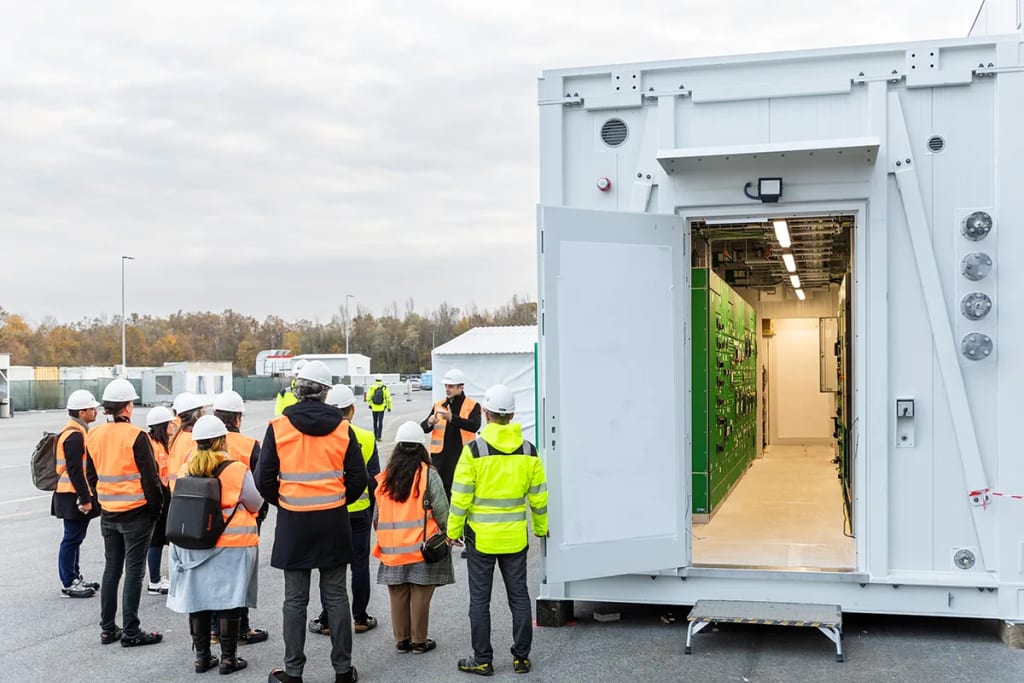
According to IMARC Group's latest research publication, Saudi Arabia modular data center market size reached USD 338.7 Million in 2025. The market is projected to reach USD 958.7 Million by 2034, exhibiting a growth rate (CAGR) of 12.26% during 2026-2034.
How AI is Reshaping the Future of Saudi Arabia Modular Data Center Market
- AI-Driven Capacity Planning: Machine learning algorithms optimize power distribution and cooling systems in modular facilities, enabling operators to predict workload demands and adjust infrastructure capacity dynamically, reducing operational expenses by up to 30%.
- Predictive Maintenance and Uptime: AI-powered monitoring systems analyze equipment performance patterns in real-time, detecting potential failures before they occur. This proactive approach minimizes downtime in unmanned edge facilities across remote Saudi locations.
- Smart Cooling Optimization: AI systems automatically adjust liquid cooling parameters based on ambient temperatures and rack densities, particularly critical in Saudi Arabia's extreme climate where temperatures exceed 50°C during summer months.
- Automated Edge Deployment: AI facilitates rapid deployment of modular edge data centers by automating configuration, testing, and integration processes. This reduces traditional 18-24 month deployment timelines to just weeks for standardized modular units.
- GPU Workload Management: Advanced AI algorithms manage high-density GPU clusters within modular units, optimizing power consumption and thermal management for training large language models and supporting hyperscale AI deployments nationwide.
How Vision 2030 is Revolutionizing Saudi Arabia Modular Data Center Industry
Vision 2030 has positioned digital infrastructure as a cornerstone of national transformation, making Saudi Arabia a magnet for modular data center investments. The government's target of achieving 1,300 megawatts of data center capacity before 2030 has triggered massive infrastructure development across Riyadh, Jeddah, Dammam, and NEOM. SDAIA's landmark Hexagon Data Centre, a $2.7 billion initiative, will become the world's largest government-owned facility with 480 megawatts capacity, demonstrating the scale of national ambition. The Ministry of Communications and Information Technology has partnered with seven companies to develop mega data centers with expected investments exceeding $18 billion. Special economic zones now offer 100% foreign ownership, complete profit repatriation, and elimination of import duties, attracting global operators like Khazna, DataVolt, and center3. The PIF-backed Humain company plans to deliver 6 gigawatts of AI-ready data center capacity by 2034, positioning Saudi Arabia to handle approximately 6% of global AI workloads and establishing the Kingdom as the world's third-largest AI market after the United States and China.
Saudi Arabia Modular Data Center Market Trends & Drivers:
The modular data center market in Saudi Arabia is experiencing explosive growth driven by hyperscale cloud deployments and the urgent need for AI-ready infrastructure. Companies like Microsoft, AWS, Oracle, and Alibaba Cloud are establishing regional cloud zones, requiring rapid deployment of scalable capacity that only modular solutions can deliver. The Kingdom's National Strategy for Data & AI has elevated Saudi Arabia to global top-tier rankings in digital government services according to UN indices. Investment commitments from Blackstone ($3 billion with Humain), DataVolt ($5 billion for NEOM's net-zero AI facility), and xAI ($500 million for Nvidia-powered computing) showcase unprecedented capital inflows. Modular designs enable deployment within weeks rather than traditional 18-24 month construction cycles, critical for meeting aggressive expansion timelines. The Kingdom's competitive electricity rates at $0.05 per kilowatt-hour, combined with abundant renewable energy initiatives targeting 50% clean power by 2030, make energy-intensive modular data centers economically viable while supporting sustainability goals.
Edge computing proliferation across telecommunications, healthcare, and industrial sectors is accelerating modular data center adoption throughout Saudi Arabia. Nearly 70% of healthcare services now utilize telemedicine platforms requiring low-latency infrastructure, while 34% of physicians employ AI diagnostic tools demanding local processing power. The telecommunications sector's 5G rollout by operators including STC, Mobily, and Zain necessitates thousands of edge sites with micro modular units positioned near population centers and industrial zones. Saudi Arabia's industrial digital economy, valued at approximately $850 billion and contributing 13% to GDP, requires distributed computing for Industry 4.0 applications including smart manufacturing, autonomous logistics, and real-time analytics. Tawal's partnership with 5SKYE to deploy AI-enabled micro edge data centers exemplifies this trend, supporting public safety, retail, and IoT applications with scalable, remotely managed modular infrastructure that eliminates the need for on-site engineering staff at distributed locations.
The extreme climate conditions across Saudi Arabia, where ambient temperatures frequently exceed 50°C, are driving innovation in modular data center cooling technologies and sustainable design. Operators are rapidly adopting liquid cooling systems, immersion cooling, and AI-driven thermal management within pre-engineered modular units to reduce power usage effectiveness below 1.2 compared to traditional air-cooled facilities at 1.4-1.6. Khazna's 200-megawatt modular facility in Dammam features scalable architecture with dynamic adaptability, while NEOM's DataVolt campus integrates advanced cooling technologies powered entirely by renewable energy for net-zero operations. The Kingdom's strategic location connecting Asia, Europe, and Africa through submarine cable systems, combined with government initiatives providing land, power infrastructure, and streamlined permitting, makes Saudi Arabia ideal for modular deployments. Major players including Delta Electronics, Cisco, Equinix, and regional specialists are investing in energy-efficient hardware, smart power management, and prefabricated modular designs that can withstand harsh environmental conditions while delivering hyperscale capacity for cloud, AI, and edge computing workloads.
Saudi Arabia Modular Data Center Market Industry Segmentation:
The report has segmented the market into the following categories:
Component Insights:
- Solutions
- All-in-One Module
- Individual Module
- Services
- Design and Consulting
- Integration and Deployment
- Support and Maintenance
- Data Center Size Insights:
- Small and Medium-sized Data Centers
- Large Data Centers
Application Insights:
- Disaster Backup
- High Performance/ Edge Computing
- Data Center Expansion
- Starter Data Centers
Industry Vertical Insights:
- BFSI
- IT and Telecom
- Retail and Manufacturing
- Healthcare
- Energy
- Media and Entertainment
- Government and Defense
- Others
Regional Insights:
- Northern and Central Region
- Western Region
- Eastern Region
- Southern Region
Competitive Landscape:
The competitive landscape of the industry has also been examined along with the profiles of the key players.
Recent News and Developments in Saudi Arabia Modular Data Center Market
- December 2025: Khazna Data Centers acquired 225,000 square meters of land in Dammam to develop a 200-megawatt AI-ready data center using modular architecture, with Mohammed Bin Hassan appointed as Country Head to drive expansion supporting Vision 2030 objectives.
- December 2025: Al Moammar Information Systems (MIS) was awarded a contract exceeding 155% of its annual revenues by HUMAIN to design and build a private AI-focused data center, strengthening the Kingdom's artificial intelligence infrastructure capabilities.
- November 2025: xAI and HUMAIN announced a partnership to develop a 500-megawatt data center powered by Nvidia computing chips, surpassing xAI's Memphis Colossus facility and positioning Saudi Arabia as a major AI computing hub.
- November 2025: HUMAIN and Blackstone signed a $3 billion agreement to develop data centers across the Kingdom, while HUMAIN publicly launched its AI-powered operating system supporting the target of 6 gigawatts capacity by 2034.
Note: If you require specific details, data, or insights that are not currently included in the scope of this report, we are happy to accommodate your request. As part of our customization service, we will gather and provide the additional information you need, tailored to your specific requirements. Please let us know your exact needs, and we will ensure the report is updated accordingly to meet your expectations.
About the Creator
Faisal Al-Harbi
Market research professional based in Saudi Arabia (KSA), focused on industry trends, market growth, and economic insights.
Writing data-driven articles on Saudi markets, business outlook, and Vision 2030–driven sectors.
Keep reading
More stories from Faisal Al-Harbi and writers in Futurism and other communities.
Saudi Arabia Waste Plastic Recycling Market: Vision 2030 Goals & Recycling Infrastructure Growth
According to IMARC Group's latest research publication, GCC steel market size reached USD 385.2 Million in 2024. The market is projected to reach USD 743.7 Million by 2033, exhibiting a growth rate (CAGR) of 6.80% during 2025-2033.
By Faisal Al-Harbiabout 24 hours ago in Futurism
About Binding Prometheus
I want to start actively advocating on behalf of my own work, and the most valuable part of my canon is, without a doubt, Binding Prometheus, the play I have been working on since 2019 and only finished in 2023 as part of my MA. The play itself is an amalgamation of a million different inspirations. On one end, it evokes the Ancient Greek myth-play, deriving its own title from the earliest extant work of Western drama we have, Aeschylus’s Prometheus Bound. On the other end, it borrows significantly from the sci-fi bulwarks from over the years, namely Mary Shelley’s Frankenstein and Karel Capek’s Rossum’s Universal Robots. The play could be an episode of Black Mirror, I fear. I don’t know. I’ve only ever seen one episode of Black Mirror.
By Steven Christopher McKnight29 days ago in Futurism
Deodorants Market: Private Label Expansion, Pricing Strategies & Market Forecast
According to IMARC Group's latest research publication, global deodorants market size reached USD 29.78 Billion in 2024. Looking forward, IMARC Group expects the market to reach USD 42.45 Billion by 2033, exhibiting a growth rate (CAGR) of 3.69% during 2025-2033.
By sujeet. imarcgroup3 days ago in Futurism



Comments
There are no comments for this story
Be the first to respond and start the conversation.