
Saudi Arabia Aviation Market: Fleet Modernization, Passenger Growth & Airport Expansion
How airport expansion, fleet modernization, digital aviation technologies, and Vision 2030–driven investments are transforming connectivity, passenger experience, and operational efficiency across Saudi Arabia’s rapidly growing aviation market.

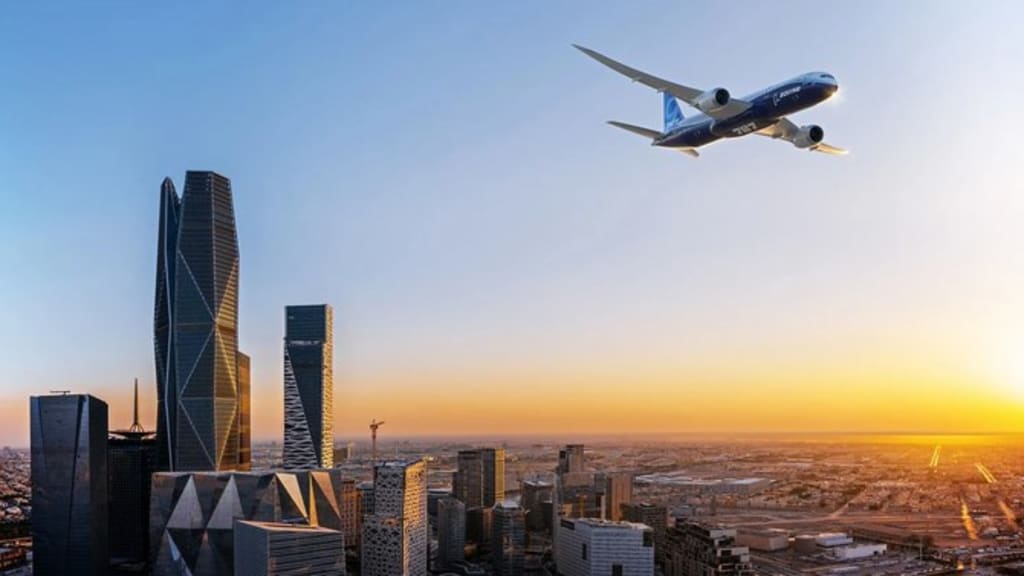
Saudi Arabia's aviation market thrives on Vision 2030's tourism boom, with Riyadh and Jeddah airports expanding capacity for 100 million passengers yearly through new terminals and fleet modernizations. The Saudi Arabia aviation market size was valued at USD 6.2 Billion in 2025 and is projected to reach USD 12.0 Billion by 2034, growing at a compound annual growth rate of 7.68% from 2026-2034.
How AI is Reshaping the Future of Saudi Arabia Aviation Market
- AI-Native Airline Operations: Riyadh Air partnered with IBM to launch as the world's first AI-native airline, embedding intelligent automation across 59 workstreams, enhancing crew enablement, customer care, and operational efficiency from day one.
- Predictive Maintenance and Efficiency: AI-driven systems monitor equipment in real-time, predicting component failures before they occur, reducing Aircraft on Ground events, and optimizing turnaround times at airports across the Kingdom.
- Smart Airport Infrastructure: Airports are implementing AI-powered biometric screening, integrated digital platforms, and automated passenger processing systems to streamline check-in, security clearance, and boarding while reducing congestion and wait times.
- Demand Forecasting and Network Optimization: Advanced analytics predict passenger traffic patterns, enabling airlines to optimize route profitability, adjust flight frequencies, and support data-driven decision-making for commercial planning and capacity management.
- Enhanced Customer Experience: AI-enabled voice bots and agent-assist systems use contextual data to anticipate traveler needs, provide personalized support, and enable cabin crews to deliver tailored services throughout the passenger journey.
How Vision 2030 is Revolutionizing Saudi Arabia Aviation Industry
Vision 2030 is reshaping Saudi Arabia's aviation landscape by positioning the Kingdom as a global connectivity hub. The government is investing heavily in airport expansion, with King Khalid International Airport handling 37.6 million passengers and the sector breaking through 103 million total passengers. New airline development is accelerating, with Riyadh Air commencing operations and three additional carriers planned for Dammam, Madinah, and giga-project destinations. The strategy includes massive infrastructure projects like King Salman International Airport targeting 120 million passengers, alongside digital transformation initiatives and sustainability mandates. Tourism-driven connectivity is expanding rapidly, with international tourist arrivals reaching 29.7 million and domestic travelers climbing to 86.2 million. Workforce localization programs are building aviation capabilities across pilots, maintenance crews, and ground services, while liberalized air policies attract foreign airlines and private investment to strengthen the Kingdom's aviation ecosystem.
Saudi Arabia Aviation Market Trends & Drivers:
The Saudi Arabia aviation market is experiencing rapid transformation driven by unprecedented infrastructure investment and strategic policy reforms. Government commitment under Vision 2030 has catalyzed massive projects including airport expansions, airline launches, and supporting services development. King Khalid International Airport's passenger volume of 37.6 million demonstrates strong infrastructure performance, while the sector surpassing 103 million passengers signals sustained growth momentum. New carrier development, including Riyadh Air's operational launch and three planned airlines, intensifies competition while expanding service accessibility. Airport modernization projects, fleet expansion initiatives, and digital transformation across booking platforms enhance operational efficiency throughout the aviation ecosystem. Geographic positioning between Asia, Europe, and Africa enables strategic connectivity advantages, supported by growing tourism initiatives encompassing leisure, cultural, and religious travel segments generating sustained air transport demand.
Tourism expansion is fundamentally reshaping aviation demand patterns across the Kingdom. International tourist arrivals surged to 29.7 million, nearly doubling from 18.04 million, while domestic travelers climbed to 86.2 million during the same growth period. Religious tourism remains a cornerstone sector, with 18.5 million pilgrims performing Hajj and Umrah, including 16.92 million international Umrah visitors representing significant growth. Mega-project developments including NEOM, AlUla, and Red Sea destinations are generating dedicated aviation infrastructure requirements and expanding route network development. Airlines are launching direct services from Europe, Asia, and Africa to capitalize on the Kingdom's rising profile as a leisure and cultural destination. Improved visa policies, enhanced tourism promotion, and better connectivity are attracting first-time and repeat visitors, strengthening airline revenues and justifying ongoing fleet expansion investments.
Low-cost carrier expansion and network development are accelerating across the Kingdom's aviation landscape. Flyadeal launched five new routes from Madinah, expanding destinations from three to eight and increasing weekly capacity by 40 percent to 88 flights. The airline established Madinah as its fourth operational base with two permanently stationed aircraft, complementing existing hubs in Riyadh, Jeddah, and Dammam. New routes include Istanbul alongside domestic services to Abha, Al Hofuf, Jazan, and Tabuk, serving both outbound travel and inbound religious tourism. Air Arabia consortium secured authorization to establish a Dammam-based low-cost carrier targeting 24 domestic and 57 international routes by the target year, operating 45 aircraft and carrying 10 million passengers. Digital booking platforms, improved service quality, and competitive pricing are making air travel more accessible, supporting both domestic connectivity and international route expansion aligned with national transformation objectives.
GCC Steel Market Industry Segmentation:
The report has segmented the market into the following categories:
- Aircraft Type Insights:
- Commercial Aviation
- General Aviation
- Military Aviation
Regional Insights:
- Northern and Central Region
- Western Region
- Eastern Region
- Southern Region
Competitive Landscape:
The competitive landscape of the industry has also been examined along with the profiles of the key players.
Recent News and Developments in Saudi Arabia Aviation Market
- January 2026: Flyadeal introduced five new routes from Madinah, representing a major expansion from its latest operational base and increasing weekly capacity by 40% at the airport in the holy city. The New Year expansion added new services to Istanbul Sabiha Gökçen along with four domestic routes to Abha, Al Hofuf, Jazan, and Tabuk.
- December 2025: Saudi Arabia was set to introduce three new airlines to cater to its 'giga-project' locations, including NEOM and Qiddiya, as part of its Vision 2030 initiative aimed at drawing 150 million visitors each year. One will be a low-cost airline headquartered in Dammam, a coastal city on the Arabian Gulf. Based at King Fahd International Airport, the currently unnamed airline plans to operate flights to 24 domestic and 57 international locations by 2030, transporting 10 million passengers with a fleet of 45 aircraft.
- December 2025: Riyadh Air and IBM partnered to launch the world's first AI-native airline at IBM Think Riyadh 2025, unveiling comprehensive AI-driven operations designed to transform guest and employee experiences. IBM Consulting orchestrated 59 workstreams integrating over 60 partners to operate the airline as an AI-native enterprise from day one.
- September 2025: Saudia began operating domestic flights using Sustainable Aviation Fuel uplifted from Red Sea International Airport, conducted in partnership with Red Sea Global. The initiative supports the General Authority of Civil Aviation's Comprehensive Environmental Sustainability Program aimed at reducing aviation sector emissions.
- February 2025: Red Sea International Airport introduced 35% Sustainable Aviation Fuel blends in partnership with Red Sea Global and Arabian Petroleum Supply Company, marking the first SAF availability in the Kingdom and reducing aircraft emissions by up to 35% per flight.
Note: If you require specific details, data, or insights that are not currently included in the scope of this report, we are happy to accommodate your request. As part of our customization service, we will gather and provide the additional information you need, tailored to your specific requirements. Please let us know your exact needs, and we will ensure the report is updated accordingly to meet your expectations.
About the Creator
Jeffrey Wilson
Hello, I’m Jeffrey Wilson, a market research specialist with over 9 years of experience in uncovering consumer insights and driving data-backed strategies.
Keep reading
More stories from Jeffrey Wilson and writers in Futurism and other communities.
Saudi Arabia Edible Oil Market: Changing Food Habits, Premium Oils & Growth Outlook
Saudi Arabia's edible oil market thrives on soaring demand from a growing population and urbanization, with palm oil dominating imports alongside sunflower varieties. According to IMARC Group's latest research publication, Saudi Arabia edible oil market size reached USD 2.4 Billion in 2025. The market is projected to reach USD 3.5 Billion by 2034, exhibiting a growth rate (CAGR) of 3.99% during 2026-2034.
By Jeffrey Wilson3 days ago in Futurism
About Binding Prometheus
I want to start actively advocating on behalf of my own work, and the most valuable part of my canon is, without a doubt, Binding Prometheus, the play I have been working on since 2019 and only finished in 2023 as part of my MA. The play itself is an amalgamation of a million different inspirations. On one end, it evokes the Ancient Greek myth-play, deriving its own title from the earliest extant work of Western drama we have, Aeschylus’s Prometheus Bound. On the other end, it borrows significantly from the sci-fi bulwarks from over the years, namely Mary Shelley’s Frankenstein and Karel Capek’s Rossum’s Universal Robots. The play could be an episode of Black Mirror, I fear. I don’t know. I’ve only ever seen one episode of Black Mirror.
By Steven Christopher McKnight18 days ago in Futurism
Aircraft Cabin Interior Market: Premium Cabin Demand, Luxury Interiors & Global Aviation Trends
According to IMARC Group's latest research publication, the global aircraft cabin interior market size reached USD 31.1 Billion in 2024. Looking forward, IMARC Group expects the market to reach USD 56.2 Billion by 2033, exhibiting a growth rate (CAGR) of 6.47% during 2025-2033.
By sujeet. imarcgroup4 days ago in Futurism


Comments
There are no comments for this story
Be the first to respond and start the conversation.