
Samsung’s Satellite Strategy Just Upended the Market: Retroactive Support and A-Series Inclusion Leave Apple Scrambling
For years, the smartphone industry has treated satellite connectivity as a high-stakes arms race where Samsung was strangely absent. Apple ignited the trend in 2022 with the iPhone 14, and Google solidified it in 2024 with the Pixel 9 series.

1. Introduction: The Long-Awaited Connection
For years, the smartphone industry has treated satellite connectivity as a high-stakes arms race where Samsung was strangely absent. Apple ignited the trend in 2022 with the iPhone 14, and Google solidified it in 2024 with the Pixel 9 series. While its rivals dominated the headlines, Samsung remained uncharacteristically silent. From a strategic perspective, this delay wasn't a lack of innovation, but likely a calculated wait for 5G Non-Terrestrial Network (NTN) standards to mature and for carrier-satellite partnerships—like the T-Mobile and Starlink alliance—to reach critical mass.
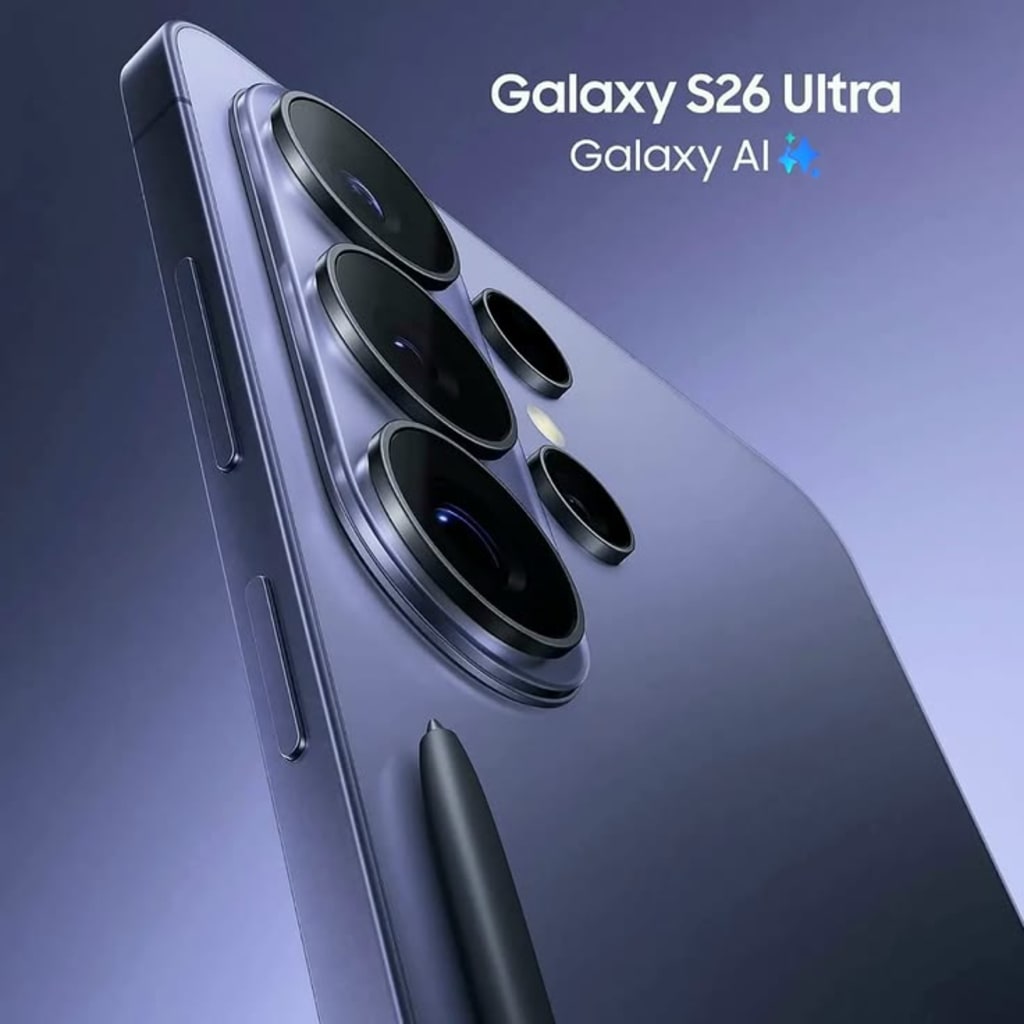
That silence has finally been broken with the Galaxy S26 announcement. Samsung isn't just catching up; it is executing a strategic disruption of the hardware lifecycle that fundamentally changes the value proposition of both new and existing Galaxy devices.
2. Takeaway 1: It’s Not Just for the S26 Ultra
In a move that prioritizes ecosystem-wide safety over tiered gatekeeping, Samsung has confirmed that satellite connectivity will be standard across the entire Galaxy S26 lineup: the S26, S26+, and S26 Ultra.
By democratizing this feature across the flagship tier, Samsung is moving away from the "luxury safety" model. While competitors often reserve their most advanced hardware features for "Pro" or "Ultra" variants, Samsung is establishing a baseline of protection for any user investing in their current flagship generation.
"This expansion reflects Samsung’s continued commitment to enhancing user safety and providing seamless mobile experiences through next-generation connectivity — particularly in the era of AI as everyday infrastructure."
3. Takeaway 2: The Retroactive Reach (The S22 and Beyond)
The most unprecedented aspect of this rollout is the retroactive support for older hardware. This isn't just about the newest chips; Samsung is enabling satellite capabilities on devices that have been in users' pockets for years.
Specifically, for T-Mobile users, support extends to flagship models released after the Galaxy S21 series—meaning the Galaxy S22, S23, S24, and S25 series are eligible. This reveals a fascinating industry "insider" truth: the Qualcomm and Exynos modems used since the S22 era likely possessed dormant NTN capabilities that Samsung is only now choosing to activate through software and carrier handshakes. This level of retroactive support for a hardware-adjacent feature is nearly unheard of in the mobile space, instantly increasing the resale and utility value of three-year-old handsets.
4. Takeaway 3: A Surprising Win for the Mid-Range A-Series
Samsung is also aggressively targeting the mid-range market, a segment where Apple and Google have strictly withheld satellite features. By including "select Galaxy A series models" in this rollout (specifically via T-Mobile, KDDI, and Japanese carriers), Samsung is leapfrogging the competition.
This move puts immense pressure on Google’s "A-series" Pixels and Apple’s iPhone SE. By offering life-saving connectivity on mid-tier hardware, Samsung is positioning the Galaxy brand as the superior choice for value-conscious consumers who refuse to compromise on safety.
5. Takeaway 4: The "Carrier Catch" and Regional Fragmentation
Despite the broad hardware compatibility, the user experience remains dictated by a complex web of carrier partnerships. Your phone’s capability is now inextricably linked to your service provider's infrastructure.
Carrier Region Supported Services Eligible Devices
T-Mobile USA T911, Text, and Data via Starlink Post-S21 Flagships (S22+); Select A-series
Verizon USA eSOS and Text Following S25 series (S26 and later)
AT&T USA Coming Soon TBD
KDDI Japan Text and Data S22 and later flagships; Select A-series
SoftBank / docomo Japan Flagship / A-series Support Launching later in 2026
Rakuten Mobile Japan Coming Soon TBD
Virgin Media O2 UK Satellite Communication Select Galaxy smartphones
Vodafone UK Coming Soon TBD
MasOrange Spain Field Trials Beginning March 2026
This fragmentation creates a strange reality: a Galaxy S22 user on T-Mobile may soon have more robust off-grid capabilities than a Galaxy S25 user on Verizon.
6. Takeaway 5: Satellite Connectivity as "AI Infrastructure"
The most significant strategic insight lies in Samsung’s framing of satellite connectivity as "infrastructure for the era of AI." To a digital strategist, this reveals that Samsung doesn't view satellite links merely as an emergency "SOS" tool for hikers.
Because Samsung’s Galaxy AI features often rely on hybrid processing—partially on-device and partially in the cloud—the company needs a persistent data link to ensure their AI services remain functional. By providing a satellite backbone, Samsung is attempting to transform a safety feature into a service-reliability feature. They are ensuring that "everyday AI" doesn't stop working just because a user moves into a terrestrial dead zone.
7. Conclusion: The Future of Constant Connection
Samsung’s entry into the satellite market was delayed, but the scope of its rollout is undeniably more ambitious than its predecessors. By reaching back to the S22 series and extending down to the A-series, Samsung has effectively neutralized one of Apple's key marketing advantages while simultaneously future-proofing millions of existing devices.
We are witnessing the beginning of the end for the mobile "dead zone." For the consumer, the takeaway is clear: the value of a smartphone is no longer just about the glass and silicon in your hand, but the reach of the network above it. As these features go live, one must wonder if a "new" phone is even necessary when your current Galaxy is about to receive its most significant upgrade years after you bought it.
About the Creator
Mohammad Hamid
Big Dream Work Hard and Achieve 💪
Keep reading
More stories from Mohammad Hamid and writers in Futurism and other communities.
Tesla Pi Phone: The Truth Behind the Internet’s Favorite Mythical Smartphone
In the fast-moving world of consumer technology, few things generate as much consistent buzz as a product that doesn’t actually exist. For years, the internet has been saturated with spectacular renders, wild specification leaks, and enthusiastic viral videos detailing the impending arrival of the Tesla Pi Phone (sometimes called the Model Pi).
By Mohammad Hamidabout 24 hours ago in Futurism
Samsung Galaxy Unpacked 2026: What to Expect From the Galaxy S26 Event
What Happened (Facts) Samsung’s first Galaxy Unpacked event of 2026 is scheduled for Feb. 25 in San Francisco, with the presentation set to begin at 1 p.m. ET / 10 a.m. PT, according to the live coverage preview shared by Gizmodo’s team (Raymond Wong, Kyle Barr, and James Pero).
By Behind the Tech5 days ago in Futurism
Australia Smoothies Market: Health & Wellness Trends, Retail Expansion & Product Innovation
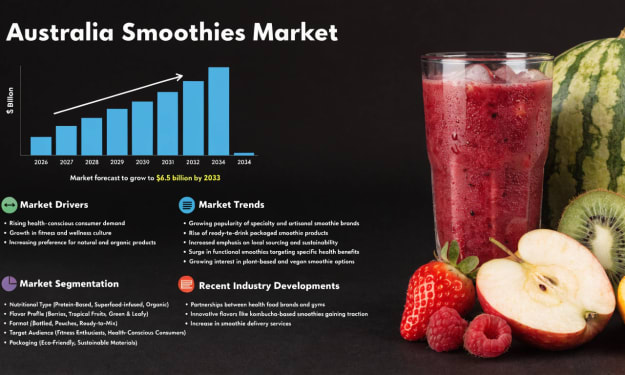
According to IMARC Group, the Australia smoothies market reached USD 504.6 Million in 2025 and is projected to grow to USD 749.1 Million by 2034, exhibiting a compound annual growth rate (CAGR) of 4.26% during 2026–2034. The market’s expansion reflects increasing consumer focus on health, nutrition, and convenience across Australia. Rising demand for nutrient-rich beverages, growing availability of ready-to-drink (RTD) options, and the proliferation of smoothie bars in urban centers are collectively strengthening Australia smoothies market share. As consumers prioritize balanced diets and functional ingredients, smoothies are becoming a mainstream component of daily nutrition.
By Shrestha Roya day ago in Futurism


Comments
There are no comments for this story
Be the first to respond and start the conversation.