
Robotics in Everyday Life: Opportunities and Challenges
Integrating Robotics into Everyday Life: Harnessing Technology for Enhanced Living

Introduction
Robotics has seen exponential growth over the last decade, becoming an essential component of our daily lives. From simple household appliances to complex surgical machines, robots are transforming how we live and work. This article explores the numerous opportunities robotics offers, as well as the challenges it presents. The goal is to provide an in-depth overview of how robotics is changing various aspects of our society, from domestic to healthcare, education, industry, and beyond. Through a critical analysis of emerging trends and ethical, legal, and social implications, we aim to understand how to navigate the technological future in a balanced and responsible manner.
1. Robotics in Household Tasks
Evolution of Smart Appliances
The evolution of smart appliances began with relatively simple devices like the first automated vacuum cleaners introduced in the 1990s. These devices, though rudimentary by today’s standards, represented a significant step towards home automation. Today, modern domestic robots include a range of advanced functions, from vacuum robots like Roomba to lawn-mowing robots and smart voice assistants like Alexa and Google Home that can control a variety of devices with voice commands. The integration of technologies like artificial intelligence (AI) and the Internet of Things (IoT) has further enhanced the capabilities of these devices, making them indispensable tools in modern homes.
Benefits of Domestic Robotics
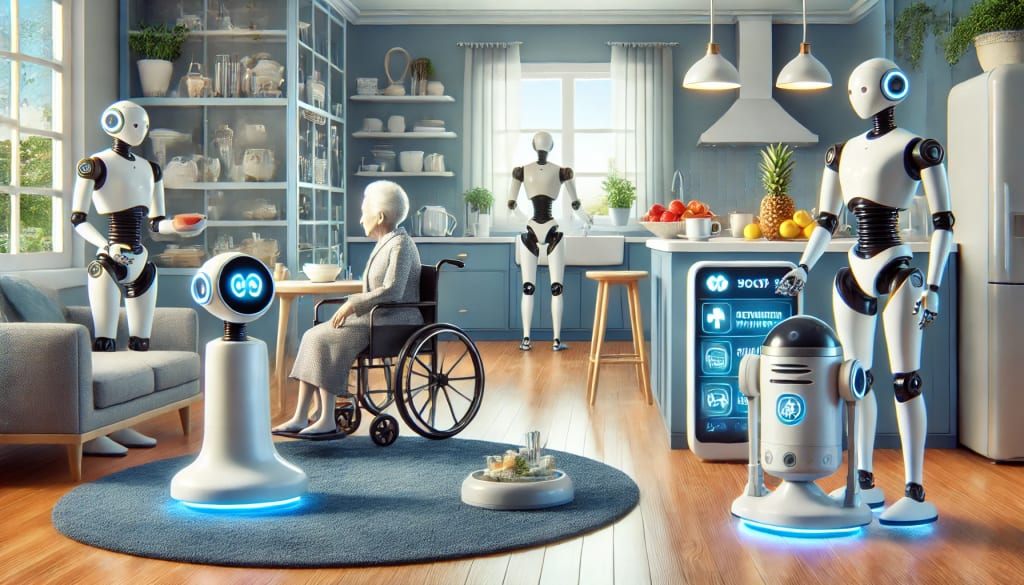
Domestic robots offer numerous benefits. Firstly, they improve efficiency and save significant time. Everyday tasks such as cleaning the house, mowing the lawn, or managing shopping lists can be automated, leaving more free time for users. Additionally, using robots can improve the quality of life, especially for the elderly or disabled, by providing assistance and companionship. The precision of robots also ensures that tasks are performed consistently and accurately. Furthermore, the increasing accessibility of these devices is helping democratize the use of robotics in homes, making it more affordable for a broader audience.
Challenges of Domestic Robotics
Despite the many advantages, domestic robotics also presents some challenges. Initial costs for purchasing advanced robots can be high, limiting accessibility for some families. Additionally, maintenance and reliability are critical aspects; robots require regular updates and can need costly repairs if they break down. Finally, there is concern for safety and privacy, as many devices collect and transmit personal data that could be vulnerable to breaches. Managing these risks requires adopting advanced security measures and ongoing user education on the safe use of technology.
2. Robotics in Healthcare
Surgical and Assistive Robots
Robotics has revolutionized healthcare, introducing innovations like surgical robots. The Da Vinci system, for example, allows surgeons to perform operations with unprecedented precision, minimizing incisions and improving patient recovery times. Moreover, assistive robots are increasingly used to help the elderly and disabled, offering support in daily activities and constant health monitoring. These robots can administer medication, assist with movement, and continuously monitor vital signs, significantly enhancing patients’ quality of life.
Impact on Quality of Care
The use of robots in healthcare has significantly improved the quality of care. The precision of surgical robots reduces medical errors and post-operative complications, improving clinical outcomes. Additionally, assistive robots can continuously monitor patients’ vital signs, providing valuable data for managing chronic conditions and preventing emergencies. The ability of these robots to deliver personalized care and continuous monitoring represents a significant advancement in medicine, contributing to overall patient well-being and reducing long-term healthcare costs.
Ethical and Legal Considerations
Despite the benefits, using robotics in healthcare raises important ethical and legal issues. Liability in the case of errors made by surgical robots is a complex topic. Additionally, patient data privacy is a growing concern, as robots collect a significant amount of sensitive information. Developing regulations that ensure safety and privacy, balancing technological innovation with protecting patient rights, is essential. Continuous training of healthcare professionals and transparency in using technology are crucial for gaining patients’ trust and ensuring the ethical and safe use of robotics in healthcare.
3. Robotics in Education and Entertainment
Teaching with Robots
In education, robots are becoming increasingly common tools to support teaching, especially in STEM subjects (Science, Technology, Engineering, and Mathematics). Educational robots like NAO and Pepper are used to make learning more interactive and engaging. These robots can answer questions, explain complex concepts, and help students develop technical skills through programming and using algorithms. Additionally, the presence of robots in the classroom can stimulate students’ interest in technological careers, preparing new generations for future challenges.
Robotics in Entertainment
Robotics also plays a significant role in the entertainment industry. Robotic toys like Cozmo and Anki are designed to interact with children, offering educational and fun play experiences. Furthermore, companion robots like Aibo provide social interactions, helping to reduce loneliness and improve emotional well-being. Augmented and virtual reality also benefit from robotics, creating immersive experiences that combine the real and virtual worlds. These innovations transform how people interact with technology, offering new forms of entertainment and personal enrichment.
Educational and Psychological Challenges
Integrating robotics in education and entertainment is not without challenges. One of the main risks is dependency on technology, which can limit the development of social and cognitive skills in children. Additionally, there are concerns about the psychological impact of interactions with robots, particularly regarding building emotional relationships with machines. It is crucial to balance the use of robotics with activities that promote human interaction and holistic development. Educating parents, teachers, and product developers about the critical and conscious use of technology must be a priority.
4. Robotics in Industrial Sectors
Automation and Production
Industrial automation is one of the areas where robotics has had the most significant impact. From automotive production lines to electronic assembly plants, robots have become indispensable. Early industrial robots, like the Unimate introduced in the 1960s, paved the way for widespread use of robotics in manufacturing. Today, collaborative robots, or cobots, work alongside humans, enhancing safety and efficiency. These cobots are designed to be easily programmable and adaptable to various tasks, making them versatile tools for a wide range of industrial applications.
Efficiency and Productivity
Introducing robots into production processes has led to a significant increase in efficiency and productivity. Robots can operate 24/7 without interruptions, reducing production times and operating costs. Moreover, the precision and repeatability of robots improve product quality, reducing waste and defects. Automation has also improved working conditions by reducing workers’ exposure to dangerous and repetitive tasks. Robotics is also driving innovation in production processes, enabling companies to explore new technologies and manufacturing methodologies.
Employment Concerns
However, automation raises concerns regarding employment. Replacing human workers with robots can lead to job losses, particularly in sectors like manufacturing. This requires a commitment to professional retraining and continuous education to prepare the workforce for the new skills demanded by the digital economy. Collaboration between government, industry, and educational institutions is essential to address these challenges. Developing training programs that prepare workers for the skills required by emerging technologies is necessary to ensure a fair and inclusive transition to an automated economy.
5. Future of Robotics in Everyday Life
Emerging Trends
Looking to the future, several emerging trends are shaping the robotics landscape. Artificial intelligence (AI) continues to evolve, making robots increasingly autonomous and capable of making complex decisions. The combination of AI and robotics with technologies like the Internet of Things (IoT) and 5G promises to create smart and connected environments where robots interact seamlessly with other devices and systems. This integration promises to revolutionize sectors such as home automation, healthcare, and transportation, leading to new opportunities and challenges.
Long-term Challenges
Despite promising prospects, there are long-term challenges that must be addressed. The environmental sustainability of robotic production is a growing concern, with a need to develop more eco-friendly materials and processes. Additionally, the ethical and regulatory management of robot use requires careful balancing of innovation with protecting human rights. Developing policies and regulations that guide the responsible use of robotics is crucial. Continuous education and public awareness about the ethical and safe use of technology are essential to ensure a harmonious coexistence with robots.
Vision of a Shared Future
Imagining a shared future with robots involves considering different scenarios. Robots could become everyday companions, assisting humans in various activities, from work to private life. Education and training play a crucial role in preparing new generations to coexist with technology, developing critical skills and an ethical understanding of its use. Continuous dialogue between citizens, experts, and policymakers will be essential to navigate the complexities of the technological future. International collaboration and the adoption of global standards can help ensure that robotics is developed and used in a way that benefits all of humanity.
Conclusion
Robotics in everyday life offers immense opportunities but also significant challenges. From domestic efficiency to healthcare, from education to industry, robots are transforming our world in profound ways. However, it is essential to address the ethical, legal, and social issues that arise with the widespread adoption of robotics. Only through a balanced and responsible approach can we maximize the benefits of robotics and minimize the risks, ensuring a future where humans and robots can thrive together. Preparing a society ready to embrace these technological changes requires education, innovation, and a strong ethical foundation.
About the Creator
Fabio Smiraglia
I am a passionate content writer with extensive experience in crafting engaging texts for blogs, websites, and social media. I love telling stories, informing, and connecting with audiences, always with creativity and precision.
Keep reading
More stories from Fabio Smiraglia and writers in Futurism and other communities.
Ethics of Artificial Intelligence: Dilemmas and Solutions
Introduction Artificial intelligence (AI) is revolutionizing numerous sectors, from healthcare to finance, transforming the way we live and work. However, as this technology advances, significant ethical issues arise. This article will explore the main ethical dilemmas related to AI and propose possible solutions to address them.
By Fabio Smiragliaabout a year ago in Futurism
About Binding Prometheus
I want to start actively advocating on behalf of my own work, and the most valuable part of my canon is, without a doubt, Binding Prometheus, the play I have been working on since 2019 and only finished in 2023 as part of my MA. The play itself is an amalgamation of a million different inspirations. On one end, it evokes the Ancient Greek myth-play, deriving its own title from the earliest extant work of Western drama we have, Aeschylus’s Prometheus Bound. On the other end, it borrows significantly from the sci-fi bulwarks from over the years, namely Mary Shelley’s Frankenstein and Karel Capek’s Rossum’s Universal Robots. The play could be an episode of Black Mirror, I fear. I don’t know. I’ve only ever seen one episode of Black Mirror.
By Steven Christopher McKnight12 days ago in Futurism
Where's the Glory?
In breaking news, rehabilitated Republican Senator Johnnie Johnson (Pronouns: HE, HIM, HIS) called a press conference from the Men’s room of the New Orleans Louis Armstrong International Airport, Concourse B, across from the Ignatius Reilly’s Lucky Dog stand. The Senator had just returned from a sexual reorientation rehabilitation program in Memphis, TN after being publically disgraced at a Buckee’s Truckstop restroom soliciting sex from an undercover cop three months ago. He is a founding member of the Reformed Christians for Christ, a conservative, pro-family and ex-gay advocacy group. In the spirit of being reborn, Senator Johnson invited reporters to marvel at his plans for a major remodeling of airport bathrooms.
By Cathy Schieffelin6 days ago in Humor


Comments
There are no comments for this story
Be the first to respond and start the conversation.