
Review of 'The Man Who Fell to Earth' 1.5 and 1.6
Music of the Spheres

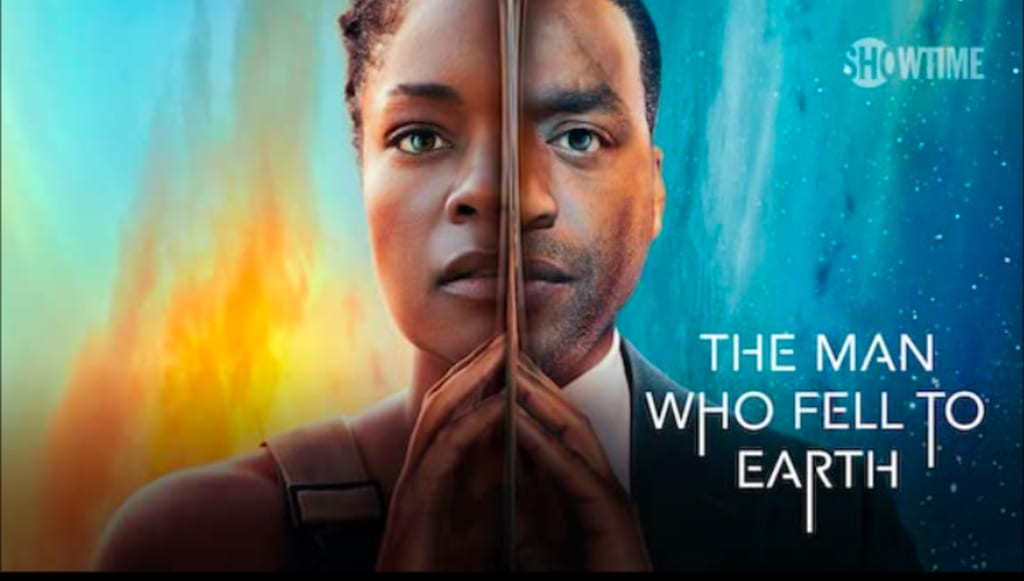
The Man Who Fell to Earth 1.5 features an important revelation. To wit:
[Spoilers ahead ... ]
Earth and Anthea have had some kind of co-mingling in the distant past. Antheans carry with them some element of humanity deep inside, and presumably vice versa. This explains why Faraday, despite his linguistic and cultural faux pas (I mean that as a plural), is ultimately so sympatico in his understanding of human beings. And it may explain why Justin is so understanding of Faraday, and more than that, as her daughter Molly asks Justin if the Anthean is her boyfriend.
Digging deeper, the relationship of the two planets may explain why the Antheans chose to come to Earth for help. They certainly didn't pick our planet randomly, or even just because the Antheans reckoned we had the degree of technology necessary to save them. It now seems that Earth and Anthea are two brethren or at least cousin worlds, that go back a long way.
With that mind, Molly's question takes on a more profound light. Could Faraday and Molly's mother have children? How about Newton and whomever? Are any of the characters we're now seeing in the story the result of such interstellar unions?
The bad guy in all of this still remains Spencer. He seems to be doing more than just doing his job. So far, he hasn't done any lasting damage that we know of, but he has a lot of venom for the Antheans and their science if they or anyone other than the CIA has any control over it.
Again, we know from the first scene of the very first episode that Faraday will come up on top of all this. I'm sorry we saw that, because if the show has any suspense in the episode that shows us Faraday giving that speech, that would be because something unexpected and bad happens to the Anthean right after.
Which I'm hoping doesn't happen.
###
An usually beautiful, powerful, erudite episode 1.6 of The Man Who Fell to Earth this past Sunday on Showtime, in a series in which every episode has had a rich helping of those qualities.
Music of the spheres -- the idea since at least the time of Pythagoras in Ancient Greece that the mathematically describable motion of the planets describe a kind of music, if not necessarily hearable, definitely knowable by the soul -- has given rise to all manner of philosophical speculation since then. I'm neither astronomer nor mathematician, but the idea has always appealed to me in some fuzzy, consoling way.
And it provides the solution to the problem vexing Faraday and his allies -- how to turn those equations into a workable energy generator. And that solution is: music, or, more precisely, jazz. The essence of jazz, as everyone knows, is improvisation. Josiah turns out to have been a jazz man -- literally, in this case -- via the infusion of Faraday's Anthean DNA.
Let's rewind this a little. Faraday cured Josiah, made him whole, by giving Josiah some of Faraday's DNA. Josiah always loved and gravitated to jazz. But with Faraday's DNA, Josiah's music, fed into a computer, is able via Faraday's and Justin's brilliant orchestration to implement Newton's vision.
Now, I doubt that's quite what Pythagoras had in mind, but his whole theory, after all, is a kind of magnificent science fiction. Meanwhile, this episode was also animated by Faraday's video letter to his Anthean wife, which provided a droll and incisive commentary on human nature and custom.
The episode ends with Spencer in maximum threatening mode, and, frankly, given the luminescence of the rest of this narrative, I'm beginning to find Spencer and his threats more of an annoyance than anything. But such is the nature of even cable television these days, and the rest of The Man Who Fell to Earth, especially this past Sunday, was so sublime, I'll take Spencer and his irritations.
About the Creator
Paul Levinson
Novels The Silk Code, The Plot To Save Socrates, It's Real Life: An Alternate History of The Beatles; LPs Twice Upon A Rhyme & Welcome Up; nonfiction The Soft Edge & Digital McLuhan, translated into 15 languages. Prof, Fordham Univ.
Keep reading
More stories from Paul Levinson and writers in Futurism and other communities.
About Binding Prometheus
I want to start actively advocating on behalf of my own work, and the most valuable part of my canon is, without a doubt, Binding Prometheus, the play I have been working on since 2019 and only finished in 2023 as part of my MA. The play itself is an amalgamation of a million different inspirations. On one end, it evokes the Ancient Greek myth-play, deriving its own title from the earliest extant work of Western drama we have, Aeschylus’s Prometheus Bound. On the other end, it borrows significantly from the sci-fi bulwarks from over the years, namely Mary Shelley’s Frankenstein and Karel Capek’s Rossum’s Universal Robots. The play could be an episode of Black Mirror, I fear. I don’t know. I’ve only ever seen one episode of Black Mirror.
By Steven Christopher McKnight19 days ago in Futurism
Saudi Arabia Eyewear Market: Premiumization Trends, Digital Retail & Consumer Lifestyle Shifts
Saudi Arabia's eyewear market grows with rising fashion consciousness and premium brands, fueled by Vision 2030 tourism and e-commerce, as opticians expand luxury and blue-light glasses for young consumers. According to IMARC Group's latest research publication, Saudi Arabia eyewear market size reached USD 1.38 Billion in 2025. The market is projected to reach USD 2.29 Billion by 2034, exhibiting a growth rate of 5.80% during 2026-2034.
By Jeffrey Wilsona day ago in Futurism



Comments
There are no comments for this story
Be the first to respond and start the conversation.