
Review of 'Silo' Season 2
Connections to Foundation Trilogy

Hugh Howey's Silo came back on Apple TV+ for its second season, and it couldn't have come back at a more appropriate time.
[And there will be spoilers ahead ... ]
Juliette escaped/was thrown out of the silo at the end of the first season. She and we knew that the air wasn't really poisonous outside, but, hey, you can never be sure. But she and we were right, and after we discover/confirm that it's not quite the world that has gone to hell, Juliette makes her way into and through another shelter, within easy walking distance from the silo with Sims and all those other characters we saw so much of last year. One question that immediately arises: why are these two silos so close to one another? What is it about this particular area?
But there ensue three parts to Juliette's journey now: 1. She uses a series of rusty ladders to get over the huge caverns in the shelter she enters (she's an engineer -- the title of the first episode -- so she knows how to position a ladder across cavern and make her way across it with almost by not getting killed). 2. She hears a song faintly in the background, which gets louder as she walks on -- it's "Moon River," you can't go wrong with that, though "You'll Never Walk Alone," especially Patti Labelle and the Blue Bells' version, with that impossibly high note Labelle hits at the end, would have worked well, too. 3. And we learn that someone has been playing that song -- it's not some remnant of Spotify that's been programmed in the future -- and that someone ends the first episode with a threat to kill Juliette if she opens the door.
I'll mention here (in case you haven't read my reviews of the first season, which you can read here) that I haven't read any of Hugh Howey's books, and once I started watching and enjoying the series, I didn't want to, because I wanted to enjoy all the twists and turns in the TV series. So I don't know who any of the characters who are new to the second season are. All we see of the man who plays the music and makes the threat in episode 2.1 are his eyes. I thought the actor playing him might have been Steve Buscemi. But it turns out the actor is another Steve -- Steve Zahn (a fine actor, I first noticed him in Treme).
Anyway, the return of Silo got off to a good start, with a nearby silo, and fine music and acting likely to take place there, and I'll tell you what I thought of the rest of the second season in the rest of my review.
***
And there was something about this second season that made me feel I wanted to see the whole rest of the season before I wrote another review, which I did, and here's the review.
What especially struck me about this second season of Silo, as it progressed, is that it had a cadence and essence that reminded me of Isaac Asimov's Foundation trilogy (and I mean the original printed trilogy, not the series, now waiting for its third season, also on Apple TV+, which in many crucial ways is a very different story than the one in the novels).
Now, Silo takes place on Earth, and a very limited part of it, at that, while Foundation takes place in the galaxy writ large, so what could the two have in common? For me, one of the best parts of the Foundation trilogy is the search for Second Foundation, which requires Ebling Mis to spend the rest of his life looking for answers in the library on Trantor. [And here I guess I should warn you about spoilers for the Foundation trilogy, in case you haven't read it.] Ebling pores of over countless documents, to say the least, trying desperately to glean information from a galactic culture that no longer exists.
And as people in both silos start to do that in this second season of Silo -- more in the second silo than the first, but really in both -- I got the same feeling I did when I read equivalent passages of the very different story, in a very different settling, in the Foundation trilogy. But there's something very powerful -- emotionally as well as intellectually -- in the struggle to make sense of what's right before your very eyes, what your forebears have left for you, intentionally or not, which offers life-saving, civilization-saving information. It doesn't matter whether it's presented in codes or symbols or letters of an alphabet. The effect is the same.
It gets, in my mind, to magic of written words, and all written communication, whether on paper in books or on screens. These squiggles on surfaces provide essential keys to our very existence, and the science fiction stories which focus on them are narratives in which these words and numbers are as much as or even more than the heroic people who must decode them.
***
Now, on another topic, I thought ending of the second season of Silo had of one the better twists I've seen in a science fiction story on the television in quite awhile. The jump to our outside world in Washington DC -- pretty literally our world -- was stunning stuff. It reminded me of I think the finale of the 3rd season in Lost, when we suddenly saw our world, back in Los Angeles, not in the past, not in a flashback, but in the present, as three people from the island made it back home.
The move in both series -- Silo and Lost -- was at once jolting and immensely refreshing. And I'll see you back when Season 3 of Silo is up on the screen.
About the Creator
Paul Levinson
Novels The Silk Code, The Plot To Save Socrates, It's Real Life: An Alternate History of The Beatles; LPs Twice Upon A Rhyme & Welcome Up; nonfiction The Soft Edge & Digital McLuhan, translated into 15 languages. Prof, Fordham Univ.
Keep reading
More stories from Paul Levinson and writers in Futurism and other communities.
Review of 'Aporia'
Readers of my posts here on Vocal will know that my favorite genre -- as a viewer, reader, and author -- is time travel, and its close relative alternate history. You'll know this because I say it in just about every other post. But you would also know this because, at least by my lights, excellent and even good examples are not easy to find (and, I'll immodestly or modestly say, as an author, to write).
By Paul Levinsonabout a year ago in Futurism
Australia Aerospace and Defense Market: Sovereign Defense Capability Development, Next-Generation Aerospace Systems & Integrated Security Infrastructure
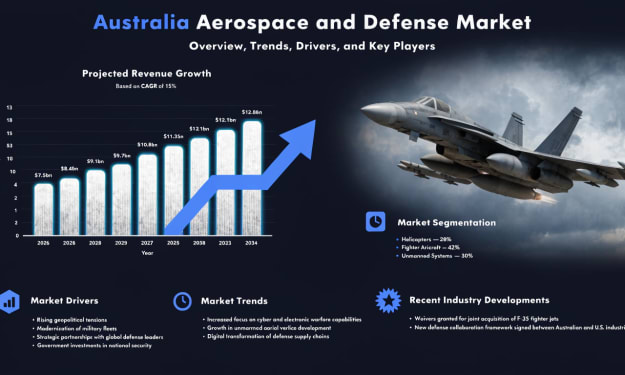
According to IMARC Group, the Australia aerospace and defense market reached a value of USD 13.6 Billion in 2025 and is projected to reach USD 21.4 Billion by 2034, growing at a compound annual growth rate (CAGR) of 5.04% during 2026–2034. The market is expanding as Australia strengthens its national security framework and invests in advanced aerospace technologies and defense capabilities. Rising geopolitical considerations and evolving security challenges are encouraging governments to increase defense budgets and modernize military infrastructure. Programs focused on sovereign defense capability development are encouraging domestic manufacturing of defense equipment, aircraft systems and advanced military technologies. At the same time, collaborations between Australian defense agencies and international contractors are accelerating innovation and enabling technology transfer. Investments in next-generation aerospace systems, cyber defense technologies and satellite communication infrastructure are further supporting the growth of the aerospace and defense sector.
By Kevin Cooperabout 18 hours ago in Futurism


Comments (1)
Really enjoyed this, and looking forward to season three