
Review of 'Bliss'
The Music and the Acting Not So Much the Movie

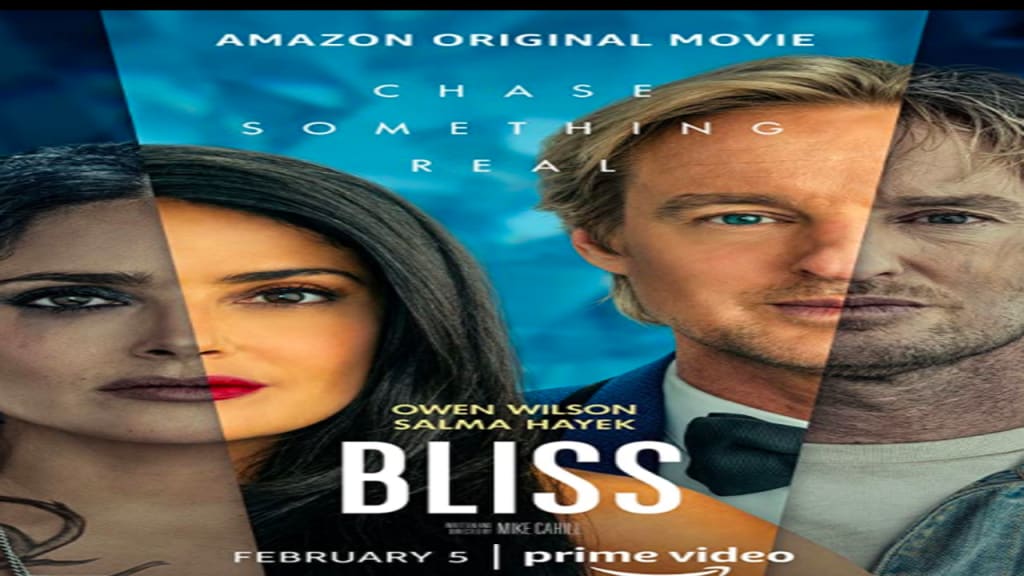
Just saw Bliss on Amazon Prime Video. In a phrase, it's another well-acted simulation movie, with an obvious, even hackneyed story, but it's very well acted by Owen Wilson (Greg) and Salma Hayek (Isabel), with an appearance by Bill Nye the science guy, and excellent music, especially a really beautiful, captivating song under the closing credits, written by Will Bates and sung by Skye Edwards.
Just to be clear: Bliss is no Matrix, not even close, but then again, what is? Matrix, the first movie in particular, is the best simulation movie ever made, which touches almost all of the bases and invents some while it's at it. Bliss, in contrast, asks us once again what is real and what is simulation, and likely doesn't even provide an answer in the end, unless that answer is both are real, which is something we've also seen before.
But the micro-stories are good. Greg and Isabel make an effective, even memorable couple, with Hayek giving one of the best performances of her career. Isabel apparently is from the simulated, drug induced, or whatever engendered world, and she's ultimately in competition with Greg's daughter, who wants him back and with her in what presumably is the real world. [Spoiler: It seems that blood is thicker than mercurial water.]
I have a suggestion: I think what I just saw in Bliss would have worked better as the debut of a 10-episode television series, rather than a standalone hour-and-three-quarter movie. The problem is in the three quarters -- Bliss the movie seems like three quarters at best of a possibly much better narrative.
But I'd say, see it, because, who knows, we may get a couple of sequels.
About the Creator
Paul Levinson
Novels The Silk Code, The Plot To Save Socrates, It's Real Life: An Alternate History of The Beatles; LPs Twice Upon A Rhyme & Welcome Up; nonfiction The Soft Edge & Digital McLuhan, translated into 15 languages. Prof, Fordham Univ.
Keep reading
More stories from Paul Levinson and writers in Futurism and other communities.
Review of 'Perfume'
Perfume, a 2018 movie which my wife and I saw just the other night on Netflix, starts out as a straight-up, if perverted, serial killer story, based on Patrick Süskind's 1985 novel of the same name. A beautiful singer is found dead, with her scent glands removed. There apparently is a murderer at large who gets off so much on scents, he (or she) needs literally cuttings of glands to satisfy the craving.
By Paul Levinson5 years ago in Futurism
About Binding Prometheus
I want to start actively advocating on behalf of my own work, and the most valuable part of my canon is, without a doubt, Binding Prometheus, the play I have been working on since 2019 and only finished in 2023 as part of my MA. The play itself is an amalgamation of a million different inspirations. On one end, it evokes the Ancient Greek myth-play, deriving its own title from the earliest extant work of Western drama we have, Aeschylus’s Prometheus Bound. On the other end, it borrows significantly from the sci-fi bulwarks from over the years, namely Mary Shelley’s Frankenstein and Karel Capek’s Rossum’s Universal Robots. The play could be an episode of Black Mirror, I fear. I don’t know. I’ve only ever seen one episode of Black Mirror.
By Steven Christopher McKnight18 days ago in Futurism




Comments
There are no comments for this story
Be the first to respond and start the conversation.