
Redefining Reality: AI’s Grip on Virtual and Physical Worlds
The AI-integrated laptop boosts performance, adapts to usage patterns, enhances security, and optimizes battery life.


Imagine you wake up in the morning, put on your smart glasses and see an overview of your whole day.
Sounds interesting isn't it?
Well! It is a reality. Today AI devices serve as assistants to optimize our various tasks, predict our needs and even interact with the environments around us.
It is a matter of fact that AI is revolutionizing both virtual and physical worlds to enhance reality. With more advancements in Machine Learning, Deep Learning and Spatial computing, AI is completely changing how humans used to interact with technology.
But what makes AI blur the line between virtual and physical worlds?
Let's talk in detail to understand better!
1. AI in Virtual Worlds: Intelligent Realities
AI is completely changing the virtual world through various pre-programmed simulations. Various AI devices such as an AI-integrated laptop enhance virtual worlds using certain AI-driven algorithms such as Reinforcement learning, and NPCs to create immersive environments based on user behavior.
Complementing the role of AI a report states: that the market of AI in virtual worlds is expanding rapidly with the market expected to reach $198.5 billion by the end of 2033.
Key Applications:
Metaverse AI Agents employ artificial intelligence to create virtual human dialogue simulations that happen in digital atmospheres.
AI-powered Digital Twins use industrial and urban digital mirrors for environment simulations which enable analytical purposes.
Additionally, Procedural Generation enables AI to produce fresh customizable content because it uses user preferences to build mission maps and environments.
2. Natural Language Processing (NLP)
The current generation of OpenAI's GPT uses NLP models to design virtual experiences based on predictive commands. AI systems deliver high-level human interaction features that enhance gaming experiences and the functionality of both metaverse applications and virtual reality training platforms.
How NLP Enhances Virtual Spaces:
Virtual Reality improves gaming and training through conversational AI systems as a strategic mechanism.
Real-time AI-generated dialogues for interactive NPCs
Additionally, Virtual assistants using multiple languages provide users with cross-cultural interaction that requires no interruptions.
3. AI-Driven VR Training and Education
Virtual education together with training is receiving significant advancements from AI technologies. Virtual reality (VR) environments use machine learning to generate adaptive learning opportunities through features that include flight simulations along with AI-supported medical education.
Industry-Specific VR Applications:
Aerospace: AI-powered flight simulators with real-time scenario adaptation
Medical Training: Virtual surgeries with AI-driven assistance and real-time feedback
AI functions as an educational tool for corporate employees through its delivery of both soft skills and business simulation training.
AI in the Physical World: Automation and Augmented Intelligence
1. AI-Powered Robotics and Automation
Artificial Intelligence drives the majority of automated operations in the physical realm. Machines powered by computer vision, LiDAR and deep reinforcement learning achieve complex operations with exceptional precision through robotics technology.
Industries Benefiting from AI Automation:
The manufacturing industry uses AI-controlled robotic arms to optimize their production process by eliminating human errors.
Similarly, the precision of surgical procedures becomes better through AI assistance which also decreases operator mistakes.
Moreover, Self-driving vehicles with Artificial Intelligence operate the vehicle system to make navigation decisions on the fly.
2. Augmented Reality (AR) and Mixed Reality (MR)
The physical world experiences a transformative revolution in how humans interact through Augmented Reality (AR) and Mixed Reality (MR). Systems that combine AI technology with AR functionality evaluate environmental surroundings in real-time to display relevant data above actual scenes.
This is the reason the market of AR of continuously on the upsurge as mentioned in a report: The AR market was last valued at $83.65 billion in 2024 with an expectation to grow at an annual rate of $37.9% between 2025 and 2029.
Real-World AR Applications:
Today, smart retailers use body scanning technology to supply shopping recommendations through their fashion store mirrors.
Similarly, engineers use AR overlays to view building blueprints in the construction environment.
3. AI and Smart Cities
Urban infrastructure becomes optimized through the integration of AI with IoT technology in AI-driven smart cities. USmarty cities utilize Artificial Intelligence to study traffic behavior alongside energy use patterns and emergency readiness information to boost urban operational capabilities.
How AI Enhances Smart Cities:
AI-powered traffic flow optimization
Utilities that operate smart grids through real-time adaptation toward energy efficiency
AI systems now help security officials by enhancing public safety monitoring while also supporting predictive crime prevention operations.
The Modern Convergence
Modern technological progress makes digital and physical reality integration more effortless each day. Modern smart environments enable Extended Reality (XR) which combines VR, AR and MR to adapt their experiences automatically according to how users interact with virtual content.
Key Technologies Driving Convergence:
Real-time holographic digital avatars implemented through AI technology appear in physical environments.
Brain-Computer Interfaces (BCIs): Direct neural interaction with AI-driven systems.
Conclusion
AI is not just a tool, it's a modern force that is blurring the line between reality and virtual worlds. From Natural Language Processing to the convergence of virtual worlds, AI is making the world an intelligent place where each element is designed to assist humans in one way or another.
As AI continues to advance, it will continue to redefine various sectors such as education, healthcare, entertainment and more. However, it completely depends on humans how they utilize the potential of AI to reap its benefits for the betterment of society.
About the Creator
Harry Cmary
Hi, I'm Harry, a tech expert who loves writing about technology. I share simple and useful information about the latest gadgets, trends, and innovations to help everyone understand and enjoy the world of tech.
Keep reading
More stories from Harry Cmary and writers in Futurism and other communities.
Australia Power Market: Renewable Energy Expansion, Grid Modernization & Electricity Demand Growth
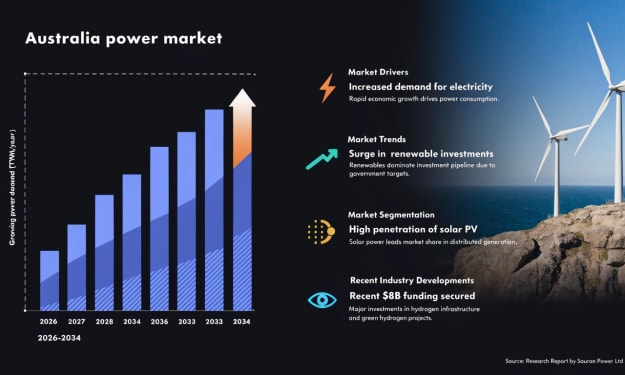
According to IMARC Group, the Australia power market reached 285.7 TWh in 2025 and is projected to reach 377.0 TWh by 2034, growing at a compound annual growth rate (CAGR) of 3.04% during 2026–2034. The market’s growth is being shaped by accelerating renewable energy adoption, increasing electricity demand and large-scale investments in grid modernization. Government incentives supporting clean energy transition, combined with rising corporate sustainability commitments, are encouraging the expansion of solar, wind and battery storage infrastructure. At the same time, the gradual phase-out of coal-fired power plants is transforming the structure of Australia’s electricity generation mix. With emerging technologies such as hydrogen energy systems and virtual power plants gaining traction, Australia’s power sector is evolving into a more diversified, digitally integrated and sustainable energy ecosystem.
By Kevin Cooper5 days ago in Futurism
Cyber Insurance Market: Rising Cyber Threats, Digital Risk Coverage & Industry Growth Outlook
According to IMARC Group's latest research publication, global artificial insemination market size reached USD 14.2 Billion in 2025. Looking forward, IMARC Group expects the market to reach USD 73.5 Billion by 2034, exhibiting a growth rate (CAGR) of 17.88% during 2026-2034.
By sujeet. imarcgroup2 days ago in Futurism



Comments
There are no comments for this story
Be the first to respond and start the conversation.