
React vs. Webix Comparison
Explore the strengths of React and Webix, compare their performance, scalability, development speed, and other aspects


We often guide our clients through the choice between React and Webix, two top-tier JavaScript UI libraries we usually use. This decision represents a fundamental question: should you build a custom interface from the ground up using foundational tools, or accelerate development with powerful, ready-made widgets? This article provides a comparison of React and Webix, explores their strengths, weaknesses, and demonstrates ideal use cases to show that the best solution might not be a choice of one over the other, but a combination of both.
Evaluating React.js: Where It Excels and Where It Falls Short
React remains one of the most widely used tools in modern web development, and its strengths truly shine when supported by the right React development services and applied in the proper context. Below is a balanced look at where React delivers exceptional value and where its limitations may introduce friction or added development overhead. Understanding both sides helps teams choose the most efficient path for their product.
Key Benefits of Using React for Web Development
High Performance and Scalability. React's virtual DOM technology creates an in-memory cache that computes changes made through user interactions and efficiently updates the browser's displayed DOM. This results in smoother user experiences, especially crucial for applications with frequent updates like dashboards or social platforms. This architectural advantage makes React exceptionally suitable for large-scale applications that need to handle complex state changes while maintaining performance.
Strong Ecosystem and Community. React has one of the largest developer communities, which translates to extensive resources, continuous updates, security patches, and countless third-party libraries. This vast ecosystem provides solutions for virtually any development challenge, from state management (Redux, Zustand) to routing (React Router) and server-side rendering (Next.js).
Flexibility and Integration Capabilities. React's agnostic approach to other technologies makes it exceptionally flexible for integration with existing stacks. It can seamlessly connect with various backend technologies (Node.js, Python, .NET), state management libraries, and API services. This flexibility allows development teams to select the optimal tools for each project aspect, rather than being constrained by framework decisions.
Developer Experience and Tooling. React provides an exceptional development experience through tools like React DevTools, which now includes enhanced performance tracing and error boundary integration. The updates of React 19 in 2025 brought further improvements to concurrent rendering, automatic hydration, and Server Components, streamlining development workflows and reducing boilerplate code. Features like hot reloading during development and strong TypeScript integration also enhance productivity.
Potential Drawbacks and Challenges of React
Additional Dependencies Required. As a focused UI library rather than a full framework, React often requires additional decision-making and integration efforts for features like routing, state management, and advanced form handling. While this modularity provides flexibility, it also places the burden of architectural decisions on development teams, potentially leading to inconsistency across projects or additional research and integration time.
No Built-In Widgets. React is just a UI library. It does not include ready-made tables, charts or complex controls. You must build or integrate all UI components. Our study shows that building a sample data dashboard took 34 hours with React versus just 17 hours with Webix, because React required creating many custom components. In practice, teams often pull in multiple 3rd-party React UI libraries, which means more setup and learning, leading to longer Time-to-Market (for data-heavy apps).
License Management. A typical React project pulls in many libraries, each with its own license and version. This dependency tree can become hard to manage or audit. Using many free React libraries can lead to complex dependency chains and potential licensing risks. In contrast, a single-library approach avoids this headache.
When Is React.js the Best Choice?
- Large-Scale Real-Time Applications. React excels at building complex applications that require frequent interface updates, such as social platforms, collaborative tools, and dynamic dashboards;
- Custom UI Requirements. When your project demands highly customized user interfaces with unique interactions and branding requirements that don't fit standardized component patterns;
- Cross-Platform Expansion. If you anticipate expanding to mobile platforms using.
Webix: Key Advantages and Limitations
While React dominates the broader web ecosystem, Webix offers a very different, and often more efficient, approach for building data-heavy business applications. Its ready-made widgets, consistent design system, and rapid development capabilities make it a strong choice when speed and complex UI requirements are top priorities. Below, we break down Webix’s biggest strengths, its limitations, and the scenarios where it delivers the most value.
Core Benefits of the Webix Component Library
Comprehensive Component Library. Webix is a JavaScript UI library that comes with 114+ controls and 15 advanced widgets (Grids, Charts, Kanban, Gantt, Spreadsheet, etc.). This means developers can implement complex features (like drag-drop grids or report managers) without coding from scratch, dramatically reducing development time for feature-rich business interfaces.
Rapid Development Cycle and Lower Cost. For projects with well-defined requirements that align with standard business application patterns, Webix enables remarkably fast prototyping and development. The availability of pre-built, customizable components means development teams can focus on application logic rather than rebuilding common interface elements. This acceleration is particularly valuable for internal enterprise tools, admin dashboards, and applications with tight deadlines.
Consistent Design and Behavior. Unlike pieced-together component libraries from various sources, Webix provides a coherent, consistent design system across all its components. This consistency ensures predictable behavior and appearance throughout the application, reducing usability concerns and interface inconsistencies that can arise when mixing components from different sources or building custom implementations.
Built-in Complex Functionality. Webix components include sophisticated features that would require significant development effort to implement from scratch. For example, its data grid supports advanced functionalities like drag-and-drop reordering, hierarchical data presentation, cell editing, and Excel-like filtering right out of the box. This depth of functionality makes it particularly valuable for data-intensive business applications.
Consistent API and Theming Tools. All Webix widgets share a uniform API and look. Webix provides development aids like a Skin Builder, UI Designer, and Form Builder to customize appearance and behavior without coding. For instance, Webix’s UI Designer makes it easy to style data tables for a client app while maintaining performance.
Potential Drawbacks to Consider
Smaller Community and Resources: Compared to React's massive ecosystem, Webix has a smaller community and fewer online resources, tutorials, and third-party extensions. This places more reliance on official documentation and support channels for problem-solving. While professionally maintained, the resource pool doesn't match the extensive community-driven knowledge base available for React.
Limited Design Customization. While Webix components are customizable to a certain degree, they operate within the constraints of their predefined structures. Teams requiring highly innovative or unconventional interface designs may find Webix components restrictive compared to fully custom-built React components. The library follows established patterns for business interfaces, which may not suit projects demanding breakthrough UI innovations.
When to Choose Webix
- Data-Intensive Business Applications. Webix excels at building complex data management interfaces such as admin dashboards, CRM systems, and financial applications that require advanced data grids, charts, and form controls;
- Rapid Prototyping and Development. When time-to-market is critical and project requirements align with standard business application patterns, Webix helps accelerate development cycles;
- Specialized Component Requirements. When projects require specific complex components like spreadsheets, file managers, charts, or sophisticated schedulers that would be prohibitively expensive to develop from scratch.
Why not Both? Integrating React and Webix
Instead of choosing one technology exclusively, developers can use Webix and React together. This hybrid UI development approach allows programmers to use React for application structure and state management, while dropping in Webix widgets where complex UI is needed. The Webix team provides a Webix-React demo on GitHub that demonstrates the technique of integrating Webix with React. For instance, technical integration approaches include:
- Prebuilt Webix-React Components. The simplest integration method uses prebuilt wrapper components that abstract the underlying implementation details. This approach allows React developers to incorporate Webix widgets using familiar JSX syntax;
- Custom Webix-React Components. For more complex scenarios requiring greater control, developers can create custom wrapper components that manage the Webix widget lifecycle within React's component structure;
- State Management Integration. Webix components can successfully integrate with React state management systems, including Redux. It allows Webix components to respond to state changes while maintaining their internal functionality and performance characteristics.
Technology Selection Decision Matrix

Conclusions
The React vs. Webix decision represents a choice between flexible foundation and specialized acceleration. Rather than viewing these technologies as mutually exclusive, forward-thinking development teams can consider them complementary tools. By strategically combining React's structural capabilities with Webix's specialized components, programmers can deliver robust applications more efficiently, balancing customization needs with development pragmatism.
About the Creator
Keep reading
More stories from Sergey Laptick and writers in Futurism and other communities.
AI MVP vs. Traditional MVP: Key Differences, Benefits & Use Cases
Building a minimum viable product (MVP) is a core strategy for any startup or new product line. Decision-makers can choose between two flavors of MVP: a traditional MVP focused on core functionality, or an AI MVP that embeds artificial intelligence. AI helps add some “wow” features that correspond to modern users’ expectations. At the same time, it introduces complexity, costs, and data requirements. Traditional MVPs, on the other hand, still shine for quick validation of core ideas with small teams and budgets. This article compares the two approaches in detail to help product leaders decide which fits their project.
By Sergey Laptick2 months ago in Futurism
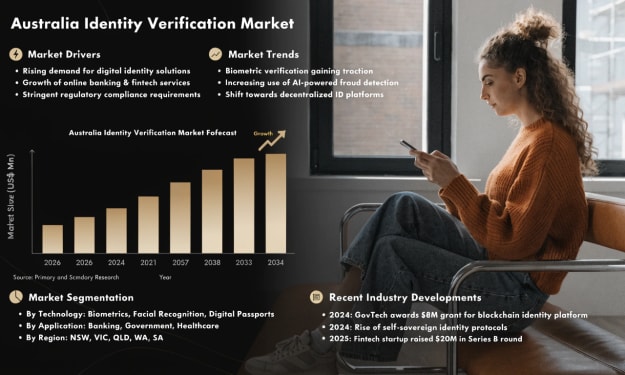
Australia Identity Verification Market: Digital Adoption, Fraud Prevention & Regulatory Compliance
According to IMARC Group, the Australia identity verification market reached USD 315.9 Million in 2025 and is projected to grow to USD 1,005.3 Million by 2034, exhibiting a compound annual growth rate (CAGR) of 13.32% during 2026–2034. The rapid digitization of financial services, e-commerce platforms, and public sector portals across Australia is creating an urgent need for secure, scalable, and compliant identity authentication systems. Increasing concerns regarding cybercrime, identity theft, and data breaches are accelerating investments in biometric technologies, AI-driven verification tools, and automated compliance platforms. As digital transformation deepens across industries, identity verification is becoming a foundational pillar of secure digital infrastructure.
By Kevin Coopera day ago in Futurism
Levulinic Acid Market Analysis: Specialty Chemicals, Pharma Applications & Industry Outlook to 2033
The increasing shift toward renewable chemicals, the surge in sustainable agricultural practices, and the growing application of bio-based solvents are fueling the demand for levulinic acid. Supported by green chemistry initiatives, rising investments in carbon-neutral manufacturing, and the expansion of the personal care and pharmaceutical sectors, the market is witnessing significant transformation. According to IMARC Group’s latest data, the global levulinic acid market size was valued at USD 29.7 Billion in 2024. Looking forward, IMARC Group estimates the market to reach USD 42.6 Billion by 2033, exhibiting a CAGR of 3.9% during 2025-2033.
By Andrew Sullivan4 days ago in Futurism



Comments
There are no comments for this story
Be the first to respond and start the conversation.