
Quantum Computing developments and their impact on technology
Transforming the World Through NLP, Computer Vision, Machine Learning, and Deep Learning.

Quantum computing is a rapidly evolving technology that has the potential to transform the world as we know it. Unlike classical computers, which use bits to represent data as either a 0 or 1, quantum computers use qubits, which can exist in multiple states simultaneously. This ability to process large amounts of data simultaneously makes quantum computing much faster than classical computing. This article will explore the latest quantum computing developments and their impact on the world.
One of the most significant quantum computing developments is the creation of a quantum computer that can perform calculations beyond the capabilities of even the most powerful classical computers. In 2019, Google announced that it had achieved "quantum supremacy," meaning that its quantum computer had solved a problem that would take even the fastest classical computer thousands of years to solve. This breakthrough has the potential to revolutionize the fields of cryptography, chemistry, and drug development, among others.
Another significant quantum computing development is the emergence of quantum communication networks. Quantum communication networks use the principles of quantum mechanics to create a secure communication system. Unlike classical communication systems, which can be intercepted and compromised, quantum communication systems are impossible to hack without being detected. This makes quantum communication networks ideal for use in military, government, and financial institutions, among others.
Quantum computing is also having a significant impact on the field of artificial intelligence (AI). AI algorithms require large amounts of data to learn and improve. Quantum computing's ability to process large amounts of data simultaneously makes it well-suited for AI applications. Researchers are using quantum computing to develop new machine learning algorithms and to improve existing ones.
Another potential application of quantum computing is in the field of materials science. Quantum computing has the potential to revolutionize the way we design and develop new materials. By simulating the behavior of atoms and molecules, researchers can use quantum computing to predict the properties of new materials before they are synthesized. This could lead to the development of new materials with unique properties, such as superconductors, which could revolutionize energy storage and transmission.
Quantum computing is also having an impact on the field of cybersecurity. Quantum computers are capable of breaking many of the encryption algorithms used to protect sensitive data. This has led to the development of new encryption algorithms that are resistant to quantum attacks. Researchers are also using quantum computing to develop new methods of detecting and defending against cyberattacks.
One of the challenges facing the development of quantum computing is the difficulty of building and maintaining stable qubits. Qubits are extremely sensitive to environmental factors such as temperature and electromagnetic radiation. Any disturbance can cause qubits to lose their quantum state, leading to errors in calculations. Researchers are working to develop new materials and technologies that can stabilize qubits and make quantum computers more reliable.
In conclusion, quantum computing developments are rapidly transforming the world of technology. The ability of quantum computers to process large amounts of data simultaneously has the potential to revolutionize many fields, including cryptography, materials science, artificial intelligence, and cybersecurity. However, the development of quantum computing is not without its challenges. Researchers must overcome the technical challenges of building and maintaining stable qubits to realize the full potential of quantum computing. Nonetheless, the potential benefits of quantum computing are vast, and it is an exciting time for the field of quantum computing.
About the Creator
Keep reading
More stories from Joel Marks and writers in Futurism and other communities.
Artificial Intelligence (AI) advancements in computer technology
Artificial Intelligence (AI) has rapidly transformed the computer industry, making the impossible possible. AI refers to the development of computer systems that can perform tasks that typically require human intelligence. Over the past few years, AI advancements in computer technology have made significant strides, and it has become a buzzword in the technology industry. This article will explore the latest AI advancements in computer technology and their impact on the world.
By Joel Marks3 years ago in Futurism
About Binding Prometheus
I want to start actively advocating on behalf of my own work, and the most valuable part of my canon is, without a doubt, Binding Prometheus, the play I have been working on since 2019 and only finished in 2023 as part of my MA. The play itself is an amalgamation of a million different inspirations. On one end, it evokes the Ancient Greek myth-play, deriving its own title from the earliest extant work of Western drama we have, Aeschylus’s Prometheus Bound. On the other end, it borrows significantly from the sci-fi bulwarks from over the years, namely Mary Shelley’s Frankenstein and Karel Capek’s Rossum’s Universal Robots. The play could be an episode of Black Mirror, I fear. I don’t know. I’ve only ever seen one episode of Black Mirror.
By Steven Christopher McKnight21 days ago in Futurism
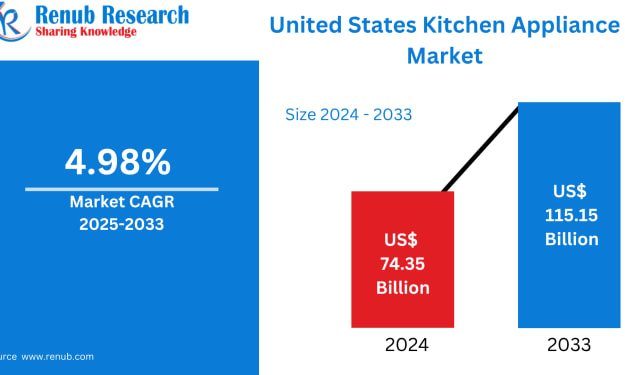
United States Kitchen Appliance Market Size and Forecast 2025–2033
The United States kitchen appliance market is entering a defining decade shaped by innovation, sustainability, and evolving consumer lifestyles. According to Renub Research, the market is projected to reach US$ 115.15 billion by 2033, rising from US$ 74.35 billion in 2024, at a compound annual growth rate (CAGR) of 4.98% during 2025–2033.
By Marthan Sir6 days ago in Futurism



Comments
There are no comments for this story
Be the first to respond and start the conversation.