
Personalization in Healthcare Beyond EHRs and Dashboards
Creating Care Experiences That Adapt to Every Individual

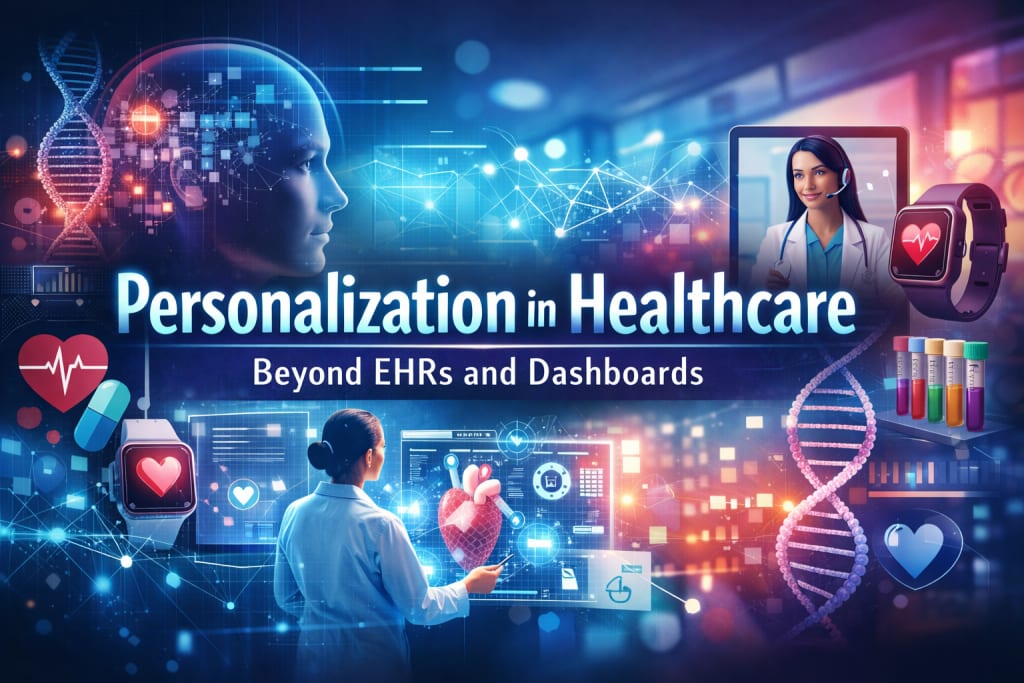
Healthcare has long relied on electronic health records (EHRs), analytics dashboards, and standardized workflows to manage patient data and clinical operations. While these tools have undoubtedly improved efficiency and record-keeping, they represent only the surface of what modern care can achieve. The real transformation lies in moving beyond static systems toward deeply adaptive, patient-centric experiences that respond to individual needs in real time. This is where personalization in healthcare becomes far more than a technology upgrade, it becomes a care philosophy.
Personalization today extends into how patients interact with providers, how care plans are designed, how data is interpreted, and how outcomes are improved across populations. Instead of treating personalization as a feature within software, leading organizations are embedding it across the entire care continuum.
Understanding Personalization Beyond Traditional Systems
Traditional EHRs and dashboards focus on storing and displaying data. They tell clinicians what has happened, but often fail to guide what should happen next for a specific patient. True personalization moves beyond retrospective data toward predictive and prescriptive insights.
This approach considers not just clinical history, but also behavioural patterns, social determinants of health, lifestyle data, and patient preferences. When these factors are combined intelligently, healthcare systems can tailor interventions that are more relevant, timely, and effective.
At its core, personalization in healthcare aims to shift care from being reactive and generalized to proactive and individualized, without increasing the burden on clinicians.
The Role of AI and Advanced Analytics
Artificial intelligence has become a critical enabler of next-generation care models. Machine learning algorithms can analyze massive datasets to identify patterns that humans might miss, such as early indicators of disease progression or likelihood of treatment adherence.
Instead of static alerts, AI-driven systems provide context-aware recommendations. For example, two patients with the same diagnosis may receive different care pathways based on risk scores, lifestyle factors, or previous responses to treatment. This level of intelligence allows personalization to happen continuously, not just during clinical visits.
By integrating AI with clinical decision support tools, healthcare organizations can move beyond dashboards toward systems that actively assist care teams in delivering individualized treatment strategies.
Personalized Patient Engagement and Communication
Patient engagement is one of the most visible areas where personalization delivers value. Generic reminders and one-size-fits-all educational content often fail to resonate with patients. Personalized communication, on the other hand, adapts to patient behavior, language preferences, and engagement history.
Smart engagement platforms can adjust messaging frequency, tone, and content based on how patients respond. For instance, a patient managing a chronic condition may receive targeted educational resources, medication reminders aligned with daily routines, and motivational prompts tailored to personal goals.
This form of healthcare personalization strengthens trust, improves adherence, and helps patients feel seen as individuals rather than record numbers.
Remote Monitoring and Wearable-Driven Care
Wearable devices and remote monitoring tools have expanded the scope of personalization far beyond clinical settings. Continuous streams of real-world data—such as activity levels, heart rate variability, sleep patterns, and glucose levels—offer a more complete picture of patient health.
When this data is analyzed in context, care teams can tailor interventions dynamically. Alerts can be customized to individual thresholds rather than generic norms, reducing alarm fatigue while improving accuracy. Care plans can evolve based on daily patterns rather than episodic visits.
By combining remote monitoring with predictive analytics, personalization in healthcare becomes an ongoing process rather than an isolated event.
Precision Medicine and Personalized Treatment Plans
One of the most impactful applications of personalization is precision medicine. By leveraging genomics, biomarkers, and advanced diagnostics, clinicians can design treatments that align with a patient’s biological makeup.
This approach is especially powerful in oncology, cardiology, and rare disease management, where standardized treatments may not deliver optimal outcomes. Personalized treatment plans reduce trial-and-error prescribing, minimize adverse effects, and improve overall effectiveness.
Precision medicine also supports population health strategies by identifying subgroups that benefit most from specific interventions, bridging the gap between individualized care and large-scale health management.
Personalization for Healthcare Operations and Workflows
Personalization is not limited to patient-facing experiences—it also plays a vital role in clinical workflows. Adaptive systems can learn how individual clinicians work, prioritizing information based on specialty, preferences, and past interactions.
Instead of overwhelming providers with irrelevant data, personalized interfaces surface the most critical insights at the right time. This reduces cognitive load, improves decision-making, and supports clinician well-being.
From scheduling optimization to care coordination, personalization for healthcare operations enhances efficiency while maintaining a human-centered approach.
Addressing Social Determinants of Health
Social determinants such as income, education, environment, and access to resources have a profound impact on health outcomes. Personalized care models that incorporate these factors can address root causes rather than symptoms alone.
For example, a patient with diabetes may require not only medication adjustments but also nutrition guidance aligned with cultural preferences and local food availability. Personalized interventions can connect patients with community resources, transportation services, or digital tools tailored to their circumstances.
By integrating social and behavioral data, personalization in healthcare becomes more equitable and impactful across diverse populations.
Data Interoperability and Intelligent Integration
Personalization depends on seamless data flow across systems. Interoperability standards like HL7 and FHIR enable diverse platforms—EHRs, wearable devices, lab systems, and patient apps—to communicate effectively.
When data is integrated intelligently, healthcare organizations gain a unified view of each patient. This enables real-time insights, reduces duplication, and supports coordinated care across multiple providers.
Interoperable ecosystems are essential for scaling personalized care without fragmenting the patient experience.
Privacy, Ethics, and Trust in Personalized Care
As personalization increases, so does the responsibility to protect patient data and maintain ethical standards. Transparent data usage policies, robust cybersecurity measures, and consent-driven data sharing are critical.
Patients must understand how their data is used to improve care and retain control over their information. Ethical AI practices, including bias mitigation and explainable algorithms, help maintain trust while delivering personalized insights.
Responsible governance ensures that personalization enhances care without compromising privacy or fairness.
The Future of Personalization in Healthcare
The future points toward hyper-personalized, predictive, and preventive care models. Digital twins, AI-powered care navigation, and adaptive treatment pathways will continue to redefine how care is delivered.
As technology matures, personalization will no longer be an add-on—it will be the default expectation. Organizations that invest in intelligent platforms, data integration, and patient-centered design will be better positioned to deliver meaningful outcomes.
Ultimately, personalization in healthcare is about aligning technology with humanity—using data and intelligence to support empathy, precision, and better health for every individual.
Conclusion
Moving beyond EHRs and dashboards marks a pivotal shift in how healthcare systems operate. By embracing advanced analytics, AI, remote monitoring, and patient-centric design, providers can deliver care that adapts to individual needs at every stage.
This evolution is not just technological but cultural, requiring collaboration, trust, and a commitment to continuous improvement. As personalization becomes more deeply embedded across clinical, operational, and engagement layers, healthcare will move closer to its ultimate goal: delivering the right care, to the right person, at the right time.
About the Creator
Keep reading
More stories from Steve Waugh and writers in Futurism and other communities.
Top 10 Telemedicine App Development Companies in the US
Telemedicine has moved from being a convenience to a necessity in the U.S. healthcare ecosystem. From virtual consultations and remote patient monitoring to AI-driven diagnostics and EHR-integrated platforms, healthcare providers are increasingly relying on advanced digital solutions to deliver care beyond hospital walls.
By Steve Waugh2 months ago in Futurism
🟢💧 The Liquid Green Drop That Froze: The Epic Rise and Fall of Sony Ericsson 📉
If you grew up in the first decade of the 21st century, you likely remember the iconic liquid-green logo—a glowing orb of energy—and 그 short, ascending ringtone that echoed through school hallways and office corridors. 📱 Sony Ericsson wasn't just a phone manufacturer; it was a status symbol, a lifestyle accessory, and proof that technology could have a soul. But how did the duo that defined modern mobile entertainment vanish almost overnight? 🕵️♂️
By Piotr Nowak7 days ago in Futurism
Building the Modern Web: Current Trends and Technologies Reshaping Web Development
Web development has never stood still. From the static HTML pages of the early 1990s to the dynamic, data-driven, globally distributed applications of today, the discipline has undergone a series of paradigm shifts that have repeatedly redefined what it means to build for the web. But the pace of change in recent years has been particularly striking — driven by advances in artificial intelligence, the maturation of JavaScript frameworks, the emergence of edge computing, and a growing emphasis on performance, accessibility, and developer experience that is reshaping how engineers approach their craft.
By noor ul amin6 days ago in Futurism




Comments
There are no comments for this story
Be the first to respond and start the conversation.