
Pallet Market Dynamics: The Shift Towards Eco-Friendly Materials
The pallet market is a vital component of global logistics and supply chains, serving as a primary tool for the storage, handling, and transportation of goods.


Overview of the Pallet Market
The pallet market is an essential part of global supply chains, providing the platforms used to store, transport, and handle goods. Pallets are used across various industries, including retail, food & beverage, pharmaceuticals, automotive, and e-commerce. As goods move from manufacturers to consumers, pallets serve as the foundation that ensures products reach their destination safely and efficiently.
Traditionally, pallets were made from wood, but in recent years, alternatives like plastic, metal, and paperboard pallets have become increasingly popular due to their durability, hygiene benefits, and sustainability features. The market is witnessing steady growth driven by global trade, e-commerce expansion, and increasing demand for logistical efficiency.
In 2025, the global pallet market is projected to reach USD 100 billion, growing at a steady rate as industries innovate with more sustainable and tech-enhanced solutions. Increasing focus on the circular economy, reusability, and smart technology is also shaping the future of the pallet market, with businesses looking for ways to reduce waste and improve supply chain transparency.
Request a Sample Report with Latest Data & Forecasts:
The Company: Pallet
Several key players dominate the pallet industry, from manufacturing giants to niche companies specializing in specific pallet types. Some of the major companies in the pallet market include:
CHEP (a Brambles company): Known for its large-scale rental services of wooden pallets, CHEP operates globally and provides solutions that emphasize sustainability, recycling, and efficient logistics management.
Pallite: Specializes in innovative, eco-friendly paperboard pallets designed to be lightweight and durable, ideal for industries that prioritize sustainability.
iGPS Logistics: Offers a rental service for plastic pallets, providing durable, reusable, and hygienic alternatives to traditional wood pallets.
UFP Technologies: Focuses on custom-designed pallets, particularly for the automotive and pharmaceutical industries, where specific requirements and regulations must be met.
These companies provide various solutions ranging from pallet rental services to custom-built pallets, catering to both small-scale operations and large, multinational corporations. With an increasing emphasis on supply chain visibility, several companies are also integrating IoT (Internet of Things) into their products for better monitoring and tracking.
The Physical Pallet Market
The physical pallet market is categorized based on materials, with wooden pallets still holding the largest share due to their low cost, availability, and strength. However, alternative materials are gaining ground as businesses seek more efficient, sustainable, and hygienic solutions.
Wooden Pallets
Wooden pallets are widely used due to their affordability, easy production, and recyclability. They are the most common pallet type used globally in various industries, particularly in logistics and warehousing. However, they face challenges such as vulnerability to damage, insect infestations, and the environmental cost associated with cutting down trees.
Plastic Pallets
Plastic pallets are growing in popularity because of their durability, resistance to contamination, and recyclability. They are ideal for industries where cleanliness and durability are crucial, such as pharmaceuticals and food production. Additionally, plastic pallets have a longer lifespan, making them more cost-effective in the long run.
Metal Pallets
Metal pallets are used in industries that require heavy-duty pallets, such as automotive and aerospace. They offer the highest durability and load-bearing capacity but are typically more expensive than wooden or plastic pallets.
Paperboard Pallets
Lightweight and sustainable, paperboard pallets are increasingly used in less demanding environments and are highly favored for their recyclability and reduced environmental impact. They are often used for lighter goods and in e-commerce packaging.
Market Growth and Key Drivers
The pallet market is expected to continue growing in the coming years, driven by several key factors:
1. E-commerce Expansion
The rise of online shopping has led to an increased need for efficient packaging and delivery solutions. E-commerce companies are seeking pallets that reduce shipping costs, optimize warehouse space, and minimize handling time.
2. Globalization and Increased Trade
As global supply chains become more interconnected, the demand for pallets to support the transportation of goods across long distances continues to rise. The Asia-Pacific region, particularly China, is a major hub for pallet production due to its manufacturing dominance and booming trade sector.
3. Sustainability Trends
Businesses and consumers alike are demanding more sustainable packaging solutions. Pallets made from recyclable materials like plastic and paperboard align with growing environmental goals, prompting more companies to shift toward eco-friendly alternatives.
4. Technological Advancements
The integration of IoT (Internet of Things) and smart technology in pallets is becoming a game-changer. RFID (radio frequency identification) tracking systems and sensors allow businesses to monitor the condition, location, and movement of pallets in real-time, providing better control and enhancing supply chain efficiency
Recent News in the Pallet Market
1. CHEP Invests in Sustainability Initiatives
CHEP recently launched a new initiative to increase the use of recycled materials in pallet production. The company has committed to improving its sustainability practices by investing in a more efficient and eco-friendly pallet rental system, focusing on circular economy principles.
2. iGPS Launches Smart Pallets
iGPS Logistics unveiled its new line of smart plastic pallets, which come equipped with RFID technology for real-time tracking. This innovation is set to revolutionize inventory management and offer greater transparency in the supply chain.
3. Increased Demand for Eco-Friendly Pallets
With sustainability becoming a top priority for businesses across industries, plastic pallets and paperboard alternatives are seeing increased demand. Companies are moving away from single-use wood pallets in favor of products that can be reused, recycled, and help reduce waste.
Recent News & Developments Pallet Market
FAQs: Pallet Market
Q1. What are the types of pallets used in the market?
The main types of pallets are wooden, plastic, metal, and paperboard, each suited to specific applications based on durability, weight capacity, and cost.
Q2. Why are plastic pallets becoming more popular?
Plastic pallets offer advantages like increased durability, resistance to contamination, and recyclability, making them ideal for industries such as pharmaceuticals, food, and logistics.
Q3. What is driving the growth of the pallet market?
The pallet market is driven by the growth of e-commerce, globalization of trade, increased demand for sustainable packaging, and technological advancements in tracking and logistics.
Q4. How is technology being integrated into the pallet market?
Technologies like RFID and IoT are being used to make pallets smarter, enabling real-time tracking and improved supply chain visibility.
Q5. What is the environmental impact of using wooden pallets?
While wooden pallets are recyclable, they are less sustainable compared to plastic or paperboard alternatives, as they contribute to deforestation and are prone to damage, leading to higher replacement rates.
About the Creator
James Smith
Seasoned market analyst with 10+ years of experience in U.S. economic trends and stock market insights.
Keep reading
More stories from James Smith and writers in Futurism and other communities.
The Food Service Market: How It’s Adapting to Consumer Demands
Overview of the Food Service Market The food service market is a thriving sector that encompasses businesses providing food and beverage services outside of the home. It includes a wide variety of establishments, such as restaurants, cafes, food trucks, catering services, and institutional food providers (e.g., schools, hospitals). The market has expanded dramatically over the years, driven by evolving consumer preferences, technological advancements, and shifts in eating habits.
By James Smith2 months ago in Futurism
Microfluidics Market Analysis: Biomedical Applications, Automation Integration & Industry Forecast to 2033
The integration of microfluidics into clinical diagnostics, drug development, and point-of-care testing is revolutionizing the healthcare landscape. Driven by the demand for miniaturization, rapid results, and reduced reagent consumption, the technology is becoming a cornerstone of modern biotechnology. According to IMARC Group’s latest data, The global microfluidics market size reached USD 33.1 Billion in 2024. Looking forward, IMARC Group expects the market to reach USD 101.8 Billion by 2033, exhibiting a growth rate (CAGR) of 12.64% during 2025-2033.
By Andrew Sullivan7 days ago in Futurism
Australia Ready-to-Drink Coffee Market: Consumer Demand, Retail Expansion & Product Innovation
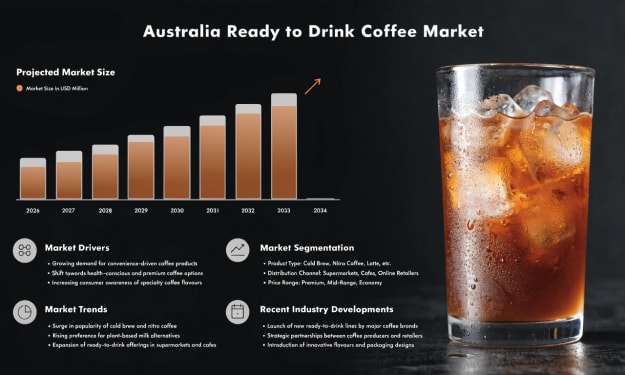
According to IMARC Group, the Australia ready-to-drink (RTD) coffee market reached USD 1,097.9 Million in 2025 and is projected to grow to USD 1,841.6 Million by 2034, exhibiting a compound annual growth rate (CAGR) of 5.74% during 2026–2034. The market’s expansion reflects shifting beverage consumption patterns across Australia, where convenience, portability, and premium taste experiences are becoming central to purchasing decisions. Rising demand for functional beverages, plant-based alternatives, and high-quality cold brew offerings is reshaping product portfolios. As supermarkets, convenience stores, and online platforms expand their beverage selections, Australia ready-to-drink coffee market share continues to strengthen across urban and regional areas.
By Shrestha Roy5 days ago in Futurism
Pearl
1980 something. we all hung out at Pearl and you and i were nothing special, or so i thought. i mean we all danced, drenched in our own sweat, our own saline solution of fear, too many beers, shots, laughter, tears, fucks in the bathroom and i don't know when we began to be afraid. do you?
By ROCK aka Andrea Polla (Simmons)6 days ago in Fiction



Comments
There are no comments for this story
Be the first to respond and start the conversation.