
Online Grocery Market: Urban Demand Growth, Tech Integration & Market Evolution
How urbanization, dual-income households, and time-saving preferences are accelerating adoption across the online grocery market

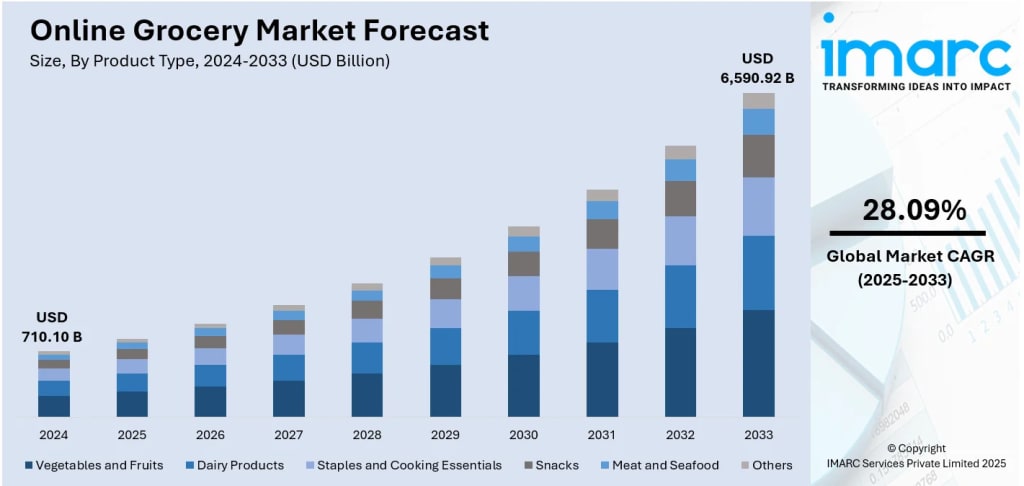
According to IMARC Group's latest research publication, global online grocery market size reached USD 710.10 Billion in 2024. Looking forward, IMARC Group expects the market to reach USD 6,590.92 Billion by 2033, exhibiting a growth rate (CAGR) of 28.09% during 2025-2033.
How AI is Reshaping the Future of Online Grocery Market
- AI analyzes customer browsing history and purchase patterns to deliver tailored product suggestions. Machine learning predicts future buying behavior, enabling platforms to offer personalized deals and optimize inventory. Smart algorithms increase repeat purchases by 20% through customized shopping experiences.
- AI-powered systems monitor stock levels and predict demand fluctuations across different locations. Retailers reduce waste by 25% while maintaining optimal product availability. Advanced forecasting prevents stockouts during peak shopping periods, ensuring customer satisfaction and minimizing losses from expired inventory.
- Platforms now feature AI tools that convert uploaded grocery lists into complete shopping carts. Voice-activated assistants enable hands-free ordering, simplifying the shopping process. These innovations reduce time spent on grocery shopping by 40%, enhancing convenience for busy households.
- Machine learning adjusts prices in real-time based on demand patterns and competitive market conditions. Retailers optimize promotions to target specific customer segments, maximizing conversion rates. AI-driven pricing strategies balance profitability with affordability, helping platforms maintain competitive advantages while meeting consumer expectations.
- AI algorithms optimize delivery routes, reducing delivery times by 30% and cutting operational costs significantly. Predictive models estimate delivery windows accurately, improving customer experience. Autonomous vehicles and drone technologies are being tested for final-mile delivery, promising faster fulfillment.
Online Grocery Industry Overview:
The online grocery sector is experiencing explosive growth driven by widespread smartphone adoption and evolving consumer preferences for digital shopping. Major platforms like Amazon, Walmart, and Instacart are investing heavily in infrastructure, with Amazon operating 185 fulfillment centers across the United States. Quick-commerce players such as Blinkit and Zepto are fulfilling over 1.75 million and 1.5 million daily orders respectively, demonstrating the shift from occasional convenience to essential daily shopping. Subscription-based models are gaining momentum, capturing 58% market share as consumers embrace automated replenishment for staples. The integration of loyalty programs, same-day delivery options, and price-parity initiatives are making online grocery shopping more accessible and affordable, transforming it from a pandemic-driven necessity into the preferred shopping method for millions of households worldwide.
Online Grocery Market Trends & Drivers
The rapid expansion of same-day and ultra-fast delivery services is revolutionizing customer expectations and market dynamics. Amazon's aggressive rollout of same-day grocery delivery to over 2,300 cities represents a strategic push to dominate the perishables segment, traditionally dominated by traditional retailers. This service eliminates delivery fees for Prime members on orders above USD 25, creating significant pressure on competitors like Instacart and Walmart. Quick-commerce platforms in India and Asia Pacific are setting new standards with 10-30 minute delivery windows, fundamentally changing how consumers plan grocery shopping. The infrastructure investments required are substantial, with companies establishing dark stores and micro-fulfillment centers in urban neighborhoods. November 2025 online grocery sales reached USD 12.3 Billion, marking five consecutive months above USD 10 Billion, demonstrating sustained consumer adoption of rapid delivery models that prioritize speed and convenience.
Affordability concerns and price transparency initiatives are reshaping competitive strategies across the industry. Online markup concerns have prompted major platforms to adopt price-parity programs, matching online prices with in-store costs to eliminate the affordability barrier. Retailers implementing price-parity are experiencing growth rates 10 percentage points higher than competitors maintaining traditional markups. Instacart's Consumer Insights Portal and integration of digital flyers help shoppers compare prices and find deals, addressing the primary reason customers abandon online grocery platforms. Private label penetration is accelerating, with platform-owned brands offering 15-20% savings versus national brands, capturing 33% of staples and cooking essentials sales. The focus on affordability extends beyond pricing to include loyalty program integration, cashback offers, and subscription models that reduce per-order costs for frequent shoppers seeking value.
Mobile-first shopping experiences and AI-powered personalization are driving sustained engagement and order frequency growth. Over 40% of consumers prefer mobile apps for grocery shopping, prompting platforms to invest heavily in user-friendly interfaces and seamless checkout experiences. Order frequency has increased for 15 consecutive months, with monthly active users placing an average of 2.8 orders, up 12% year-over-year. Shoppers aged 30-44 lead adoption with 3.1 orders monthly, representing 20% growth as busy professionals and families embrace the convenience. AI-driven recommendation engines analyze browsing patterns and purchase history to suggest relevant products, increasing basket sizes and repeat purchases. The integration of ChatGPT capabilities by major players like Instacart and DoorDash enables conversational shopping experiences. Platform consolidation allows customers to combine fresh groceries with general merchandise in single carts, increasing average order values by 11% as online grocery evolves from standalone necessity to integrated lifestyle convenience.
Leading Companies Operating in the Global Online Grocery Industry:
- Amazon.com, Inc.
- Carrefour
- Costco Wholesale Corporation
- Edeka Group
- HappyFresh
- Koninklijke Ahold Delhaize N.V.
- Reliance Retail Limited (Reliance Industries Limited)
- Safeway Inc. (Albertsons Companies, Inc.)
- Schwan’s Home Delivery
- ShopFoodEx
- Tesco PLC
- The Kroger Co.
- Walmart Inc.
- Wm Morrison Supermarkets Limited
Online Grocery Market Report Segmentation:
By Product Type:
- Vegetables and Fruits
- Dairy Products
- Staples and Cooking Essentials
- Snacks
- Meat and Seafood
- Others
Staples and Cooking Essentials lead the market with around 28.9% share in 2024, driven by universal demand and convenience for everyday cooking.
By Business Model:
- Pure Marketplace
- Hybrid Marketplace
- Others
Pure Marketplace dominates the market by connecting sellers and buyers without inventory ownership, allowing for a vast assortment of products and scalability.
By Platform:
- Web-Based
- App-Based
Web-Based platforms are key to the online grocery market, offering comprehensive product views and easy navigation for users who prefer larger displays for research.
By Purchase Type:
- One-Time
- Subscription
Subscription leads the market with around 58.0% share in 2024, providing convenience and automation for regularly used products through personalized experiences.
Regional Insights:
- North America (United States, Canada)
- Asia Pacific (China, Japan, India, South Korea, Australia, Indonesia, Others)
- Europe (Germany, France, United Kingdom, Italy, Spain, Russia, Others)
- Latin America (Brazil, Mexico, Others)
- Middle East and Africa
Asia Pacific accounts for the largest market share of over 58.3% in 2024, fueled by digital adoption, innovative e-commerce platforms, and the integration of online and traditional retail.
Recent News and Developments in Online Grocery Market
- October 2025: Amazon introduced its latest private-label brand, Amazon Grocery, featuring over 1,000 food products with numerous items priced below USD 5 to attract cost-sensitive shoppers. The selection includes fresh fruits and vegetables, dairy products, meats, and essential pantry items available online and in Amazon Fresh locations, demonstrating Amazon's commitment to competing on price while expanding its proprietary product portfolio.
- October 2025: The Indonesian eCommerce leader Blibli introduced BlibliFresh, an online grocery service emphasizing freshness, quick delivery, and dependability. The platform addresses common consumer concerns like late deliveries and low product quality by offering one-hour delivery windows and easy returns, positioning itself as a quality-focused alternative in Indonesia's rapidly growing online grocery market.
- September 2025: Amazon UK revealed intentions to enhance its online grocery delivery by strengthening collaborations with Morrisons, Co-op, Iceland, and Gopuff. The company will increase Prime members' access to grocery delivery by more than twofold and launch Same-Day Delivery for fresh products starting in early 2026, significantly expanding convenience options for UK customers.
- September 2025: Naver and Kurly introduced Kurly N Mart, a high-end online grocery service in the Naver Plus Store. It offers unique and carefully selected fresh food products, including Kurly's own brand items, with next-morning delivery through Kurly's advanced cold-chain system. This initiative aims to challenge Coupang's dominance in Korea's competitive online grocery sector by emphasizing premium quality and reliable delivery.
- August 2025: Amazon introduced same-day fresh grocery delivery in 1,000 cities across the United States, including Phoenix, Orlando, and Kansas City. The company announced plans to extend this service to 2,300 cities by year-end. Complimentary shipping for Prime members on orders above USD 25 seeks to increase market share and directly compete with Walmart's grocery delivery offerings.
Note: If you require specific details, data, or insights that are not currently included in the scope of this report, we are happy to accommodate your request. As part of our customization service, we will gather and provide the additional information you need, tailored to your specific requirements. Please let us know your exact needs, and we will ensure the report is updated accordingly to meet your expectations.
About the Creator
Andrew Sullivan
Hello, I’m Andrew Sullivan. I have over 9+ years of experience as a market research specialist.
Keep reading
More stories from Andrew Sullivan and writers in Futurism and other communities.
Digital Identity Solutions Market: Secure Authentication Trends & Platform Innovation
According to IMARC Group's latest research publication, the global digital identity solutions market reached USD 43.76 Billion in 2024. Looking forward, IMARC Group expects the market to reach USD 214.2 Billion by 2033, exhibiting a growth rate (CAGR) of 17.70% during 2025-2033.
By Andrew Sullivana day ago in Futurism
About Binding Prometheus
I want to start actively advocating on behalf of my own work, and the most valuable part of my canon is, without a doubt, Binding Prometheus, the play I have been working on since 2019 and only finished in 2023 as part of my MA. The play itself is an amalgamation of a million different inspirations. On one end, it evokes the Ancient Greek myth-play, deriving its own title from the earliest extant work of Western drama we have, Aeschylus’s Prometheus Bound. On the other end, it borrows significantly from the sci-fi bulwarks from over the years, namely Mary Shelley’s Frankenstein and Karel Capek’s Rossum’s Universal Robots. The play could be an episode of Black Mirror, I fear. I don’t know. I’ve only ever seen one episode of Black Mirror.
By Steven Christopher McKnight19 days ago in Futurism
The Future Is Not Waiting for Us. It Is Rewriting Us.
Futurism used to be about flying cars, silver suits, and cities in the clouds. It was clean, distant, and comfortably unreal. Today, futurism feels different. It is intimate. It lives in our pockets, watches our habits, predicts our choices, and quietly reshapes how we think, work, love, and decide.
By noor ul amin5 days ago in Futurism
A Dart at Dusk
Seconds ago, the sullen sun set on the two of us… my exuberant furry companion and me. A fresh breeze embraces us, delivering welcome relief from the day’s oppressive heat. His typical stumbling and staggering along — apace with a sloth — has turned into trip-trapping, high-stepping, almost skipping along.
By Angie the Archivist 📚🪶6 days ago in Petlife


Comments
There are no comments for this story
Be the first to respond and start the conversation.